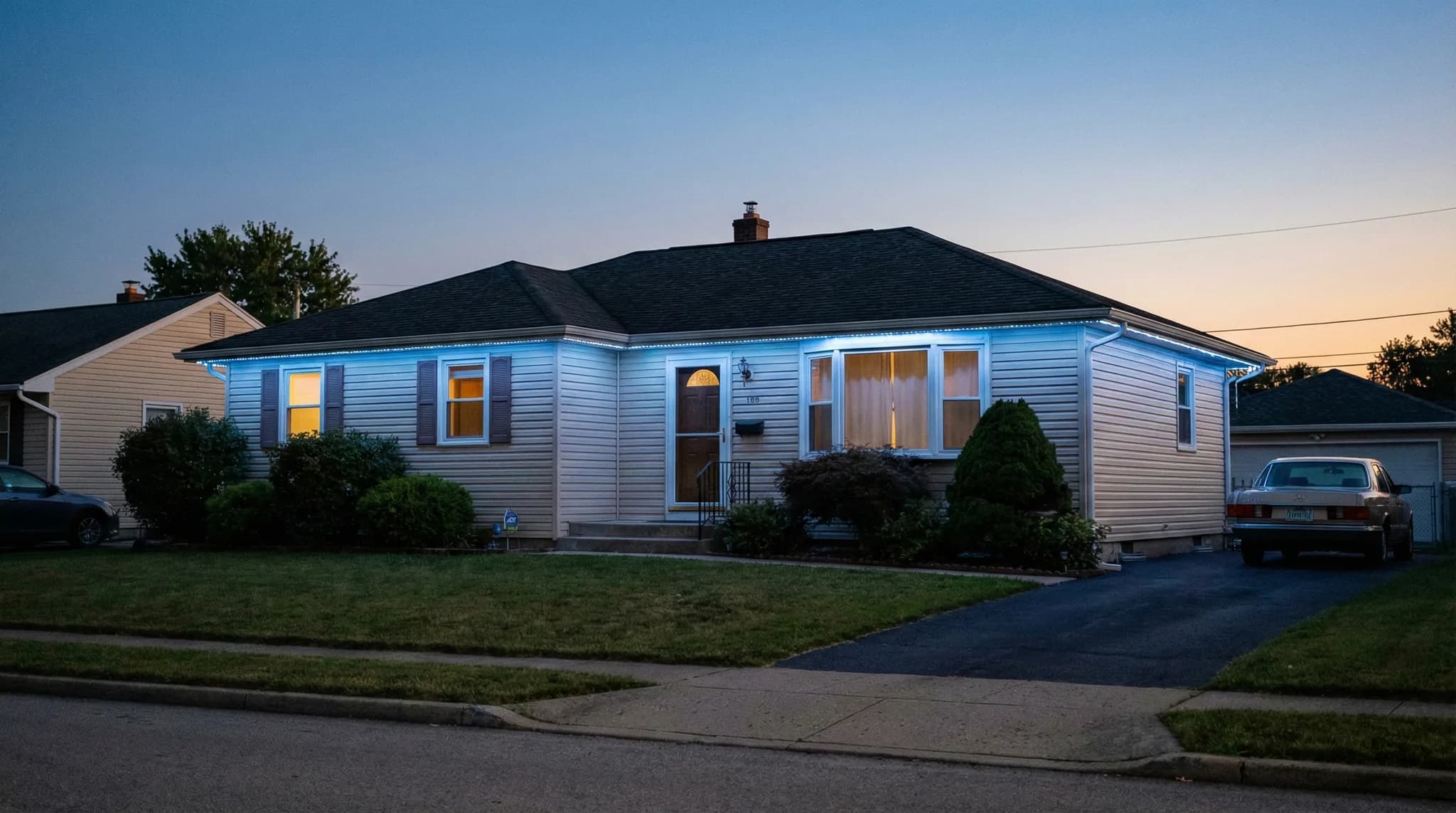
If you're considering permanent outdoor lighting for your Sacramento home, you're looking at an investment between $3,000 and $6,000 for a typical residential system. That's real money, and you deserve a straight answer about how long that system will actually last before you commit.
The headline number you'll see from most manufacturers is 50,000 hours. That sounds impressive, and it is. But a raw hour count doesn't tell you the whole story. Your permanent outdoor lights aren't operating in a vacuum. They're mounted on your roofline, exposed to everything Sacramento's climate throws at them: triple-digit summer heat, intense UV radiation for roughly 260 days per year, and a concentrated rainy season from November through March. For a dedicated deep dive on heat specifically, see our guide to permanent outdoor lights in Sacramento's extreme heat.
The real question isn't "how many hours are the LEDs rated for?" The real question is: how do those LEDs, and every other component in the system, hold up under Sacramento's specific conditions? That's what this guide covers. We'll break down what 50,000 hours actually means in practice, which components wear out first, how Sacramento's Mediterranean climate affects durability, and what separates a system that lasts 5 years from one that lasts 20.
LED Lifespan: What 50,000 Hours Actually Means
Let's start with the math. If you run your permanent outdoor lights an average of 8 hours per night (a typical schedule for accent and security lighting), 50,000 hours translates to approximately 17 years. At 6 hours per night, which is common for homeowners who primarily use their lights from dusk through the late evening, that number stretches to about 22 years. These are real, usable timeframes for a home improvement investment.
But there's an important nuance here. LEDs don't burn out the way incandescent bulbs do. There's no filament to snap, no sudden moment where the light goes dark. Instead, LEDs gradually lose brightness over time. The industry measures this with something called an L70 rating. When a manufacturer says their LEDs are rated for 50,000 hours, they typically mean the LEDs will still produce at least 70% of their original brightness at that hour mark. So after 17 years of nightly use, your lights won't be dead. They'll be dimmer, but still functional.
The gap between professional-grade and consumer-grade LEDs is significant. Professional-grade LEDs (the type used in permanent outdoor lighting systems) use higher-quality diodes, better phosphor coatings, and more robust thermal management. Consumer-grade LED strips from the hardware store might carry the same 50,000-hour claim, but their actual degradation curve is much steeper, especially in high-heat environments like Sacramento.
Here's something most homeowners don't consider: the LEDs themselves are almost always the longest-lasting component in the system. Controllers, wiring connectors, mounting channels, and power supplies all have their own lifespans. A quality system is designed so that every component matches the longevity of the LEDs. A cheap system cuts corners on these supporting components, and that's where premature failures happen.
Sacramento's Climate: The Real Durability Test
Sacramento has a Mediterranean climate, which sounds pleasant, and mostly is. But for outdoor electronics, it presents a very specific set of challenges that differ from what you'd face in the Midwest, Pacific Northwest, or East Coast. Understanding these factors is critical if you want to evaluate how long your permanent lights will actually perform.
Summer Heat and Thermal Stress
Sacramento regularly hits 100 to 110°F from June through September. In 2024, the city logged over 40 days above 100°F. Heat is the number one enemy of electronics, and LEDs are no exception. When an LED operates in high ambient temperatures, the junction temperature (the temperature at the semiconductor itself) rises. Higher junction temperatures accelerate phosphor degradation and reduce overall lifespan.
Quality permanent lighting systems address this with aluminum or heat-dissipating mounting channels that act as passive heat sinks, drawing thermal energy away from the LEDs. The housing materials are rated for continuous operation at elevated temperatures. Cheap systems use plastic housings that trap heat instead of dissipating it, creating a miniature oven effect that can cut LED lifespan by 30 to 50 percent.
UV Exposure: 260+ Sunny Days Per Year
Sacramento is one of the sunniest cities in the United States, averaging over 260 sunny days annually. That's a tremendous amount of ultraviolet radiation hitting your roofline fixtures year after year. UV radiation degrades plastics, yellows lens covers, and breaks down the polymers in housing materials.
The lens cover is particularly vulnerable. Professional-grade systems use UV-stabilized polycarbonate lenses that resist yellowing and embrittlement for 15 to 20 years. Budget systems often use acrylic or unstabilized polycarbonate that begins to yellow within 2 to 3 years of Sacramento sun exposure. Yellowed lenses don't just look bad; they reduce light output by 20 to 40 percent and alter the color temperature, making warm white lights look dingy and uneven.
Winter Rain and Waterproofing
Sacramento's rainy season runs from roughly November through March, delivering an average of 18 to 20 inches of rain per year. While that pales compared to cities like Seattle or Miami, it comes in concentrated bursts. Atmospheric river events can dump 2 to 4 inches in a single day, driving rain sideways into fixtures, connectors, and mounting points.
Every outdoor lighting system needs proper waterproofing, and we'll cover IP ratings in detail below. The key point: Sacramento's rain is seasonal but intense, and any weakness in seals, connectors, or mounting will reveal itself during these winter storms.
Sacramento's Advantage: No Freeze-Thaw Cycles
Here's where Sacramento homeowners catch a break. In much of the Midwest and East Coast, freeze-thaw cycles are the primary killer of outdoor lighting systems. Water seeps into tiny cracks and connector gaps, freezes, expands, and forces those gaps wider. Over dozens of cycles per winter, seals crack, connectors corrode, and housings split. Salt used for de-icing accelerates corrosion on metal components.
Sacramento valley temperatures rarely drop below freezing. You won't deal with ice expansion cracking your connector seals or salt corrosion eating away at your wiring. This is a genuine advantage. Systems installed in Sacramento face less mechanical stress from thermal cycling than identical systems in Chicago or Boston. The primary threats here are heat and UV, not cold and ice, and those are threats that quality materials and proper installation can manage effectively.
Dust and Pollen Accumulation
The Sacramento Valley is known for its air quality challenges, and anyone who has lived here through spring knows what tree pollen does to every outdoor surface. Central Valley agricultural dust adds another layer. Over time, dust and pollen accumulate on fixture lenses, reducing light output and potentially trapping moisture against housing surfaces.
The good news: this is easily managed. A simple wipe-down of your fixtures once or twice a year (we recommend spring after pollen season and fall before the holidays) keeps your lights performing at full brightness. No special cleaners needed; a soft cloth and mild soap do the job.
IP Ratings Explained: What They Mean for Sacramento Homeowners
You'll see IP ratings on every outdoor lighting product, but most homeowners aren't sure what the numbers mean. IP stands for Ingress Protection, and the two-digit code tells you how well a fixture resists solid particles (first digit) and water (second digit).
- IP65: Dust-tight (no ingress of dust) and protected against low-pressure water jets from any direction. This is the minimum acceptable rating for outdoor lighting.
- IP67: Dust-tight and capable of withstanding temporary immersion in water up to 1 meter for 30 minutes. A better choice for Sacramento, where driving rain can temporarily pool around fixtures.
- IP68: Dust-tight and rated for continuous submersion beyond 1 meter. This is overkill for roofline and soffit installations but relevant for ground-level or in-grade lighting.
For Sacramento specifically, IP65 is adequate for roofline and soffit installations because these locations are partially sheltered by the roof overhang. An IP67 rating provides extra insurance, particularly for fixtures on exposed fascia boards or areas where wind-driven rain hits directly. If your installer is recommending IP65, that's acceptable. If they offer IP67 at a similar price point, it's the smarter choice.
One thing IP ratings do not tell you: UV resistance, heat tolerance, or color stability over time. A fixture can be rated IP67 and still have a cheap plastic housing that degrades in Sacramento sun within a few years. IP rating is necessary but not sufficient. Always ask about the housing material (aluminum is best for heat management), lens material (UV-stabilized polycarbonate), and LED quality independently of the IP rating.
Professional Installation vs. DIY: Why It Matters for Longevity
The components themselves are only half the equation. How those components are installed determines whether you get 5 years or 20 years out of your system. Sacramento's climate puts specific demands on installation technique that generic YouTube tutorials won't cover.
Thermal Expansion and Mounting
Sacramento experiences some of the largest daily temperature swings of any major California city. On a typical July day, morning temperatures sit around 62 to 65°F, and afternoon highs reach 100 to 105°F. That's a 40-degree swing in a matter of hours. Every material expands and contracts with temperature changes. Aluminum mounting channels, the fixture housings, even the adhesive or screws holding everything in place, all move slightly with each cycle.
Professional installers account for this by leaving calculated expansion gaps at joints and using mounting techniques that allow slight movement without breaking seals or loosening connections. DIY installations that butt channels tightly end-to-end will buckle or create gaps over time as the materials cycle through expansion and contraction thousands of times per year.
Wire Management
All outdoor wiring should be UV-rated. Standard PVC-jacketed wire degrades in direct sunlight, becoming brittle and cracking within 3 to 5 years. UV-rated wire uses additives in the jacket material that resist photodegradation. Professional installations also include proper strain relief at connection points (so the wire isn't supporting its own weight at the connector) and drip loops, small downward curves in the wire before it enters a junction box or connector. Drip loops ensure that rainwater runs off the wire by gravity rather than wicking into the connection point.
Sealed Connections
This is where DIY installations fail most often. Professional systems use heat-shrink tubing with adhesive lining and, for critical junctions, silicone potting compound that completely encapsulates the connection. These methods create a watertight, airtight seal that can survive years of Sacramento rain and heat cycling. Twist-on wire nuts with electrical tape (the standard DIY approach) will work for a season or two, then moisture works its way in, corrosion begins, and you get intermittent failures that are maddening to diagnose.
The Stucco Factor
A huge percentage of Sacramento homes are stucco-clad. Stucco is a durable exterior finish, but it requires specific techniques for mounting anything to it. Drilling into stucco with standard drill bits and generic anchors risks cracking the stucco, both at the drill point and along stress lines that may not be visible immediately. Cracked stucco allows water to penetrate behind the finish, reaching the wire lath, paper barrier, and eventually the framing. Over years, this leads to hidden water damage that's far more expensive to repair than the lighting system itself.
Professional installers use masonry-specific bits, properly sized Tapcon-style anchors, and apply exterior-grade sealant around each penetration point. For residential installations, this attention to mounting detail is one of the most significant differences between professional and DIY work.
Annual Maintenance for Sacramento Homeowners
One of the biggest selling points of permanent outdoor lighting is low maintenance. You're not climbing a ladder every December to hang string lights and again in January to take them down. But "low" maintenance doesn't mean "zero" maintenance. A small amount of annual attention keeps your system performing at its best and helps you catch small issues before they become expensive problems.
Spring Inspection (After Rainy Season)
Once Sacramento's rains taper off in March or April, do a visual walk-around of your home. Look at each section of lighting and check for:
- Any sections that are noticeably dimmer than their neighbors
- Fixtures that have shifted, tilted, or pulled away from the mounting surface
- Visible water staining or discoloration around connection points
- Any flickering when the system first powers on (this can indicate a loose connection)
Run through each color and lighting zone on your app to confirm all sections respond correctly. This takes 10 minutes and is the single most valuable thing you can do for system longevity.
Fall Cleaning (Before Holiday Season)
Before you switch over to your holiday lighting themes in October or November, give the fixtures a quick cleaning. Wipe down the lens covers with a soft cloth and mild soap to clear off the accumulated summer dust and spring pollen. Check the mounting channels for any debris (leaves, cobwebs, mud dauber nests) that might block airflow or trap moisture heading into the rainy season.
What You Don't Need to Do
This is the good part. With a professional permanent lighting system, you do not need to:
- Climb ladders regularly to inspect or adjust anything
- Replace individual bulbs (there are no bulbs to replace)
- Rewire or resolder any connections
- Repaint or refinish the mounting hardware
- Apply weatherproofing treatments or sealants
If any of these become necessary, that's warranty territory. EXT Lighting offers an annual check-up service where our technicians inspect the full system, clean fixtures, test all zones, and verify connections. It's a hands-off approach that keeps your system running at peak performance. Check our FAQ page for more details on what our maintenance service includes.
Warranty: What to Look For
Warranty coverage varies wildly across the permanent outdoor lighting industry, and the details matter more than the marketing language. Two companies can both claim "lifetime warranty," and one might cover everything while the other covers almost nothing.
First, understand that there are two separate warranties in play: the manufacturer's warranty on the components (LEDs, controller, channels) and the installer's warranty on the labor and workmanship. You want both. A manufacturer warranty that covers a defective LED is useless if you have to pay $500 in labor to have it replaced.
A legitimate lifetime warranty on permanent outdoor lighting should cover:
- LED replacement if sections fail or dim prematurely
- Controller repair or replacement
- Wiring and connector failures
- All labor required to diagnose and fix issues
Watch for red flags. Warranties that exclude "weather-related damage" or "normal wear and tear" are essentially worthless for outdoor lighting in Sacramento. Heat and UV exposure are the operating conditions, not exceptions. If a warranty won't cover degradation caused by the climate the system is designed to operate in, that's a warranty designed to avoid paying claims.
EXT Lighting's warranty covers parts and labor for as long as you own your home. That includes everything: LEDs, controller, wiring, connectors, and the labor to service any of it. The warranty is also transferable to the next homeowner if you sell, which adds genuine resale value to your property. Learn more about how warranty factors into the overall value of permanent outdoor lights.
When to Expect Replacement
Here's the honest, component-by-component breakdown of what to expect from a professionally installed, quality permanent lighting system in Sacramento:
- LEDs: 15 to 20+ years before brightness drops to a level where replacement makes sense. Professional-grade LEDs in a well-ventilated mounting system with proper heat management will reach or exceed their rated hours in Sacramento.
- Controller: 8 to 12 years is a typical lifespan for the electronic controller and power supply. In practice, many homeowners upgrade their controller before it fails because newer models offer better app features, integration with smart home systems, or expanded color options. Think of it like upgrading a phone; the old one still works, but the new one does more.
- Wiring: 20+ years with UV-rated wire and professionally sealed connections. Wiring failures in well-installed systems are rare.
- Mounting Channels: 15 to 20+ years for aluminum channels with proper UV-resistant finish. Powder-coated or anodized aluminum holds up well in Sacramento conditions.
The honest summary: a well-installed system using quality components should give you 15 or more years before any major components need attention. Minor touch-ups or a controller upgrade might happen sooner, but the core system (LEDs, wiring, mounting) should serve you well for nearly two decades.
The Bottom Line for Sacramento Homeowners
Professional-grade permanent outdoor lights, properly installed, will last 15 to 20+ years in Sacramento's climate. The city's heat and UV exposure are real challenges, but they're well-understood challenges that quality materials and expert installation handle effectively.
The difference between a system that lasts 5 years and one that lasts 20 comes down to two things: the materials used in the components (housing material, lens grade, wire jacket, connector seals) and the quality of the installation itself. Both matter equally.
If you're ready to invest in permanent outdoor lighting for your Sacramento home, get a free quote from EXT Lighting. We use professional-grade fixtures rated for 50,000+ hours, back everything with a lifetime warranty on parts and labor, and our installation techniques are designed specifically for Sacramento's climate conditions.