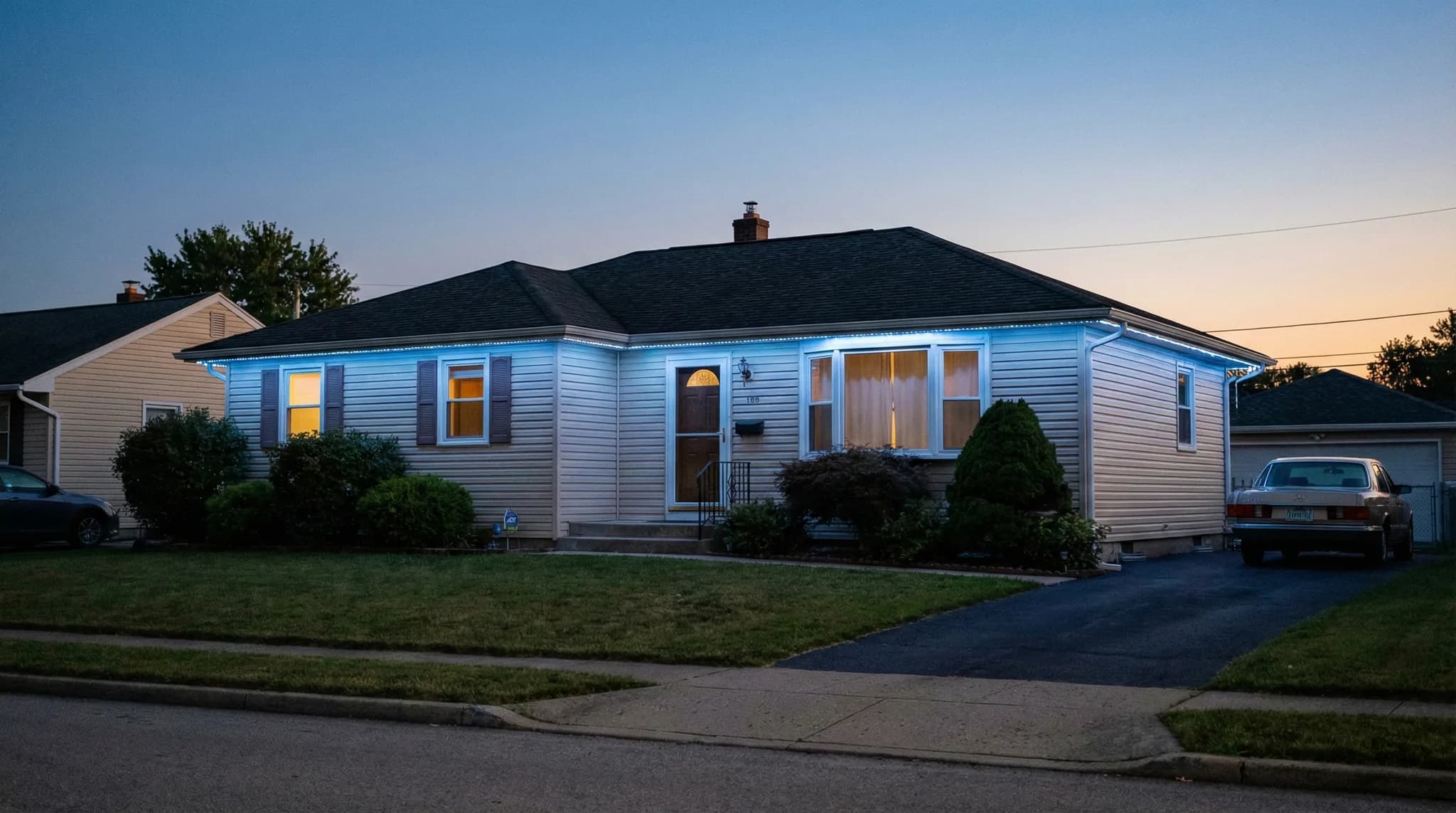
Most Sacramento homeowners think about permanent outdoor lights in terms of curb appeal and holiday displays. That makes sense. But there's a quieter, more practical benefit that rarely gets the attention it deserves: security.
California's property crime rate sat at 2,084 per 100,000 residents in 2024 (California DOJ, Crime in California 2024). That's a 9.9% decrease from the year before and the lowest rate since 1985, but it still means property crime is common enough that every homeowner should be thinking about prevention. And one of the simplest, most cost-effective prevention tools? A well-lit exterior.
This isn't a sales pitch for expensive alarm systems or surveillance cameras. We're going to look at what the data actually says about outdoor lighting and crime deterrence, why consistent lighting outperforms motion sensors, and how permanent outdoor LED lights fit into a broader home security strategy. If you've been considering whether permanent lights are worth the investment, the security angle might be the piece you haven't fully considered.
TL;DR: Well-lit properties are significantly less attractive targets for burglars, according to law enforcement agencies nationwide. Permanent outdoor LED lights provide consistent dusk-to-dawn illumination that signals occupancy, eliminates dark hiding spots, and costs roughly $3 to $8 per month to operate (U.S. Department of Energy). For Sacramento homeowners, they're one of the most practical security layers you can add.
What Does the Data Actually Say About Lighting and Crime?
Law enforcement agencies universally recommend exterior lighting as a crime deterrent. The FBI's Uniform Crime Reporting program reports that most residential burglaries occur during daytime hours when homes are unoccupied. But nighttime break-ins, while less frequent overall, disproportionately target homes that appear dark and vacant.
Here's what matters for homeowners. Burglars are opportunistic. They look for easy targets. A dark house signals that nobody is home or nobody is paying attention. A consistently well-lit exterior signals the opposite: someone lives here, someone cares, and the risk of being seen is high.
In 2024, 14.7% of California property crimes were burglaries, while 64.7% were larceny-thefts (FBI UCR / California DOJ). Both categories involve criminals selecting targets based on perceived risk. Lighting directly increases that perceived risk. A thief approaching a home bathed in light is far more visible to neighbors, passing cars, and security cameras than one moving through shadows.
Does this mean lights alone will prevent every break-in? Of course not. No single measure does. But as part of a layered approach to home security, consistent exterior lighting is one of the most effective and affordable tools available.
Why Does Consistent Lighting Beat Motion-Sensor Lighting?
Motion-sensor lights have been the go-to security lighting solution for decades. They're affordable, easy to install, and they do provide some benefit. But according to CPTED (Crime Prevention Through Environmental Design) principles, automated lighting that runs on a schedule creates a more effective deterrent than motion-activated systems alone.
Here's the problem with motion sensors that most people don't consider: they create a pattern. Your house is dark. Then it's bright. Then it's dark again. Anyone watching your home can quickly figure out the sensor's range, its blind spots, and its reset timing. Experienced burglars know how to avoid triggering sensors, or they simply wait for the light to turn off.
Consistent lighting eliminates that vulnerability entirely. When your exterior is lit from dusk to dawn, there are no dark periods to exploit. There are no blind spots to probe. The house simply looks occupied and monitored at all times.
Motion Sensors Still Have a Role
We're not saying motion sensors are useless. They work well as a secondary alert system, especially in backyards or side yards where a sudden burst of light draws attention to unexpected movement. The key is not relying on them as your only lighting. Think of motion sensors as a complement to consistent perimeter lighting, not a replacement.
The "Occupied Home" Effect
CPTED principles emphasize that the appearance of occupancy is one of the strongest deterrents against property crime. Automated outdoor lighting that turns on at dusk and off at a set time (or runs all night) creates that appearance whether you're home, at work, or on vacation in Hawaii. A dark house at 9 PM on a Tuesday tells a different story than a house glowing with warm light along every roofline.
What Does Sacramento's Property Crime Landscape Look Like?
California's overall property crime rate dropped to 2,084 per 100,000 in 2024, the lowest since 1985 (California DOJ). That's genuinely good news. But statewide averages only tell part of the story for Sacramento homeowners.
Sacramento is a sprawling metro area with wide variation in crime rates from neighborhood to neighborhood. Communities like Land Park, East Sacramento, and Curtis Park have different security profiles than areas along Stockton Boulevard or parts of North Highlands. Suburban neighborhoods in Roseville, Folsom, and El Dorado Hills generally see lower crime rates, but they're not immune. Daytime burglaries in particular can happen anywhere, including affluent neighborhoods where homes sit empty during work hours.
What's consistent across all these areas? The homes that get targeted tend to share common traits. They look unoccupied. They have poor visibility from the street. They offer dark approaches and concealed entry points. Good exterior lighting addresses every one of those vulnerabilities.
In our experience installing permanent lighting systems across the Sacramento metro, homeowners in neighborhoods like Pocket, Natomas, Arden-Arcade, and Elk Grove frequently mention security as a primary motivation, sometimes even more than aesthetics. They've seen package thefts, garage break-ins, or car prowls on their block, and they want their home to look occupied and uninviting to anyone with bad intentions.
How Do Permanent Outdoor Lights Work as a Security Layer?
LED lighting uses approximately 75% less energy than incandescent bulbs and lasts 25 times longer (U.S. Department of Energy). That efficiency is what makes permanent outdoor lights practical as an always-on security feature. Running them every night costs so little that the security benefit alone justifies the electricity.
Here's how a permanent system functions specifically as a security tool:
Scheduled Automation
You set your lights to turn on at dusk and off whenever you choose. This happens automatically, every single day, without you touching a button. Whether you're cooking dinner, out for the evening, or traveling for two weeks, your home looks the same: lit, occupied, and monitored. There are no timers to forget, no switches to flip, no dark nights because you came home late and forgot.
Vacation Mode
Heading out of town? Your lights don't know the difference. They follow the same schedule they always follow. Some homeowners adjust their schedule slightly when traveling, running lights a bit later into the night to mimic someone being home. You can make these changes from the app on your phone from anywhere in the world.
Full Perimeter Coverage
Unlike a porch light that illuminates only your front door, permanent lights trace the entire roofline of your home. That means every side, every corner, and every potential approach is bathed in light. There are no dark zones for someone to hide in. The installation process is designed to create continuous, gap-free illumination along your roofline.
Adjustable Brightness and Color
For everyday security, most homeowners run a warm white at moderate brightness. It looks elegant and provides excellent visibility without being harsh. But if you want brighter output during a specific situation, or you want to draw attention with a specific color pattern, you can adjust that instantly through the app.
What Is the CPTED Approach to Designing Out Crime?
CPTED stands for Crime Prevention Through Environmental Design. It's a framework used by law enforcement, urban planners, and security professionals to reduce crime through the design of physical spaces. Well-lit properties are a cornerstone of CPTED principles, which emphasize natural surveillance and eliminating opportunities for concealment.
The core idea is straightforward. Instead of reacting to crime after it happens (alarms, cameras, police reports), you design your environment so crime is less likely to happen in the first place. Lighting plays a central role in three of CPTED's key strategies.
Natural Surveillance
The more visible your property is, the higher the risk for a criminal. Good lighting ensures that neighbors, pedestrians, and passing drivers can see what's happening around your home. A well-lit house on a Sacramento street doesn't just protect itself. It contributes to the overall safety of the block.
Territorial Reinforcement
Lighting defines boundaries. It signals that this is private, maintained space and someone is paying attention. A brightly lit roofline communicates ownership and care in a way that a dark, unlit home simply does not. Think about how differently you feel walking past a lit home versus a dark one. Criminals make the same assessment, just from a different angle.
Eliminating Dark Zones
Every dark corner around a home is a potential hiding spot. Side yards, back entrances, garage approaches, and areas behind landscaping all become less threatening when ambient light from a roofline system reaches them. Permanent lights mounted along the entire perimeter push light outward and downward, reducing shadows where someone could wait undetected.
Permanent Lights vs. Traditional Security Lighting: How Do They Compare?
Not all outdoor lighting serves the same security function. Here's how permanent LED systems compare to common alternatives that Sacramento homeowners typically consider.
| Feature | Permanent LED Lights | Motion-Sensor Floods | Porch Light |
|---|---|---|---|
| Coverage Area | Full perimeter roofline | Limited zones (1–3 spots) | Front door only |
| Consistency | Dusk-to-dawn, every night | Only when triggered | Manual on/off or basic timer |
| Dark Zones | Eliminated | Present between sensors | Most of the home is dark |
| Occupancy Signal | Strong (consistent pattern) | Weak (on/off cycling) | Moderate (if left on) |
| Vacation Coverage | Automatic, no changes needed | Works, but no occupancy signal | Often forgotten off/on |
| Monthly Energy Cost | $3–$8 | $1–$3 | <$1 |
| Curb Appeal Bonus | High (architectural accent) | None (utilitarian look) | Minimal |
| App Control | Full (brightness, color, schedule) | Some smart models only | Smart bulb required |
The table tells a clear story. Motion sensors and porch lights each address a narrow slice of the security picture. Permanent lights cover the full perimeter, run automatically, and deliver curb appeal as a bonus. For homeowners who want meaningful security lighting without the harsh, institutional look of floodlights, permanent LEDs hit the right balance.
How Much Does It Cost to Run Outdoor Lights for Security?
LED lighting uses approximately 75% less energy than incandescent bulbs (U.S. Department of Energy). For a typical Sacramento home with a permanent LED system running 6 to 8 hours per night through SMUD, the monthly electricity cost falls between $3 and $8.
Let's put that in perspective. You're paying less per month for full-perimeter security lighting than you'd spend on a single coffee. Over a full year, that's $36 to $96 in electricity for a security measure that runs every single night without fail.
Compare that to other security investments:
- Monitored alarm system: $20 to $60 per month ($240 to $720/year)
- Video doorbell subscription: $3 to $10 per month ($36 to $120/year)
- Permanent outdoor lighting (electricity): $3 to $8 per month ($36 to $96/year)
The electricity cost is a rounding error compared to the security benefit. And unlike alarm systems, there's no monthly subscription fee for permanent lights. The only ongoing cost is the electricity itself. For a detailed look at system pricing and what's included, see our Sacramento permanent lights cost guide.
LED lights also last 25 times longer than incandescent bulbs (U.S. Department of Energy), which means you won't be replacing bulbs every year or two. Professional-grade permanent systems are rated for 50,000+ hours. At 8 hours per night, that's over 17 years before you'd even need to think about LED replacement. Learn more about how long permanent outdoor lights last.
Can Outdoor Security Lighting Affect Your Homeowners Insurance?
Some homeowners insurance providers offer discounts for security measures that reduce the risk of burglary and property damage. Exterior lighting falls into this category for certain insurers, especially when it's part of a broader security setup that includes deadbolts, alarm systems, and cameras.
The discount amount varies by carrier and policy. It's typically modest, ranging from 2% to 10% off your premium when combined with other qualifying security features. That won't pay for the lighting system by itself. But it's worth a quick call to your insurer to ask whether your permanent lighting qualifies.
Even without a formal discount, there's an indirect insurance benefit. Fewer incidents mean fewer claims, which keeps your premiums stable over time. A home that deters crime through good lighting, maintained landscaping, and visible security measures is statistically less likely to file a theft or vandalism claim.
Frequently Asked Questions
Do outdoor lights really deter burglars?
Yes. Police departments universally recommend exterior lighting as a crime deterrent. Well-lit properties are significantly less attractive targets because visibility increases the risk of detection. Lighting alone won't stop every crime, but it's one of the most effective and affordable layers in a home security strategy. Pairing consistent lighting with cameras and good locks creates a strong defensive combination.
Should I leave outdoor lights on all night for security?
Running lights from dusk until midnight or 1 AM covers the highest-risk hours for nighttime property crime. Some homeowners run theirs all night. With LED permanent lights costing just $3 to $8 per month (U.S. Department of Energy efficiency data), the energy cost of all-night operation is minimal. The stronger security signal comes from consistency, so pick a schedule and stick with it every night.
Are motion-sensor lights better than permanent lights for security?
Motion sensors and permanent lights serve different roles. Motion sensors create a startle effect and alert you to movement, but they leave your home dark most of the time. Permanent lights provide consistent illumination that signals occupancy and eliminates dark zones around your property. The best approach uses both: permanent perimeter lighting as the baseline, with motion sensors in specific areas like back gates or side yards.
Do permanent outdoor lights increase my home's value?
Exterior lighting consistently ranks among the top curb appeal features that influence buyer perception. In Sacramento's housing market, where median home prices exceed $500,000 in many neighborhoods, even a modest boost in curb appeal can translate to meaningful value. Read our full analysis in the permanent lights ROI guide.
What color should security lights be?
Warm white (2700K to 3000K) is the most common choice for everyday security lighting. It provides excellent visibility without the harsh, institutional feel of bright white floodlights. Warm white also looks the most natural and residential, which reinforces the "someone lives here" signal you want to project. With permanent LED systems, you can adjust the color and brightness anytime through the app.
Making Your Sacramento Home Safer with Permanent Lighting
Security doesn't have to mean turning your home into a fortress. Permanent outdoor LED lights add a practical, effective security layer that also happens to make your home look beautiful every night. They run automatically, cost pennies per day, and eliminate the dark zones that make properties vulnerable.
For Sacramento homeowners weighing their options, here's the short version: consistent exterior lighting deters crime, signals occupancy, supports CPTED principles, and costs less per month to operate than a streaming subscription. Combined with a system that lasts 15 to 20+ years and a lifetime warranty, it's one of the highest-value security investments you can make.
Want to see what permanent lighting would look like on your home? Request a free quote and we'll schedule a no-obligation consultation. Or explore our residential lighting services to learn more about how the system works. Have more questions? Visit our FAQ page for answers to the most common questions Sacramento homeowners ask.