Every November, the same scene plays out across Sacramento: homeowners drag tangled boxes of Christmas lights out of 130-degree garages, spend a Saturday on a ladder in the cold, fight with clips that break in their hands, and plug everything in only to discover half the string is dead. Sound familiar?
If you've been through this routine enough times, you've probably wondered whether there's a better way. There is, and it's why a growing number of homeowners in Roseville, Folsom, El Dorado Hills, and across the Sacramento metro are making the switch to permanent outdoor LED lighting.
But is the switch actually worth it? That depends on your situation. In this guide, we're going to put permanent outdoor lights and traditional Christmas lights side by side – covering cost, convenience, safety, durability, and everything else that matters – so you can decide for yourself. We'll use real Sacramento-area numbers, not generic national data.
No sales pitch. Just an honest comparison.
What Are Permanent Outdoor Lights?
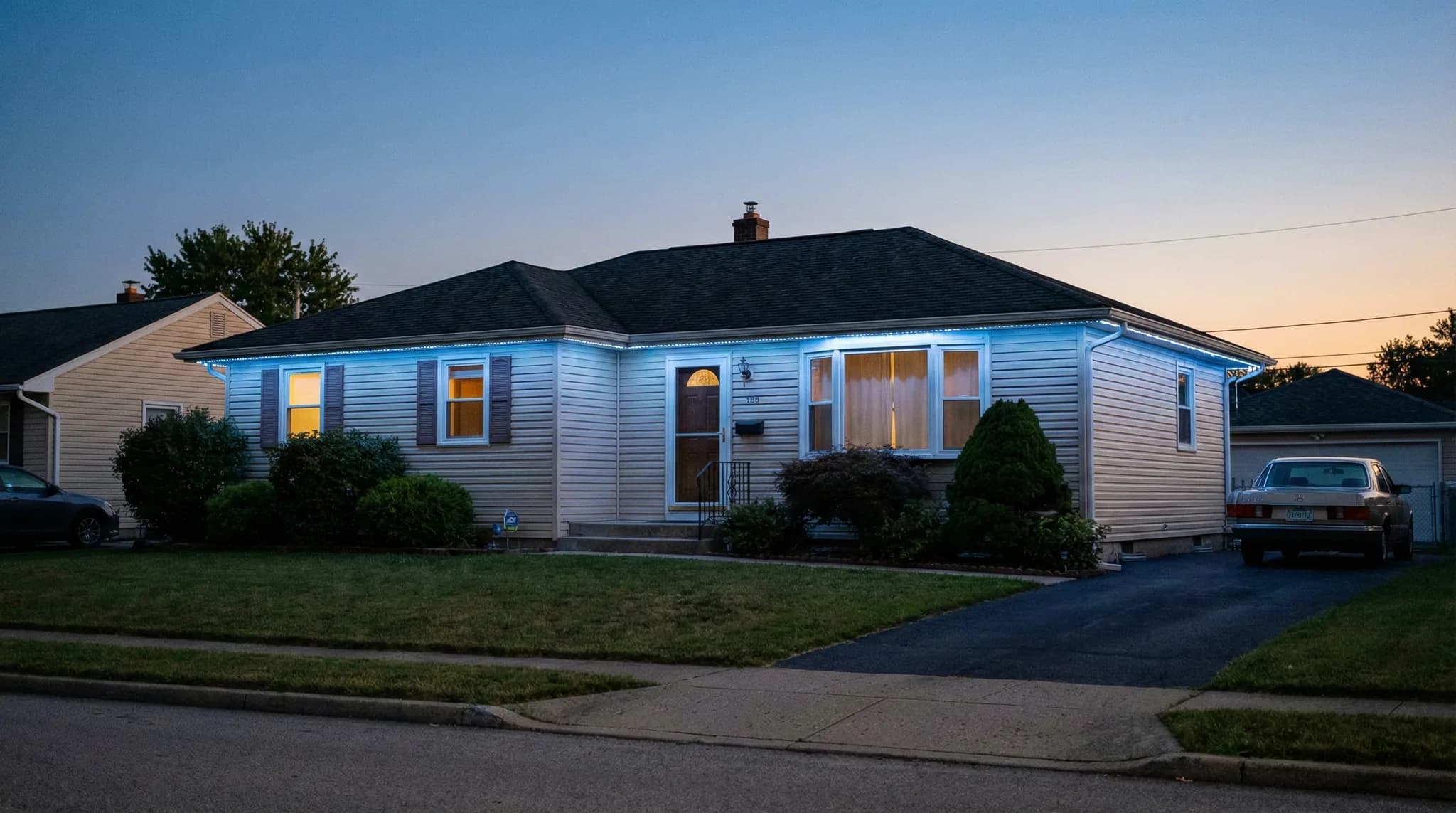
If you're new to the concept, here's the quick version. Permanent outdoor lights are commercial-grade LED modules that mount directly to your roofline inside a low-profile aluminum channel. Once installed, the channel sits flush against your fascia or soffit – virtually invisible during the day. There are no sagging wires, no visible clips, and no strings drooping between attachment points.
Each LED module can produce millions of colors and is individually addressable, meaning you can set different sections of your roofline to different colors or effects. Everything is controlled through a smartphone app: change colors, set schedules, create custom scenes, or pick from holiday presets. Want warm white on a Tuesday night and red and green on Christmas Eve? That takes about three taps on your phone.
The system runs year-round. Most homeowners use a soft warm white or amber as their everyday setting, then switch to holiday colors or special-occasion themes whenever they want. The lights are rated for 50,000+ hours and come with a lifetime warranty on parts and labor.
You can learn more about how the systems work and what installation looks like on our residential lighting page.
The Side-by-Side Comparison
Before we dive into the details, here's the full comparison at a glance. This covers the factors Sacramento homeowners ask about most.
| Factor | Permanent LED Lights | Traditional Christmas Lights |
|---|---|---|
| Upfront Cost | $3,000 – $6,000 (installed) | $50 – $300 (DIY) or $300 – $600 (pro install/year) |
| Annual Ongoing Cost | ~$36 – $96/year (electricity only) | $300 – $600+/year (pro) or $50 – $200 (DIY replacement) |
| Lifespan | 15 – 20+ years (50,000+ hours) | 1 – 3 seasons before noticeable degradation |
| Installation Time | One day (professional) | 4 – 8 hours (every year, up and down) |
| Color Options | 16+ million colors, individually addressable | Fixed (whatever you bought) |
| Control Method | Smartphone app, schedules, smart home integration | Manual plug-in or basic timer |
| Energy Use | 100 – 200 watts total (LED) | 300 – 1,000+ watts (incandescent) or 100 – 300 watts (LED strings) |
| Safety (Ladder Risk) | No ladders after initial pro install | Ladder required every year (up + down) |
| HOA Friendliness | Invisible when off; clean, architectural look | Visible clips, wires, and sagging; must remove by deadline |
| Year-Round Use | 365 days/year – holidays, security, ambiance | 6 – 8 weeks per year |
| Weather Resistance | IP67 rated (dust-tight, waterproof) | Varies; most consumer strings are not weather-sealed |
| Home Value Impact | Adds curb appeal; warranty transfers to new owner | None – temporary decoration only |
The table tells the broad story, but the real insight comes when you dig into the details. Let's start with the one most people care about first: money.
Cost Over Time: The Math Sacramento Homeowners Should Know
The upfront price gap is obvious. Permanent lights cost significantly more on day one. But lighting isn't a one-year decision – you're going to want lights on your house next year too, and the year after that. Here's how the numbers play out over time for a typical Sacramento home.
The Temporary Light Costs (Per Year)
If you hire a professional installer in the Sacramento area, expect to pay $300 to $600 per year for installation and removal of temporary Christmas lights. That covers putting them up in November and taking them down in January. If you do it yourself, you save the labor but still spend $50 to $200 per season on replacement strings, clips, extension cords, and timers – because something always breaks or burns out. And every 2 to 3 years, you're essentially buying a whole new set.
The Permanent Light Costs
A one-time investment of $3,000 to $6,000 covers the full professional installation, all materials, app setup, and a lifetime warranty on parts and labor. After that, the only ongoing cost is electricity. Running a typical system through SMUD at current rates ($0.12 to $0.15/kWh) comes out to roughly $3 to $8 per month, depending on your nightly usage hours and total linear footage. For a detailed breakdown of what drives the price, see our Sacramento permanent lighting cost guide.
The Year-by-Year Comparison
Let's use the midpoint of each range. For temporary, we'll use $450/year (professional install) plus $75/year in replacement costs, totaling $525/year. For permanent, we'll use a $4,500 one-time cost plus $60/year in electricity ($5/month).
| Timeframe | Temporary Lights (Cumulative) | Permanent Lights (Cumulative) |
|---|---|---|
| Year 1 | $525 | $4,560 |
| Year 3 | $1,575 | $4,680 |
| Year 5 | $2,625 | $4,800 |
| Year 7 | $3,675 | $4,920 |
| Year 10 | $5,250 | $5,100 |
| Year 15 | $7,875 | $5,400 |
The break-even point lands right around year 8 to 9 for most homeowners. After that, the permanent system is essentially free to operate while the temporary approach keeps costing $500+ every single year. By year 15, you've saved roughly $2,500 – and your permanent system still has years of life left.
Here's the part that really stings about the temporary route: after 10 years and $5,250 spent, you own nothing. No lights on the house, no residual value, nothing. The permanent homeowner, meanwhile, has a fully functioning system with a transferable warranty that adds value to their property.
For a deeper dive into the ROI and home value impact, read our guide on whether permanent outdoor lights are worth the investment.
The Convenience Factor
Cost is important, but let's be real – for a lot of Sacramento homeowners, convenience is what actually tips the scale. And the gap between permanent and temporary lights on this front is enormous.
With traditional Christmas lights, the process goes something like this: dig out the bins from the garage (which in Sacramento means navigating a 130-degree storage space in November that was a 140-degree storage space in August). Untangle everything. Test each string. Discover that two of the four strings are dead. Drive to Home Depot or Lowe's. Buy replacement strings that don't quite match. Spend a Saturday afternoon on a ladder. Swear a few times. Realize you need more extension cords. Go back to the store. Finally get everything up and plugged in. Then do the whole thing in reverse in January.
With permanent lights, the process is: open the app. Pick a color. That's it.
Want the lights to turn on automatically at sunset and off at midnight? Set a schedule once and forget about it. Heading into the Fourth of July and want to switch from warm white to red, white, and blue? Takes about 10 seconds from your couch. Sacramento Kings playoff game tonight? Purple and gray at the tap of a button. Your kid's birthday party this weekend? Set the lights to their favorite color.
There's also the storage issue. If you've lived in the Sacramento area, you know what summer does to anything stored in your garage. Temperatures inside a closed garage can easily hit 140 to 150 degrees during July and August. That kind of heat degrades plastic insulation, melts adhesive on cheap clips, and makes bulbs brittle. Your "perfectly good" Christmas lights from last year often aren't so good by the time October rolls around. Permanent lights eliminate storage entirely because they never come down.
Durability in Sacramento's Climate
Sacramento is not an easy environment for outdoor lighting of any kind. We get intense UV exposure (280+ sunny days per year), summer temperatures that regularly exceed 100 degrees Fahrenheit, and winter rain that can come down hard during atmospheric river events. The question is not whether your lights will face harsh conditions – they will – but whether they're built to handle it.
Traditional Christmas light strings are designed for short-term seasonal use. The plastic housings are thin, the wire insulation is basic, and the connectors are not sealed against moisture. After one or two Sacramento summers baking in your garage and one or two winters hanging on your roofline, they start showing it: faded colors, cracked housings, corroded contacts, and dead bulbs. Even higher-end consumer LED strings rarely last more than 3 to 4 seasons before they look noticeably worse.
Permanent outdoor lighting systems are engineered differently. The LED modules we install are IP67 rated, which means they are completely dust-tight and can withstand temporary submersion in water. The aluminum mounting channels protect the wiring from UV degradation and physical damage. The electrical connections are sealed and weather-tested. These systems are specifically designed to stay mounted outdoors 24/7/365 in climates far harsher than Sacramento's.
The LED modules themselves are rated for 50,000+ hours of operation. If you run your lights 6 hours every night, that's over 22 years before the LEDs even begin to dim. In real-world terms, you'll probably replace your roof before you replace these lights.
For more on how Sacramento's specific climate conditions affect permanent lighting and what to look for in a system built to last, read our guide on permanent outdoor light lifespan.
Safety: The Risk Nobody Talks About
This is the section most comparison articles skip, but it might be the most important one, especially if you have a two-story home.
According to the Consumer Product Safety Commission, approximately 160,000 people visit the emergency room every year due to injuries related to holiday decorating. The leading cause? Falls from ladders and roofs. The typical scenario is exactly what you'd expect: a homeowner climbs a ladder to hang or remove Christmas lights, loses balance or the ladder shifts, and the result is a broken bone, a concussion, or worse.
The numbers are especially sobering for two-story homes, which are common throughout Roseville, Rocklin, Folsom, and El Dorado Hills. A fall from a second-story roofline (typically 18 to 24 feet) is not a minor incident. These are the falls that result in serious injuries, long recovery times, and significant medical bills.
Even if you hire a professional to install temporary lights, someone is still getting on a ladder twice a year – once to install and once to remove. And professional installers, while experienced, are not immune to accidents either.
Permanent outdoor lights eliminate this risk entirely after the initial professional installation. Once the system is up, nobody needs to climb a ladder again. Color changes, schedules, on/off – it's all done from an app. If a module ever needs replacement (rare, but it happens), that's handled by our professional crew under warranty, not by you on a weekend with a borrowed extension ladder.
For households with aging parents, anyone with mobility limitations, or simply anyone who'd rather not take the risk, this is often the deciding factor. The convenience and cost savings are great, but never climbing a ladder to hang lights again? That's the reason many Sacramento homeowners tell us they should have switched sooner.
What Sacramento Homeowners Are Choosing
The shift from temporary to permanent outdoor lighting has been accelerating across the Sacramento metro area, and the trend is not hard to understand once you see it in your own neighborhood.
We've seen particularly strong adoption in communities like El Dorado Hills, Granite Bay, and the newer developments in West Roseville and West Rocklin, where homeowners tend to be detail-oriented about curb appeal and often have HOA guidelines to navigate. But the trend isn't limited to higher-end neighborhoods. We're installing systems in Citrus Heights, Rancho Cordova, Orangevale, Fair Oaks, Carmichael, and throughout Sacramento County at a growing pace.
One pattern we see consistently is what we call the neighbor effect. One home on a street gets permanent lights, and within 6 to 12 months, three or four neighbors reach out asking about the same thing. People notice. When you see one house on the block glowing in a clean, even warm white while the rest are dark, the difference is striking. And when that same house switches to festive red and green on December 1st without anyone climbing a ladder, it starts a conversation.
The demographics are broad. We install for young families who want a fun way to celebrate every holiday, retirees who are done with ladders permanently, and everyone in between. Sacramento's mix of older ranch-style homes, modern two-story subdivisions, and custom hillside builds in the foothills means every installation is a little different – but the satisfaction rate is consistently high across all of them.
Curious whether we serve your area? Check our full service area coverage across Sacramento, Placer, El Dorado, and Nevada counties.
When Temporary Lights Still Make Sense
We'd be doing you a disservice if we didn't acknowledge that permanent lights aren't the right fit for everyone. Here are the situations where temporary lights might still be your better option:
- You're renting: If you don't own the property, permanent modifications aren't an option (unless your landlord is on board and willing to invest). Temporary lights are your only realistic choice.
- You're selling within a year: While permanent lights do add curb appeal and the warranty transfers to the new owner, you may not recoup the full investment if you're listing in the next 6 to 12 months. That said, if you're planning to sell in 2 or more years, the calculus changes – you get to enjoy the lights and the new buyer sees it as a premium feature.
- Your budget is extremely tight right now: If spending $3,000 to $6,000 would put you in a difficult financial position, temporary lights at $50 to $100 DIY is a perfectly reasonable choice. There's no shame in good old-fashioned string lights. We do offer financing options that bring the monthly cost down to $75 to $150/month, which makes permanent lights accessible for more budgets than you might expect.
- You genuinely enjoy the annual ritual: Some people love the process of putting up Christmas lights. It's a tradition, a family activity, part of the holiday experience. If that's you, we respect it. Not everything needs to be optimized.
For everyone else – homeowners who plan to stay put for a few years, who value convenience, who want year-round functionality, or who are simply tired of the annual hassle – permanent lights are the clear winner in nearly every category.
The Bottom Line
Here's the honest summary. Traditional Christmas lights are cheaper on day one but more expensive over time. They give you 6 to 8 weeks of use per year, require annual effort (or annual spending on professional installation), degrade quickly in Sacramento's climate, create a real safety risk every time someone gets on a ladder, and leave nothing of lasting value.
Permanent outdoor lights cost more upfront but pay for themselves around year 8 to 9 – and keep saving you money every year after that. They work 365 days a year, offer millions of color options controlled from your phone, are built to withstand Sacramento's 100-degree summers and winter storms, eliminate all ladder risk, look clean enough for the strictest HOA, and add real value to your home.
The question isn't really "permanent vs. Christmas lights." It's "do I want to keep renting my outdoor lighting experience year after year, or do I want to own it?"
If you're leaning toward owning it, the next step is simple. Get a free, no-obligation quote for your home. We'll come out, measure your roofline, show you what the system looks like, and give you an exact price. No pressure, no commitment – just real numbers for your specific home. We serve homeowners and businesses throughout Sacramento, Roseville, Folsom, El Dorado Hills, Rocklin, Citrus Heights, Rancho Cordova, and dozens of other communities across the region.
Have questions before you're ready for a quote? Check out our FAQ page or explore our other guides on permanent lighting costs, ROI and home value, and system durability. We're here to help you make the best decision for your home – whatever that turns out to be.