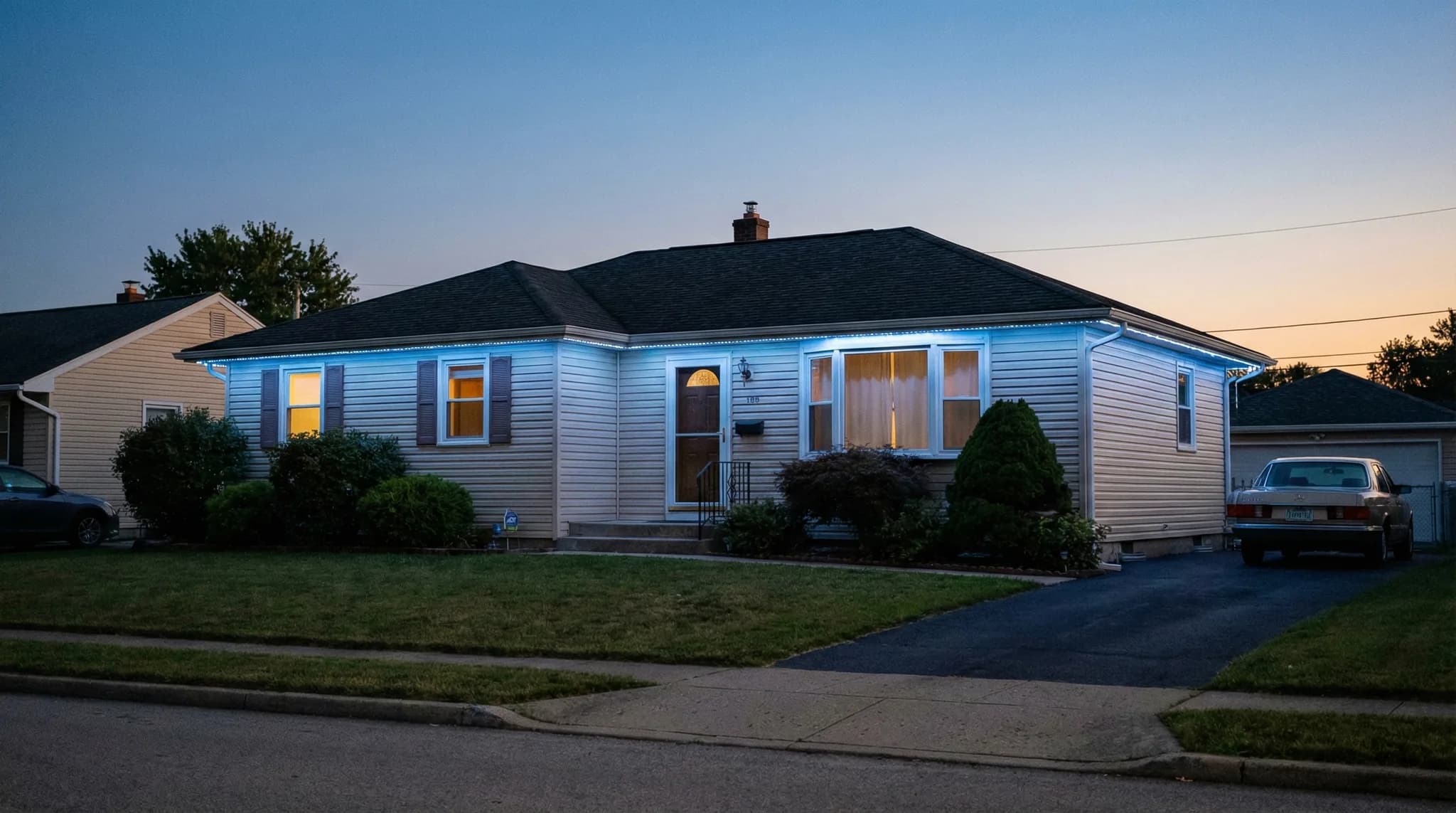
Permanent outdoor LED lights pull so little power that a small battery backup or generator can keep them running through a PG&E PSPS event – and Sacramento foothill homes are the ones most likely to need it.
Permanent outdoor lights and power outages are a real planning question for Sacramento, Roseville, and Rocklin homeowners because PG&E's Public Safety Power Shutoff (PSPS) program can de-energize entire foothill circuits for 24 to 72 hours during high wind events. The good news: a permanent LED roofline system draws so little wattage that even a small home battery, a portable power station, or a transfer-switched generator can keep the lights on through the entire outage – and most modern controllers will auto-resume the schedule the moment grid power comes back.
This guide covers exactly how PG&E PSPS events affect Sacramento-area homes, the actual watts a permanent LED system pulls, the three battery and generator backup paths that work in this climate, surge protection for the controller, and how smart-home auto-resume keeps your scheduled scenes from breaking after the grid blinks. Foothill homeowners in Folsom, El Dorado Hills, Granite Bay, Auburn, and Placerville get the most direct value here, but every Sacramento County permanent lighting customer benefits from a basic surge plan.
TL;DR: A typical Sacramento permanent outdoor LED system draws roughly 60 to 200 watts at full brightness for a whole-home perimeter, and 30 to 80 watts at the more common 50% nightly setting. That means a 1 kWh portable power station can run the lights for 5 to 15 hours, a 13.5 kWh Tesla Powerwall 3 can run them through 4 to 7 nights of PSPS, and even a 2 kW inverter generator covers them with capacity to spare. Add a whole-home or controller-level surge protector, configure the app to auto-resume on power restore, and your roofline stays functional through every PSPS event PG&E calls in 2026.
Why Sacramento Homeowners Need a PSPS Backup Plan in 2026
PG&E's Public Safety Power Shutoff program de-energizes circuits in high-fire-threat districts when the National Weather Service forecasts a combination of low humidity, high winds, and dry vegetation. According to PG&E's annual PSPS post-season reports filed with the California Public Utilities Commission, the utility has called multiple PSPS events every fire season since 2019, and in some years more than 30 unique events affecting hundreds of thousands of customers across the service territory.
Sacramento County itself sits mostly in lower fire-threat zones, so direct PSPS impacts inside the city are limited. The exposure concentrates in the eastern and northeastern foothill communities: Folsom, El Dorado Hills, Granite Bay, Loomis, Auburn, Cool, Pilot Hill, Pollock Pines, and Placerville all sit in PG&E's High Fire-Threat District Tier 2 or Tier 3 zones, which are the circuits most likely to be de-energized during a wind event. Homeowners in these areas can reasonably plan for one to four PSPS events per year lasting 12 to 72 hours each.
Even Sacramento and Roseville customers experience non-PSPS outages from storms, equipment faults, and rolling restrictions. The CPUC tracks utility reliability through SAIDI and SAIFI metrics, and PG&E's system-wide SAIDI (System Average Interruption Duration Index) in recent years has run several hours per customer per year – well above the national investor-owned utility average. Translation: every Sacramento permanent lighting install should plan for at least a few hours of outage tolerance per year, with foothill installs planning for days.
PSPS Exposure: Sacramento-Area Communities by PG&E Fire-Threat Tier
If your home sits in any of the orange or red bands above, a backup plan is not optional – it's the difference between roofline lights that quietly keep running through a 48-hour PSPS event and a controller that cold-boots into an unknown state when power returns. For a deeper look at the controller-side issues that pop up after outages, see our guide on permanent outdoor lights troubleshooting.
How Many Watts Do Permanent Outdoor Lights Actually Draw?
The answer most Sacramento homeowners are surprised by: very few. Modern channel-mounted permanent LED systems run roughly 1.5 to 2.5 watts per linear foot at full brightness, and roughly half of that at the typical 50% nightly setting. A 200-foot full-perimeter installation on a 2,500 sq ft home therefore pulls only:
- 120 to 200 watts at full 100% brightness with all colors active
- 60 to 100 watts at the more realistic 50% warm-white nightly setting
- 30 to 60 watts when running only the front roofline at moderate brightness
- 5 to 10 watts for the controller itself in idle / standby mode
For comparison, a single old-school 75-watt incandescent porch bulb uses more electricity per hour than half of a permanent LED system at typical settings. The full breakdown of monthly SMUD costs and wattage by configuration lives in our electricity cost guide for Sacramento permanent lights.
Why this matters for outage planning: backup capacity is a function of watts times hours. A 1 kWh battery (1,000 watt-hours) running an 80-watt permanent lighting load delivers 12.5 hours of run time. The same battery powering a residential refrigerator compressor (cycling at 600 watts) lasts under two hours. Permanent outdoor lights are one of the easiest loads in the entire house to back up.
Battery Backup: Tesla Powerwall, EcoFlow, and Anker SOLIX Compared
Three backup-power categories cover the realistic options Sacramento foothill homeowners actually deploy. Each has a different price point, install path, and run-time profile.
1. Whole-Home Battery (Tesla Powerwall 3, Enphase IQ Battery 5P)
A Tesla Powerwall 3 stores 13.5 kWh of usable energy and delivers up to 11.5 kW continuous. Installed cost in the Sacramento market typically runs $13,000 to $18,000 for a single-Powerwall system after permits and panel work, with federal tax credits knocking 30% off through the Residential Clean Energy Credit (currently extended through 2032 under the Inflation Reduction Act). Pair with rooftop solar and the battery recharges daily.
On a permanent lighting load alone, a single Powerwall 3 carries the system through 4 to 7 full nights of PSPS-length outage. In practice it's also keeping your refrigerator, networking, and a few outlets alive, but the lights barely move the needle on the battery's capacity budget.
2. Portable Power Station (EcoFlow Delta Pro, Anker SOLIX F3800)
A portable power station like the EcoFlow Delta Pro (3.6 kWh) or Anker SOLIX F3800 (3.84 kWh) plugs into a dedicated outdoor outlet with a manual or automatic transfer switch. Sacramento foothill homeowners use these as the sweet-spot backup option: $2,500 to $4,500 installed, no panel modification required for plug-in models, and enough capacity to run permanent lights, the WiFi router, a few lamps, and a refrigerator through a 24 to 48 hour outage.
On lighting alone, a 3.6 kWh portable battery runs an 80-watt permanent system for roughly 45 hours – longer than most PSPS events.
3. Small UPS or Power Station for Controller-Only Backup
The minimum-viable option: protect the lighting controller and the WiFi router with a small uninterruptible power supply (UPS) or a 1 kWh portable battery. The lights themselves go dark when the grid goes down, but the controller stays alive, the schedule stays loaded in memory, and the system snaps back to its programmed scene the instant utility power returns. Cost: $150 to $400. This is the right call for Sacramento and Roseville customers in low-PSPS-exposure zones.
Run Time on a Single Charge: Battery Capacity vs. Permanent LED Load
Pro Tip
When you wire a permanent lighting circuit into a battery backup, ask your electrician to put the controller and the lighting circuit on the protected sub-panel and to label the breaker clearly. During a 48-hour PSPS event you want to be able to shed the lighting load with one breaker flip if the battery gets low – without giving up the refrigerator or the WiFi.
Generator Integration: Standby vs. Portable for Sacramento Foothill Homes
Generators remain the dominant PSPS backup choice in El Dorado County and east Placer County because outage durations there can stretch past what a single battery comfortably covers. Two configurations work well with permanent outdoor lighting:
- Whole-home standby generator (Generac, Kohler, Cummins) on natural gas or propane: 14 to 26 kW units installed in Sacramento foothill markets typically run $7,500 to $15,000 with the automatic transfer switch (ATS). Permanent lighting runs through the ATS like any other circuit, with no special configuration needed. The transfer is fast enough that the controller usually rides through without rebooting.
- Portable inverter generator (Honda EU2200i, Champion 2500) with manual transfer switch: $1,200 to $2,500 installed for the generator and a 6-circuit manual transfer switch. Works fine for the lighting circuit, the WiFi, and the refrigerator. Requires you to be home to start it. Sacramento foothill homeowners with vacation-home schedules should pick standby instead.
Either way, run the generator's output through a quality online double-conversion UPS (or at minimum a high-quality surge-protected power strip) before it reaches the permanent lighting controller. Inverter generators are clean enough for sensitive electronics, but conventional generators can produce voltage waveforms that shorten controller life. A small UPS in line solves the problem for under $200.
Surge Protection: The One Upgrade Every Permanent Lighting Customer Should Add
Outages cause damage less from the dark hours and more from the moment power comes back. Grid restoration after a PSPS event or storm produces voltage spikes that can kill controllers, transformers, and individual LED nodes if the system isn't protected. The fix is straightforward and cheap relative to the cost of replacing a controller:
- Whole-home Type 2 surge protective device (SPD) installed at the main panel by a licensed electrician. Cost: $250 to $600 installed. Stops the spike before it reaches any branch circuit. This is the recommendation in NEC Article 230.67 for new and remodeled residential services.
- Point-of-use surge protector at the lighting controller (Tripp Lite, APC, Eaton). Cost: $30 to $80. Catches whatever the whole-home SPD doesn't. Combine the two for layered protection.
- Replace standard outdoor outlets with weather-resistant TR/WR receptacles rated for outdoor use, if your installation pre-dates the current NEC outdoor receptacle standards. The grounding path matters more during surges than during normal operation.
For Sacramento installs that hard-wire into the panel, a whole-home SPD is the single best surge-protection investment. For plug-in installs, the point-of-use surge protector at the controller covers the controller-killer scenario.
Smart Home Auto-Resume: How Modern Controllers Recover After an Outage
The reason permanent LED systems behave so well around outages compared to old temporary Christmas lights: modern controllers are designed to auto-resume the previously-running scene the moment power returns. The exact behavior varies by brand, but the pattern across professional systems (and the consumer-grade ones worth owning) is:
- Schedule persistence: The week-long lighting schedule lives in non-volatile memory on the controller. Power loss does not erase it.
- Real-time clock backup: A small coin-cell battery or supercapacitor on the controller board keeps time during outages so the system knows whether to resume in “evening warm white” or “late-night off” mode.
- Auto-reconnect to WiFi: When the router boots back up, the controller re-establishes its app connection within 30 to 90 seconds. Your phone regains control without any user action.
- Last-state restore: The controller resumes whatever scene was active at the time of the outage if it falls inside the current scheduled window; otherwise it skips to the next scheduled scene.
For homeowners running a deeper smart-home stack, the same auto-resume behavior propagates through Alexa, Google Home, and Apple Home routines – the lighting controller acts as a Matter, Wi-Fi, or cloud-bridged endpoint that comes back on its own. For a deeper look at the platform-by-platform behavior, see our guide on permanent outdoor lights and home automation and the broader smart permanent outdoor lights overview.
If your existing system does not auto-resume cleanly after an outage, that's usually a sign of a controller-side issue rather than a design limitation. Walk through the diagnostic flow in our troubleshooting guide before assuming the system is bad.
Putting It Together: A PSPS Plan by Sacramento Sub-Region
The right backup configuration depends almost entirely on where the home sits on the PG&E fire-threat map. A Natomas customer doesn't need a Powerwall to keep roofline lights running. A Pollock Pines customer probably does need one (or a standby generator) for non-lighting reasons, and the lights ride along for free.
| Region | PSPS Risk | Recommended Lighting Backup | Surge Plan |
|---|---|---|---|
| Sacramento, Natomas, Elk Grove | Very low | Small UPS for controller only | Point-of-use SPD ($30–$80) |
| Roseville, Rocklin, Lincoln | Low | 1 kWh portable + UPS | Whole-home SPD recommended |
| Folsom, Granite Bay, Loomis | Moderate (Tier 2 edge) | 3.6 kWh portable (EcoFlow / Anker) | Whole-home SPD required |
| El Dorado Hills, Auburn | High (Tier 2/3) | Powerwall 3 or standby generator | Whole-home SPD + point-of-use |
| Pollock Pines, Cool, Placerville | Very high (Tier 3) | Standby generator + Powerwall | Layered SPD on every entry |
For the local-install context that ties into this regional planning, the Folsom, El Dorado Hills, and Granite Bay installation guide and the Roseville and Rocklin installation guide cover neighborhood-specific HOA and architectural rules that interact with backup wiring choices.
Do Outages Shorten the Life of Permanent Outdoor Lights?
Power cycling itself does not measurably shorten LED life. The 50,000-plus hour ratings on professional permanent LED chips assume normal on/off cycles, including the one or two PSPS events a Sacramento foothill home will experience per year. What does shorten lifespan is the surge that often accompanies grid restoration, which the surge-protection layer above addresses.
The full lifespan picture – UV exposure, Sacramento summer heat, IP-rated sealing, and chip-level degradation – lives in our guide on how long permanent outdoor lights last in Sacramento's climate. The short version: outage-related risk is a tiny fraction of total lifetime risk, and a $300 whole-home SPD essentially eliminates it.
Frequently Asked Questions
Will my permanent outdoor lights work during a PG&E PSPS power outage?
Only if they are connected to a battery backup, generator, or other off-grid power source. Permanent outdoor LED lights run on standard 120V AC power, so they go dark the moment PG&E de-energizes the circuit during a Public Safety Power Shutoff. The lights themselves are fine – they simply have no power. Adding a portable power station (3 to 4 kWh runs the whole system for 40+ hours), a Tesla Powerwall, or a standby generator keeps them running through the entire event. The controller will auto-resume the scheduled scene when grid power returns.
How many watts does a permanent outdoor lighting system use?
A typical full-perimeter Sacramento installation on a 2,500 sq ft home draws roughly 120 to 200 watts at full 100% brightness, and 60 to 100 watts at the more common 50% warm-white nightly setting. The controller itself uses 5 to 10 watts in standby. By comparison, a single old-school 75-watt incandescent porch bulb uses more electricity per hour than half a permanent system at typical settings. That low draw is what makes battery backup so practical for permanent lighting.
How long can a Tesla Powerwall run permanent outdoor lights?
A single Tesla Powerwall 3 stores 13.5 kWh of usable energy. At an 80-watt permanent lighting load (typical 50% brightness on a 200-foot perimeter), that's about 168 hours of run time on lighting alone – roughly 7 nights of continuous operation. In a real install, the Powerwall is also running the refrigerator, WiFi, and selected outlets, so the lighting effectively rides along with shared backup capacity for as long as the battery lasts.
Will a standby generator damage my permanent lighting controller?
Properly installed inverter-grade or whole-home standby generators (Generac, Kohler, Cummins) produce clean enough power for sensitive electronics and pose no risk to a permanent lighting controller when run through a code-compliant automatic transfer switch. Older conventional generators can produce voltage waveforms that stress switching power supplies. The fix is a $100 to $200 line-interactive UPS between the generator output and the controller – cheap insurance for a 5-figure lighting investment.
Do I need a surge protector for permanent outdoor lights in Sacramento?
Yes, especially in foothill markets. Grid restoration after a PSPS event or wind-driven storm produces voltage spikes that can kill controllers, transformers, and individual LED nodes. A Type 2 whole-home surge protective device installed at the main panel ($250 to $600 installed) plus a point-of-use surge protector at the controller ($30 to $80) provides layered protection. NEC Article 230.67 already requires whole-home SPDs on new residential services in California, and retrofitting is straightforward for older homes.
Will permanent lights auto-restart after a power outage?
Yes, on every modern professional permanent LED system. The lighting schedule is stored in non-volatile memory on the controller, a coin-cell battery or supercapacitor preserves the real-time clock during outages, and the controller re-establishes its WiFi connection automatically when the router boots back up. Within 30 to 90 seconds of grid restoration, your roofline returns to whatever scene the schedule says should be active for the current time of day.
Outage-Resilient Permanent Lights for Sacramento Foothill Homes
EXT Lighting installs permanent outdoor LED systems across Sacramento, Roseville, Rocklin, Folsom, and El Dorado Hills with PSPS-aware wiring, controller surge protection, and integration paths for Tesla Powerwall, EcoFlow, and standby generators. Lifetime warranty on parts and labor.
Get Your Free Lighting + Backup Plan