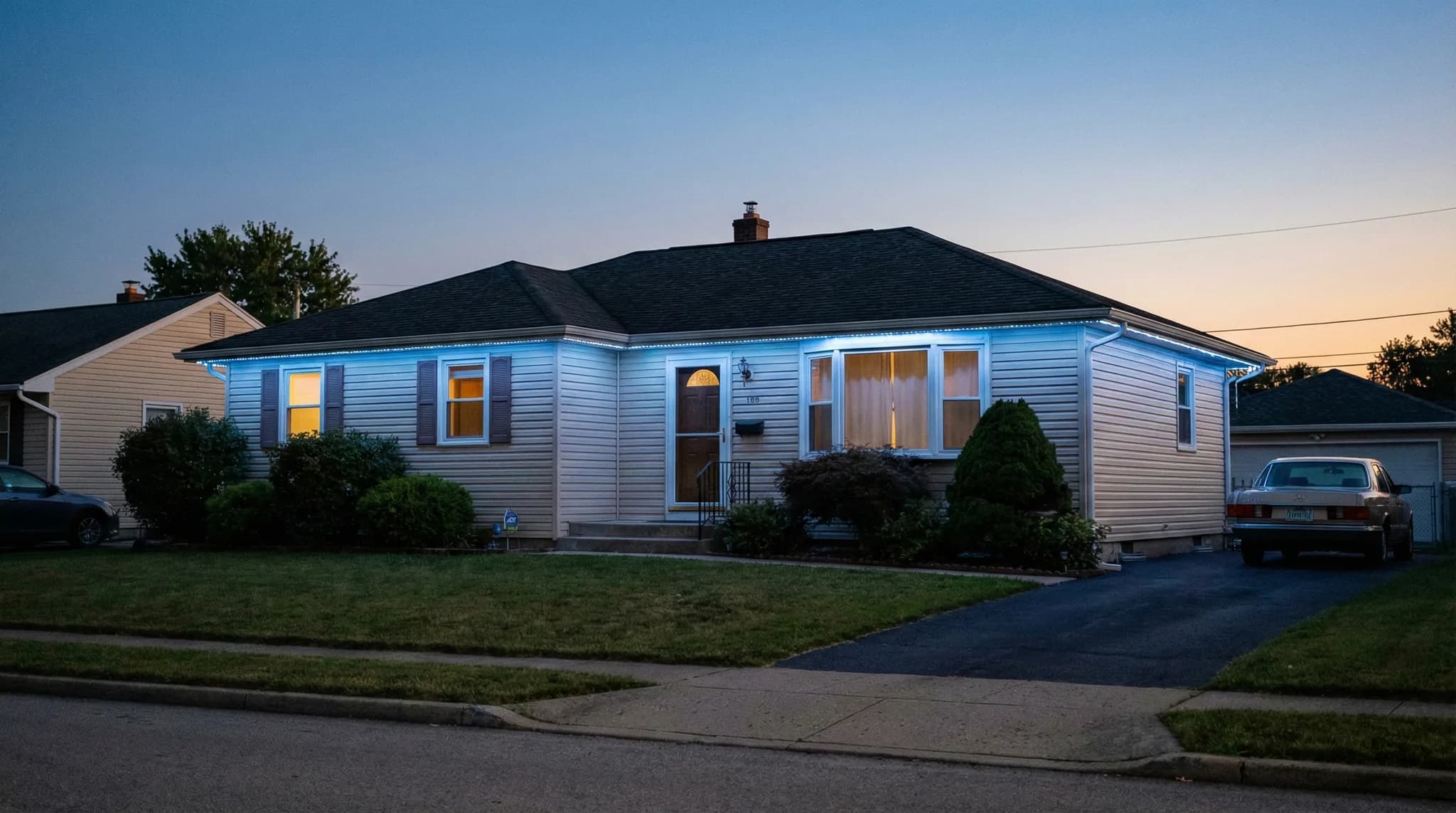
When most people think "smart home," they picture voice-controlled thermostats or streaming speakers. But smart outdoor lighting has quietly become one of the fastest-growing categories in the connected home. According to a 2024 American Home Shield survey, 93% of Americans now own at least one smart home device – and lighting ranks among the most popular additions. Permanent outdoor LED systems take that concept further, wrapping your entire roofline and exterior in app-controlled, color-changing light.
If you've been curious about how these systems actually work – not just the marketing pitch, but the real technology behind the app, the controller, and the scheduling – this guide breaks it all down. We'll walk through what happens when you tap "holiday mode" on your phone and how that signal reaches the LEDs mounted under your eaves.
TL;DR: Smart permanent outdoor lights connect to your home Wi-Fi through a controller/transformer box, giving you full app control over millions of colors, scheduling, zones, and brightness. LED technology uses roughly 75% less energy than incandescent bulbs (U.S. Department of Energy), and smart scheduling cuts waste even further. One app controls your entire exterior – no climbing ladders, no timers to reset.
Already sold on the idea and wondering about pricing? Check out our permanent outdoor lights cost guide for Sacramento homeowners for detailed numbers.
What Does "Smart" Actually Mean for Permanent Outdoor Lights?
Smart lighting adoption has reached 34% of all smart device owners, according to the same American Home Shield 2024 survey. For permanent outdoor systems, "smart" goes far beyond a simple on/off switch. It means full control from your phone, anywhere you have an internet connection.
Here's what that actually includes in practice:
- App control: Change colors, brightness, and patterns from your smartphone. No physical switch required.
- Scheduling: Set your lights to turn on at sunset and off at midnight – automatically, every night.
- Color changing: Access millions of RGBW color combinations. Go from warm white to red-and-green holiday mode in seconds.
- Zone management: Control the front roofline separately from the back patio, garage, or side accent lights.
- Scene saving: Create and save custom looks for birthdays, game days, or everyday ambiance.
The difference between "smart" permanent lights and a basic timer on your porch light is significant. A timer turns things on and off. A smart system lets you orchestrate your entire exterior from a single screen. What would you rather do on December 1st – climb a ladder, or tap a button?
How Does the Controller Work?
The global smart lighting market is projected to grow from $13.4 billion in 2024 to $35.4 billion by 2030, at a CAGR of 17.6% (MarketsandMarkets). That growth is driven partly by the simplicity of modern controller hardware. The controller is the brain of every permanent outdoor lighting system.
What the Controller Does
The controller is a small box – roughly the size of a Wi-Fi router – that mounts near your electrical panel or in your garage. It serves three functions: it steps down household voltage to safe low-voltage power for the LEDs, it connects to your home Wi-Fi network, and it translates app commands into precise electrical signals for each individual LED node.
The Wi-Fi Connection
Your controller connects to your existing home Wi-Fi, usually on the 2.4GHz band for better range through walls. Once connected, it communicates with the manufacturer's cloud server. When you open the app on your phone, your command goes from phone to cloud to controller to LEDs. The whole process takes under a second.
Worth noting: 46% of smart device issues are Wi-Fi or connectivity related (American Home Shield, 2024). A strong Wi-Fi signal near the controller location matters. If your garage is a dead zone, a mesh extender solves the problem. Professional installers typically test signal strength during the installation process before mounting anything permanent.
Where It Gets Installed
Most Sacramento homeowners have the controller installed in their garage, a utility closet, or near an existing outdoor-rated outlet. The unit needs a standard 120V outlet and a clear path for the low-voltage wiring that runs to the LED track along your roofline. In our experience, garage installs work best because they're protected from Sacramento's summer heat and occasional heavy rain, while keeping the wiring path short and clean.
What Can You Do in the App? A Feature Walkthrough
With 88% of smart device owners believing their devices are worth the money (American Home Shield, 2024), the app experience matters. Permanent outdoor lighting apps pack a surprising amount of control into a straightforward interface. Here's what you're actually working with.
Color Selection
RGBW (red, green, blue, white) LED nodes produce millions of color combinations. Most apps use a color wheel or palette interface. You can pick exact shades – Sacramento Kings purple, a specific shade of amber for autumn, or crisp daylight white for everyday security lighting. The "W" in RGBW adds a dedicated warm or cool white channel, so white tones look natural rather than washed out.
Preset Holiday Themes
Every major system ships with preloaded holiday patterns: red and green for Christmas, red-white-and-blue for the Fourth of July, orange and purple for Halloween, pastels for Easter. Some apps include animated effects – slow fades, chasing patterns, twinkling. You can switch between holidays in seconds without touching a single bulb.
Custom Scene Saving
Beyond presets, you can build and save your own scenes. Hosting a birthday party? Set alternating pink and gold. Supporting your kid's school colors for homecoming? Save it, name it, and recall it anytime. Most apps let you store dozens of custom scenes.
Zone Control
During installation, the LED track is divided into zones. A typical Sacramento home might have four to six zones: front roofline, left side, right side, back patio overhang, garage accent, and maybe a soffit zone. Each zone can display a different color, brightness, or pattern independently. You could run warm white on the back patio while the front is in full holiday mode.
Brightness Adjustment
A simple slider controls brightness from 0% to 100% – per zone or for the whole system. Dim the lights to a subtle glow for a quiet evening on the patio. Crank them up for a party. This kind of flexibility is something traditional Christmas lights simply can't match. For a deeper comparison, see permanent lights vs. Christmas lights.
How Does Scheduling and Automation Work?
According to American Home Shield's 2024 survey, 60% of smart device owners say the technology has saved them money. For outdoor lighting, scheduling is the primary way that happens. Set it once, and the system runs itself.
Dusk-to-Dawn Automation
Most apps include astronomical clock integration. The system knows your GPS location and calculates exact sunset and sunrise times for Sacramento each day. Your lights turn on precisely at dusk and off at dawn – no manual adjustment needed as the seasons shift. In June, that's roughly 8:30 PM. In December, closer to 4:50 PM. The system adapts automatically.
Time-Based Schedules
You can also set fixed time schedules. A popular setup among Sacramento homeowners: accent lighting at 50% from sunset until 11 PM, then security lighting at 20% from 11 PM to 6 AM, then off until the next evening. Some homeowners in Land Park and East Sacramento run a soft warm white year-round, switching to holiday colors only during the season.
Vacation Mode
Traveling? Your lights still run on schedule, making it look like someone's home. Some systems offer a randomization feature that varies the exact on/off time by a few minutes each night, mimicking natural behavior. We've found that homeowners who travel frequently rank this as one of the top reasons they chose smart permanent lights over traditional timers.
What Can You Control from Your Phone?
The permanent outdoor lighting segment is expected to reach $3 billion by 2025 (Grand View Research), driven largely by the depth of app-based control these systems offer. Here's a quick breakdown of what's at your fingertips.
| Feature | How It Works | Typical Use |
|---|---|---|
| Color Selection | RGBW color wheel with millions of combinations | Match team colors, holidays, or everyday ambiance |
| Brightness | 0–100% slider, per zone or whole system | Dim for evenings, full brightness for events |
| Scheduling | Astronomical clock or fixed time triggers | Auto on at sunset, off at midnight |
| Zone Control | Independent control of 4–6+ wired zones | Different colors front vs. back patio |
| Preset Themes | Preloaded holiday and seasonal patterns | One-tap switch for Christmas, Halloween, etc. |
| Custom Scenes | Save your own color/brightness combos | Birthday parties, school spirit nights |
| Remote Access | Cloud connection via Wi-Fi | Control from work, vacation, anywhere |
| Effects / Animation | Fading, chasing, twinkling patterns | Animated holiday displays, party mode |
What Are the Most Common Questions About Smart Outdoor Lighting?
Since 46% of smart device problems are connectivity-related (American Home Shield, 2024), many homeowner questions center on reliability. Here are the questions we hear most often from Sacramento residents considering permanent smart lighting.
Does It Need Wi-Fi to Work?
Yes, for full app control. The controller connects to your home Wi-Fi to receive commands from the cloud. However, most systems retain their last programmed schedule locally. So if your Wi-Fi goes down, the lights still follow their existing schedule – you just can't make changes until the connection returns.
What Happens During a Power Outage?
The lights turn off, just like any other electrical device. When power returns, the controller reboots and reconnects to Wi-Fi automatically. Your saved schedules and scenes are stored in the controller's memory, so nothing is lost. The system picks up where it left off.
Can Multiple People Control the System?
Yes. Most apps allow multiple users to connect to the same system. Each family member can install the app on their phone and control the lights independently. Some systems offer permission levels, so you can give guests limited access without full admin control.
Can I Control the Lights When I'm Away from Home?
Absolutely. As long as your home Wi-Fi is working and the controller is powered on, you can adjust your lights from anywhere with an internet connection. Sitting at your office in downtown Sacramento or on vacation in Hawaii – the app works the same. For more answers to common concerns, visit our FAQ page.
How Do Smart Permanent Lights Compare to Smart Bulbs Like Philips Hue?
Homebuyers are willing to pay an average of $2,633 more for a smart-equipped home, with 29% of buyers indicating that premium (American Home Shield, 2024). But not all smart lighting is the same. Permanent outdoor systems and smart bulbs like Philips Hue solve very different problems.
The Core Difference
Smart bulbs are individual units. You screw them into existing fixtures, and each bulb connects to Wi-Fi or a hub independently. That works great indoors, where you have a handful of lamps and overhead lights. Outdoors, the math falls apart. A typical roofline needs 100 to 200 individual light points. Managing 200 separate smart bulbs – each with its own connection, firmware updates, and potential failure points – would be a nightmare.
Permanent outdoor lighting systems take a fundamentally different approach. One controller manages a continuous track of LED nodes. Each node is addressable individually, but they're all wired together and managed as a unified system through a single app. It's the difference between managing a fleet of 200 taxis and running one subway line.
Installation and Permanence
Smart bulbs are DIY. Permanent outdoor lights are professionally installed, mounted in a track channel under your roofline or soffit. They're designed to stay up for 15+ years. No seasonal installation, no storage boxes, no tangled strings. Curious about how long they last? We cover durability in detail here.
Cost Perspective
A single Philips Hue outdoor bulb runs $30–$50. Multiply that by 150 bulbs, add the hub, and you're looking at $5,000–$8,000 in equipment alone – with no professional installation, no weatherproofing guarantee, and a significant maintenance burden. A professionally installed permanent system typically falls in a similar price range but includes everything. Check our Sacramento cost guide for exact pricing.
How Much Energy Do Smart Permanent Outdoor Lights Actually Use?
LED lighting uses approximately 75% less energy than incandescent bulbs, according to the U.S. Department of Energy. For permanent outdoor systems, that baseline efficiency gets amplified by smart scheduling – you only run lights when you actually want them on.
What Does It Actually Cost to Run?
A typical permanent LED system for a Sacramento home draws between 100 and 300 watts at full brightness – roughly equivalent to running two to five standard light bulbs. At Sacramento's average SMUD residential rate of approximately $0.12 per kWh, running a 200-watt system for six hours per night costs about $0.14 per day, or roughly $4.30 per month. That's less than a single latte.
How Smart Scheduling Reduces Waste
Without smart scheduling, outdoor lights tend to follow one of two patterns: they stay on all night (wasteful), or someone forgets to turn them on at all (pointless). Automated dusk-to-midnight scheduling eliminates both problems. You get six hours of light per night instead of twelve, cutting energy use in half compared to a dusk-to-dawn setup. Dimming to 30% after 10 PM saves even more.
Compared to Traditional Christmas Lights
Traditional incandescent Christmas lights on a similar-length roofline draw 800–1,500 watts. Running those for six hours nightly during December costs roughly $18–$33 for the month. A permanent LED system running the same hours at the same brightness costs under $5. Over a full year of nightly use, the LED system costs around $50 in electricity. We've found that most homeowners are surprised at how little these systems add to their SMUD bill. Want to see a full breakdown of the long-term value? Read our ROI analysis.
Frequently Asked Questions
Do smart permanent outdoor lights work with Alexa or Google Home?
Many systems offer voice assistant integration, but it varies by manufacturer. Some connect directly; others require a compatible hub or IFTTT setup. The primary control method is always the manufacturer's own app, which provides the fullest feature set. Voice control typically handles basic on/off and brightness – not complex color patterns or zone management.
How reliable is the Wi-Fi connection for outdoor lights?
Since the controller is installed indoors (usually in the garage), it connects to your home network like any other device. The 2024 American Home Shield survey found that 46% of smart device issues are Wi-Fi related, but most of those stem from weak signals. A controller placed within 30 feet of your router, or supported by a mesh network, rarely has connection problems.
Can I install smart permanent lights myself?
It's technically possible, but not recommended. Professional installation ensures proper mounting, weatherproof wiring, correct voltage, and optimal zone configuration. DIY mistakes with roofline work risk both the product and your safety. Most manufacturers require professional installation to honor their warranty. Learn more about how the process works in our installation guide.
What happens if a single LED node fails?
Individual LED nodes can be replaced without removing the entire track. Quality systems use addressable LEDs wired in parallel, so one failed node doesn't knock out the rest of the line. A technician can swap a single node in minutes. Most permanent LED systems are rated for 50,000+ hours of operation, so failures are uncommon. See our durability guide for more on lifespan.
Is app-controlled outdoor lighting worth the premium over basic LEDs?
For most homeowners, yes. The 2024 American Home Shield survey found that 88% of smart device owners consider their devices worth the money. The convenience of one-tap holiday themes, automated scheduling, and remote control adds daily value that basic LEDs simply can't provide. The smart features typically add $200–$500 to the total system cost – a modest premium for years of functionality.
Ready to Make Your Outdoor Lighting Smarter?
Smart permanent outdoor lighting isn't complicated. A controller connects to your Wi-Fi, an app puts millions of colors and automated scheduling at your fingertips, and professionally installed LED nodes handle the rest for years. The technology is proven, the energy costs are minimal, and the convenience factor is hard to overstate once you've experienced it.
Sacramento homeowners in Midtown, Land Park, Folsom, Granite Bay, El Dorado Hills, and Roseville are already running these systems year-round. Whether you want subtle warm white every evening or a full light show for the holidays, it starts with a single controller and one app on your phone.
Explore our residential lighting services or commercial solutions to see what's possible for your property. Ready to get specific numbers? Request a free quote and we'll walk through exactly what your home needs.