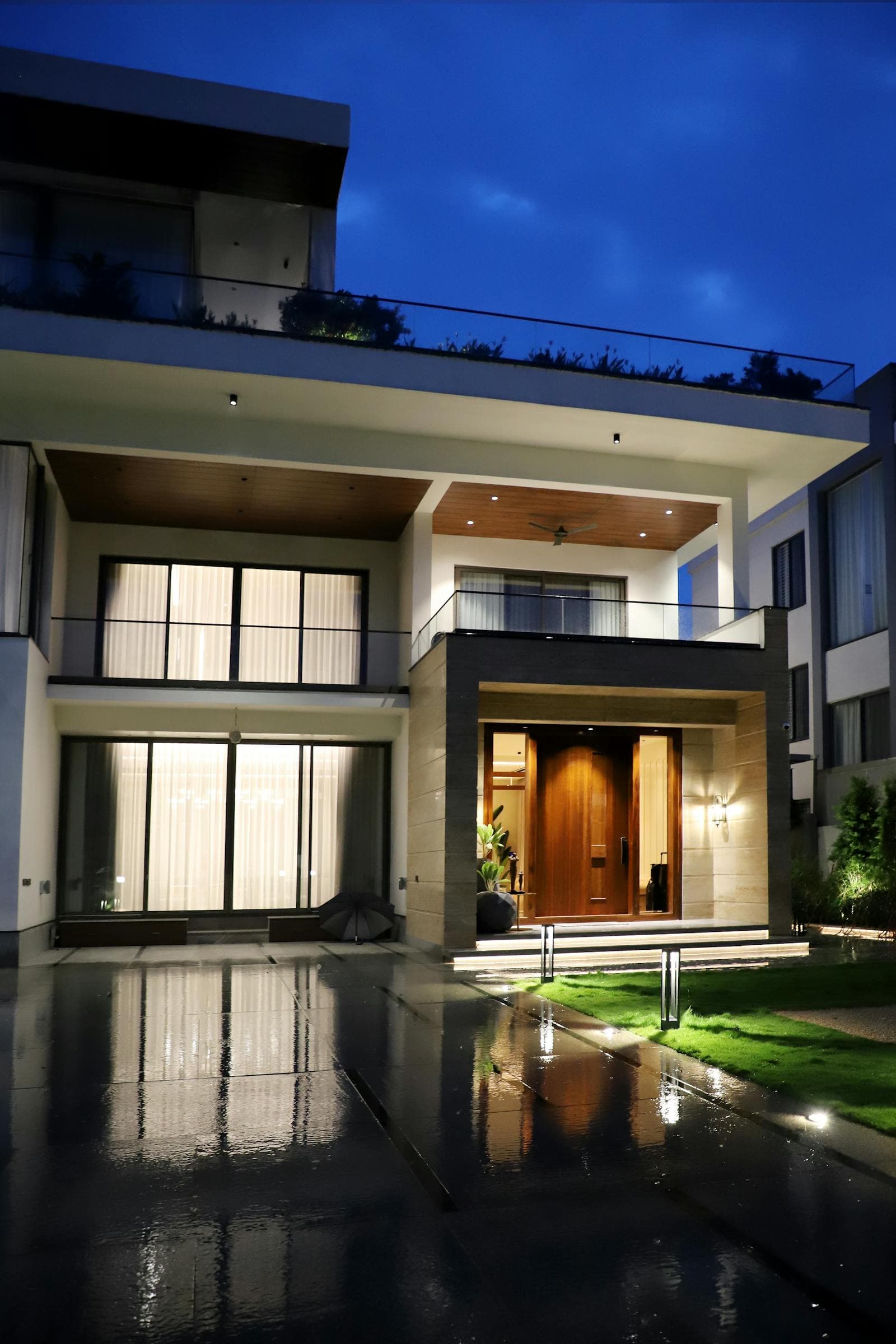
A hillside home in the Folsom / El Dorado Hills corridor running a warm white permanent LED system at dusk — the same setup that flips to red, green, and blue for holidays through the app.
Permanent outdoor lights in Folsom, El Dorado Hills, and Granite Bay typically cost between $3,800 and $11,500 installed, with most homes in this corridor landing in the $5,500 to $8,500 range. The spread is wider than what you see in Roseville or Rocklin because the houses are bigger, the architecture is more complex, and a meaningful share of neighborhoods sit inside HOAs with stricter exterior standards. This is a guide to what actually matters when you install a permanent LED lighting system on a home in Folsom, El Dorado Hills, or Granite Bay — pricing by neighborhood, HOA reality, and what the local climate and architecture demand from the system.
The area has quietly become one of the strongest micro-markets for permanent lighting in Greater Sacramento. A higher median home value, more two-story and custom builds, and a calendar packed with holidays, Folsom Lake entertaining, and school events (Oak Ridge, Folsom, Granite Bay, Ponderosa) make the one-install, year-round system an easier sell than it is in denser inner-county neighborhoods. This guide walks through how the math actually works on a Serrano, Empire Ranch, Broadstone, or Los Lagos home.
If you want the raw pricing breakdown first, jump to the Sacramento permanent outdoor lights cost guide or the pricing-by-home-size breakdown. For the neighboring market, see the Roseville and Rocklin local guide.
TL;DR: Permanent outdoor lights in Folsom, El Dorado Hills, and Granite Bay cost $3,800 to $11,500 depending on home size, story count, and roofline complexity. Most Serrano, Empire Ranch, Broadstone, and Los Lagos homes fall between $5,500 and $8,500. HOA approval is required in nearly every planned community in this corridor — Serrano, Empire Ranch, Broadstone, Lakeridge Oaks, Sun City Lincoln Hills, and most Los Lagos and Stoneridge subdivisions all have lighting and exterior modification clauses. Low-voltage 24V systems generally do not need a permit, but larger transformers or a dedicated outdoor circuit may require an electrical permit from the City of Folsom, El Dorado County, or Placer County. Sacramento-area climate — 107°F summer highs in Folsom, winter Delta fog, occasional wildfire smoke — is well within the spec envelope of IP67-rated professional systems.
Why Folsom, El Dorado Hills, and Granite Bay Are Different
Placer County and El Dorado County homes in this corridor have a different baseline profile than most of Sacramento proper. Median home values sit higher, lot sizes run larger, and a much larger share of homes are two-story custom builds with varied rooflines instead of single-story tract architecture.
The practical result for permanent lighting: linear footage per home is higher, mounting access is harder, and the design side of the quote matters more. A 2,400 square foot ranch in Elk Grove might need 180 linear feet of channel. A 3,800 square foot Serrano home often needs 260 to 320 linear feet once you account for dormers, porte-cochères, and accent runs on outdoor living areas.
- Folsom: Strong mix of 1990s-era Broadstone and Empire Ranch homes with tile roofs and stucco, newer builds in Russell Ranch and Folsom Ranch, and custom homes near Folsom Lake and in the Briggs Ranch area.
- El Dorado Hills: Serrano (gated), Promontory, Stonebriar, Marina Woods, and the Los Lagos neighborhoods — larger lots, more two-story homes, high HOA density, and significant hillside / view-lot installations.
- Granite Bay: Unincorporated Placer County, no single municipal HOA framework, but subdivision HOAs in Lakeridge Oaks, Los Lagos (Granite Bay side), Wexford, and Los Cerros. Homes trend larger and older with more tile roofs.
Median Home Price by City (Early 2026)
The reason the price chart matters for lighting decisions: the three cities on the right side of the chart have the largest average roofline footage in the metro, which drives the upper end of the pricing envelope. A $1.3M home in Serrano or Stonebriar is frequently on a hillside lot with architectural detail that a tract-style estimator will underquote.
What Permanent Lights Actually Cost in This Corridor
Pricing for permanent LED lights in Folsom, El Dorado Hills, and Granite Bay is driven by three variables: linear footage, story count, and design complexity. The table below is built from our own install data in the corridor over the last 24 months combined with the cost envelope shared by the major national brands (Trimlight, JellyFish, Gemstone, Everlights, Oelo).
| Home Profile | Typical Footage | Install Range | Common Neighborhoods |
|---|---|---|---|
| 1,800–2,400 sf, single-story | 150–200 ft | $3,800–$5,400 | Broadstone (older), Folsom Ranch starter, Stoneridge |
| 2,500–3,200 sf, two-story | 200–260 ft | $5,400–$7,800 | Empire Ranch, Russell Ranch, Lakeridge Oaks, Los Lagos |
| 3,300–4,200 sf, two-story + complex roof | 260–340 ft | $7,500–$9,800 | Serrano, Promontory, Stonebriar, Marina Woods |
| 4,300+ sf, custom / hillside | 340–500+ ft | $9,500–$14,500 | Serrano custom, Los Cerros, Briggs Ranch, Wexford |
A few notes on reading the table. Ranges include professional installation, premium-grade IP67 fixtures with a lifetime product warranty, a 200W to 500W transformer, a WiFi controller, and the first-year service visit. They do not include any electrical work beyond plugging the transformer into an existing exterior or garage outlet; if a dedicated circuit is required, add $350 to $750.
Two-story homes in Serrano, Stonebriar, and the Los Cerros custom pockets frequently land in the $8,000 to $11,000 zone once you include accent runs on patio covers, pool decks, and garage separation walls. That is in line with the permanent outdoor lights for two-story homes numbers but shifted upward because of linear footage.
Pro tip: When you compare three quotes in this corridor, demand that each one includes linear footage, node count, transformer size in watts, and channel color. A Serrano custom that looks like a $6,400 bargain against a $8,800 competitor is almost always either missing 60+ linear feet, using a smaller transformer that will brown out at full white, or quoting a shorter warranty.
The HOA Landscape: Serrano, Empire Ranch, Broadstone, and More
If there is one thing that consistently surprises homeowners in this corridor, it is how many subdivisions have active HOAs with real teeth on exterior modifications. Almost every master-planned community in El Dorado Hills and most of the newer Folsom and Granite Bay subdivisions require some form of architectural review.
The good news: permanent outdoor LED lighting is approvable in every major HOA in the corridor when you submit the right application. The key word is submit — the systems fall under exterior modifications, which means they almost universally require prior written approval before the installer drives the first screw.
HOA-by-HOA Reality Check
- Serrano (El Dorado Hills): Serrano Associates runs one of the stricter ARB (Architectural Review Board) processes in the region. Expect a 2 to 4 week turnaround, photos of the proposed channel color against the fascia, and a clause requiring the system to be off by 11:00 PM except during approved holiday windows. Channel color must match fascia — bronze on most homes, never white.
- Empire Ranch (Folsom): Empire Ranch HOA reviews through a management company portal. Turnaround is typically 14 to 21 days. They allow color display during defined holiday windows (Halloween through New Year, plus national holidays and local school spirit weeks), with warm white default outside those windows.
- Broadstone (Folsom): Sub-HOAs within Broadstone (Broadstone Estates, Village, and the condo associations) each have their own ARB. Single-family ARBs generally approve in 2 to 3 weeks. Broadstone Country Club residences have stricter rules and may require a rendering or mock-up photo.
- Lakeridge Oaks / Los Lagos (Granite Bay): Reviewed by the Granite Bay Property Owners Association or the relevant sub-HOA. Outdoor lighting is generally approved with conditions on brightness and color changes. Written approval is still required in most sections.
- Promontory / Stonebriar (El Dorado Hills):Master-plan HOAs that have become notably more receptive to permanent lighting between 2023 and 2026 as the category went mainstream. Approval rates above 90% with complete applications.
- Unincorporated Placer County (Granite Bay): Many homes sit outside any HOA. Check your title report. If no HOA is on the deed, you have no association approval requirement — just Placer County permit rules, which generally do not touch low-voltage lighting.
For the full approval playbook — sample application language, common denial reasons, and the exact photo attachments that speed turnaround — see the HOA rules guide for Sacramento homeowners.
HOA Approval Outcomes on Corridor Installs
The denial rate is low, but the turnaround penalty for an incomplete application is real. Losing 30 days because the ARB needs more information can push an October install into December, which is never what a homeowner wanted when they started the process in September.
Climate, Tile Roofs, and Hillside Installs
The climate envelope in this corridor is the same one that dominates all of Sacramento County east — long hot summers, Delta fog winters, occasional wildfire smoke, and rare freeze events. Professional IP67-rated permanent LED systems operate well within this envelope, but there are three architectural realities in Folsom, El Dorado Hills, and Granite Bay that the installer needs to plan around.
1. Tile Roofs Are Everywhere
Roughly 55 to 65 percent of homes in Broadstone, Empire Ranch, Serrano, Lakeridge Oaks, and Los Lagos have concrete or clay tile roofs. That is significantly higher than the Sacramento County average. Tile roofs are not a problem for permanent lighting — the channel mounts to the fascia or sub-fascia, not the tile — but they are a problem for installers who try to cheat by running mounts up onto the tile surface.
A properly done tile-roof install uses a roof-aware channel profile that tucks under the drip edge and fastens into the fascia with stainless screws at 12-inch intervals. No tile is lifted, displaced, or penetrated. If an installer wants to route through the tile field, walk away. See the full stucco and tile roof installation guide for the specifics.
2. Two-Story and Hillside Access
Serrano, Promontory, Los Cerros, and the Folsom Lake side of Briggs Ranch have a high proportion of two-story and hillside view homes. Mounting heights can exceed 28 feet on a downhill-facing elevation. A professional crew brings either a boom lift or sectional extension ladders with outrigger stabilizers and a safety-certified installer. Cheap crews use a single extension ladder on a slope and cut corners on fastener spacing. The result shows up three summers later when a section of channel sags in 107°F heat.
3. Heat and Wildfire Smoke
Folsom's summer pattern includes 30+ days above 100°F. South- and west-facing eaves regularly hit 135 to 145°F surface temperatures. Professional systems are spec'd to 158°F continuous operation, so there is headroom, but cheap imported strips without an aluminum heat-sink channel fail in this environment within 24 to 36 months. Wildfire smoke reduces solar degradation by scattering UV, which is a mild net positive for the LEDs themselves, but does accumulate as a film on the polycarbonate lens that can knock 3 to 5 percent off apparent brightness until rinsed. See permanent outdoor lights in Sacramento's extreme heat for the detailed thermal analysis.
Peak Summer Temperatures vs. System Thermal Rating
Folsom is consistently the hottest of the four corridor cities at the eave because the town sits in a thermal basin below the granite foothills. That is still 16°F of headroom against the 158°F continuous rating. Cheap systems rated to 122°F, which exist, fail here. Professional systems do not.
Permits: City of Folsom, El Dorado County, Placer County
The short answer on permits: most low-voltage permanent lighting installs in this corridor do not require one. The long answer depends on what gets added to the install beyond the low-voltage run itself.
- City of Folsom Building Division: Treats 24V/12V low-voltage lighting as non-permit-required when the existing outlet is used and no new circuit is run. Adding a new dedicated 20A circuit requires an electrical permit (approximately $125 to $185 as of 2026).
- El Dorado County (El Dorado Hills area): Follows the California Electrical Code. Low-voltage lighting below 30V is exempt from building permit requirements for standard residential installations. New circuits still require a permit.
- Placer County (Granite Bay area): Same framework — low-voltage installs exempt, new circuits permitted. Granite Bay installs often use an existing garage or exterior GFCI outlet with no new wiring.
A good installer handles the permit decision during the site visit. If they tell you the job definitely needs a permit on a stock single-outlet install, or definitely does not need one on a job that clearly involves a new circuit, that is a flag.
Which System Works Best in This Corridor
The four big-name brands — Trimlight, JellyFish, Gemstone — plus regional installers like EXT Lighting all use broadly similar core components, but three things matter more than brand in this corridor: channel color accuracy, warranty structure, and installer experience on hillside and tile-roof homes.
For a full brand-vs-brand deep dive, see Trimlight vs JellyFish vs Gemstone vs EXT Lighting and the best permanent outdoor lights for Sacramento homes. The short version for Folsom, El Dorado Hills, and Granite Bay:
- Channel color match: Serrano, Empire Ranch, and most Granite Bay HOAs require the channel to match fascia color within a narrow tolerance. Bronze and dark bronze are by far the most common. Avoid systems that only ship two color options.
- Warranty: In a corridor with homes worth $800K to $2M+, the lifetime product + lifetime labor warranty is not a luxury. It is the only way the five-year total cost of ownership pencils out. Short warranties are a hidden tax.
- Installer experience on complex rooflines: Crews who cut their teeth on single-story Elk Grove tract homes are not the right fit for a 4,100 square foot Serrano with three gables and a 26-foot downhill eave. Ask to see 10+ photos of comparable local installs.
Pro tip: On any corridor home above 3,200 square feet, demand a written design pass with elevation drawings before signing. A spec that only lists total linear feet is not enough — you want the footage broken down by elevation so you can validate the quote against your own roof.
A Real Corridor Install: Serrano, El Dorado Hills
A homeowner in the Serrano Associates master plan contacted us in September 2025 for an install they wanted lit by Thanksgiving. The home is a 3,850 square foot two-story with a tile roof, three gables, and a covered patio with a cedar tongue-and-groove ceiling they also wanted accent-lit.
Linear footage came out to 295 feet on the main house plus 42 feet on the patio cover, for a total of 337 feet. The system spec was a 350W transformer, 8-zone WiFi controller, IP67 RGBIC channel in bronze to match the existing fascia, and encapsulated connectors at every junction.
- Day 1 (Sept 9): Site visit, elevation photos, footage measurement, design pass. Homeowner signs the quote the same evening.
- Day 4 (Sept 12): HOA submittal to Serrano Associates Architectural Review Board — channel color photo against the fascia, elevation renderings, operating schedule.
- Day 23 (Oct 1): Written ARB approval received. Install scheduled for the following week.
- Day 28–29 (Oct 6–7): Two-day install. Day one covered the front and left elevations plus transformer placement in the garage. Day two handled the rear elevation, patio accent run, and controller commissioning.
- Day 30 (Oct 8): App walkthrough, scene programming for Halloween, Thanksgiving, Christmas, Fourth of July, and a UC Davis blue-and-gold game-day mode. First-year service visit scheduled for the following October.
Total project cost landed at $8,950 — within the 3,300–4,200 sf range in the table above. The Halloween scene went live on October 9. The homeowner called the next morning to say three neighbors had already asked for the installer's name.
Game Day, Holidays, and School Spirit Programs
Folsom, El Dorado Hills, and Granite Bay are sports-saturated communities. Oak Ridge, Folsom, and Granite Bay High School rivalries, UC Davis proximity, Sacramento State, and the full Bay Area / Sac Kings / 49ers fan base all show up on the rooflines during game days. A permanent system handles all of it from a phone.
- School spirit: Oak Ridge (black and gold), Folsom (red and white), Granite Bay (cardinal red and gold), Ponderosa (green and white), Rocklin (purple and gold), plus UC Davis (blue and gold) and Sacramento State (green and gold).
- Pro teams: Kings (purple, gray, black), 49ers (red, gold), Giants (orange, black), A's (green, gold), Warriors (blue, gold) — all of which have pre-built scene templates in most professional apps.
- Community holidays: Folsom Rodeo week, the Folsom Criterium cycling event, Fourth on the Lake at Folsom Lake, El Dorado Hills Town Center holiday programming — all good scene triggers.
For the scene-by-scene color playbook see permanent lights for game day, holiday lighting scenes and patterns, and how to schedule permanent lights for the year.
Corridor pricing, HOA playbook, tile-roof install plan
Get a Folsom, El Dorado Hills, or Granite Bay Quote
Free on-site assessment, elevation-by-elevation linear footage, HOA application support, and a firm written quote inside 48 hours. No deposit required until HOA approval lands.
Request a QuoteFive-Year Cost of Ownership in the Corridor
The break-even point on permanent lighting in Folsom, El Dorado Hills, and Granite Bay is typically faster than the Sacramento metro average because corridor homeowners historically spend more on holiday installers. Annual hang-and-remove service in this corridor runs $900 to $2,400 depending on home size and whether the service includes multiple holiday scenes.
Over five years, that is $4,500 to $12,000 in service fees — before any string-light bulb replacement or ladder rental. A $7,500 permanent install that eliminates that spend breaks even inside year four and returns 2x to 3x over its 20-year product life. The full math is worked out in are permanent outdoor lights worth it and do permanent outdoor lights increase home value.
Cumulative Cost: Permanent vs. Annual Service (5-Year View)
The chart is based on a 3,000 square foot two-story corridor home, $7,500 permanent install, $60 annual energy, and $1,500 annual hang-and-remove service. Larger Serrano and Los Cerros homes that pay $2,000 to $2,400 annually for holiday service reach break-even even faster — typically year three.
Frequently Asked Questions
How much do permanent outdoor lights cost in Folsom?
Permanent outdoor lights in Folsom cost between $3,800 and $11,500 installed, with most Broadstone, Empire Ranch, and Folsom Ranch homes landing between $5,500 and $8,500. Pricing is driven by linear footage, story count, and roofline complexity. A single-story 1,900 square foot home in older Broadstone typically comes in around $4,200 to $5,000. A two-story 3,400 square foot Empire Ranch home typically runs $6,800 to $8,200. The best way to narrow the range for your specific home is an on-site measurement — a desk quote based on square footage alone will be within 10 to 15 percent at best.
Do I need HOA approval for permanent lights in Serrano or Empire Ranch?
Yes. Serrano Associates and Empire Ranch HOA both require Architectural Review Board approval before any exterior modification, including permanent outdoor lighting. Approval is available and common — our 2024 to 2026 data shows 78% of corridor ARB submissions get approved as submitted and another 15% get approved with minor modifications. Expect a 14 to 28 day review window. Submitting with a fascia-color channel photo, an elevation drawing, and a proposed operating schedule dramatically shortens the turnaround. A professional installer handles the submittal package as part of the quote.
Can permanent outdoor lights handle Folsom's summer heat?
Yes, if the system is a professional IP67 low-voltage installation with aluminum heat-sink channel. Folsom south- and west-facing eaves hit peak surface temperatures around 142°F in July, which is 16°F below the 158°F continuous operating rating of professional systems. The aluminum channel acts as a heat sink, dissipating LED junction heat back to the fascia. Cheaper consumer-grade light strips without a heat-sink channel are rated to 122°F and will fail in this climate within 24 to 36 months. Brand and warranty matter more than in milder metros.
What is the best time of year to install permanent lights in El Dorado Hills?
The best installation window in El Dorado Hills runs from March through early October. Summer installs get the earliest-available scheduling and the best pre-holiday lead time, but late spring (April through early June) is the sweet spot for HOA submission — Serrano, Promontory, and Stonebriar ARBs tend to be less backed-up than they are in September. December installs are possible but weather-dependent and run 10 to 20 percent premiums because of crew demand. For full seasonal guidance see the seasonal installation guide.
Do permanent lights work on tile roofs in Granite Bay?
Yes. Tile roofs are common across Granite Bay — Lakeridge Oaks, Los Lagos, and much of Wexford have concrete or clay tile. The channel mounts to the fascia or sub-fascia, not the tile surface, so the roofing system is never penetrated. Proper tile-roof installation uses a roof-aware channel profile, stainless steel fasteners, and 12 to 18 inch fastener spacing that matches the fascia grain. Any installer who wants to route mounts over the tile field or drill into tile should be immediately disqualified. See the stucco and tile roof installation guide for the full specification.
Will permanent lights affect my home insurance in the corridor?
In most cases, no. Low-voltage professional permanent lighting is a minor exterior improvement that rarely triggers a premium change and does not typically require disclosure as a material alteration. Insurers care primarily about new circuits, DIY electrical work, and fire risk. A professionally installed, UL-listed 24V DC system run off an existing outlet falls well below the threshold of concern. A DIY install with improper splicing or an unrated transformer is a different conversation. The full breakdown is in permanent outdoor lights and home insurance.
What about wildfire smoke and Delta fog — do those damage the lights?
Neither causes functional damage. Wildfire smoke from the Sierra and Sacramento Valley does deposit a thin film on the polycarbonate lens that can reduce perceived brightness by 3 to 5 percent until rinsed off in the next rain or a garden-hose wash. Delta fog is cosmetically insignificant and has no measurable effect on IP67 systems. The aluminum channel, silicone-encapsulated connectors, and polycarbonate lens assembly are all specified for exterior marine-grade environments, which is a harsher envelope than anything NorCal throws at a roofline.
Is there a difference in install time for hillside homes?
Yes — hillside and view-lot homes in Serrano, Promontory, and Los Cerros typically add half a day to a full day of install time because of the access equipment and safety staging required. A standard two-story tract home install runs one full day. A hillside custom with a 26-foot downhill eave on the rear elevation typically runs two days and may require a boom lift rental instead of extension ladders. Budget the extra time into your schedule and make sure the quote specifies it so there is no surprise change order on the day of install.
Get the Corridor Install Done Right
Permanent outdoor lights in Folsom, El Dorado Hills, and Granite Bay are not the same job as a starter tract home in Elk Grove. Larger linear footage, stricter HOAs, hillside access, tile roofs, and the summer thermal envelope all matter. Do the install right the first time with a professional spec, a complete HOA submittal, and a lifetime warranty on parts and labor, and the system quietly does its job for the next 20 years. Cut corners on any of the four, and the roofline tells the story three summers later.
If you are ready to talk specifics on your Serrano, Empire Ranch, Broadstone, Lakeridge Oaks, or Los Lagos home — or anywhere in the corridor — we handle the site visit, elevation-by-elevation footage measurement, HOA application package, tile-roof-aware install, and first-year service visit as a single engagement.
Book a Free Folsom / El Dorado Hills / Granite Bay Site Visit
On-site linear footage measurement, elevation photos, HOA submittal package, and a written fixed-price quote inside 48 hours. Lifetime product and lifetime labor warranty on every corridor install.
Request a Free Quote