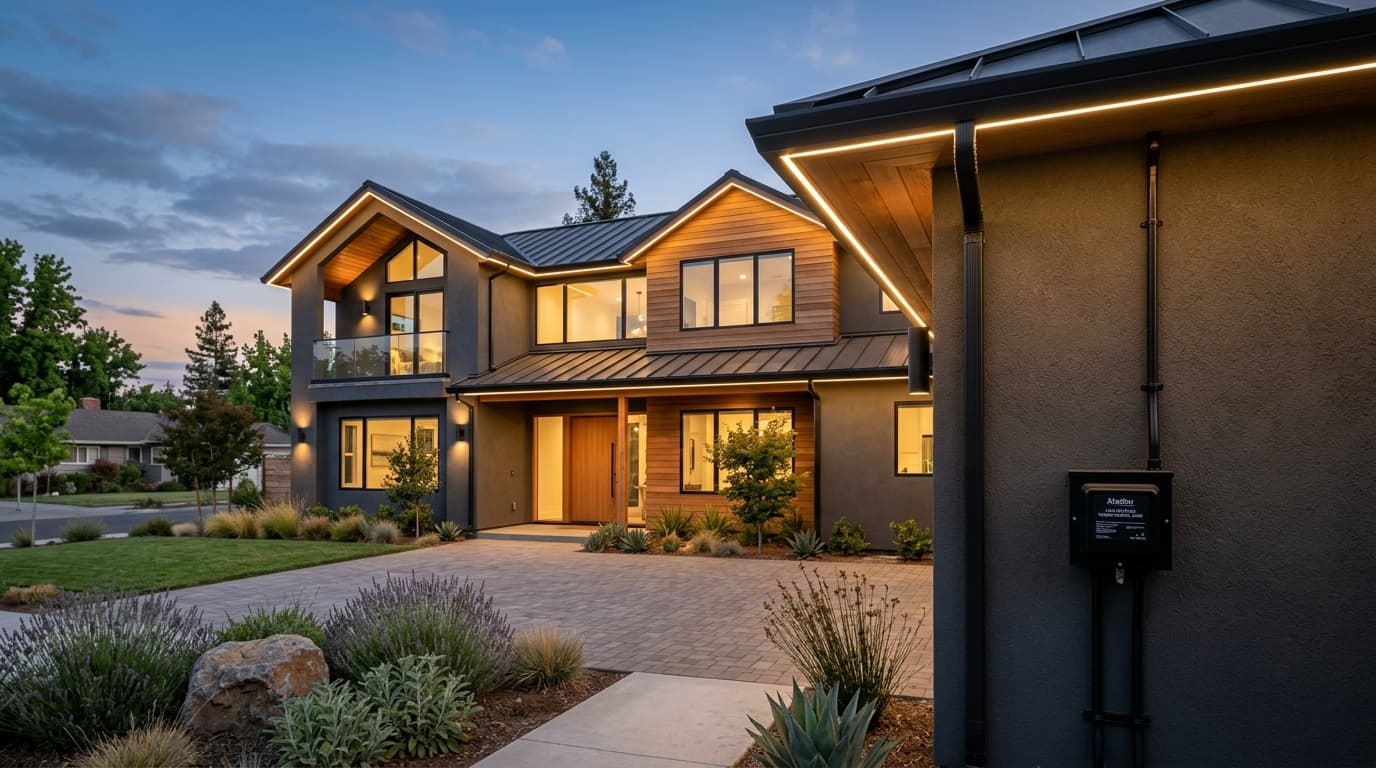
Permanent outdoor LED systems run on low voltage (12V or 24V DC) fed from a transformer that steps down 120V household power – the same fundamental design used by every major brand on the Sacramento market.
Low voltage permanent outdoor lights are safer, code-simpler, and more practical for residential rooflines than high voltage systems. Every major permanent LED brand sold in Sacramento – Trimlight, JellyFish, Gemstone, EverLights, and Oelo – runs on 12V or 24V DC delivered through a transformer wired to a single 120V circuit. High voltage (120V) outdoor lighting still has a place, but it is almost always limited to commercial wall packs, post lights, and flood fixtures – not roofline LED systems.
This matters because the voltage decision drives almost everything else: NEC code requirements, transformer sizing, wire gauge, voltage drop, wet-location ratings, and whether your installer needs to pull a permit with the City of Sacramento or Placer County. Get it wrong and you end up with dim ends of runs, tripped breakers, or a system the inspector flags during a home sale.
Roseville and Rocklin homeowners ask about this almost every week, usually because they researched landscape lighting first and read about voltage drop, or because a handyman quoted a 120V flood-light retrofit for less than a real permanent outdoor light system. The cheaper number is rarely the safer or longer-lasting one.
TL;DR: Permanent outdoor LED roofline systems use low voltage (12V or 24V DC) for a reason – it is safer in wet locations, falls under NEC Class 2 limited-energy rules, and allows long, exposed runs along the eaves without conduit. High voltage (120V) systems require permits, conduit, GFCI protection, and a licensed electrician, and they offer no real benefit for roofline LEDs. The only fair comparison is for area lighting: floods, post lights, and wall packs, where 120V still wins on throw distance. For Sacramento residential permanent lights, low voltage is the right answer in 95% of installations.
Low Voltage vs. High Voltage Permanent Outdoor Lights: Full Comparison
Before getting into NEC code, transformer sizing, and voltage drop, here is the side-by-side comparison Sacramento homeowners ask about most. This contrasts low voltage (12V/24V DC) permanent LED systems with high voltage (120V AC) outdoor lighting.
| Factor | Low Voltage (12V/24V) | High Voltage (120V) |
|---|---|---|
| Typical Use Case | Permanent roofline LEDs, landscape lighting, path lights | Flood lights, wall packs, post lights, security lights |
| NEC Classification | Class 2 (limited energy, NEC Article 411 / 725) | Standard branch circuit (NEC Article 210, 410) |
| Shock Hazard | Negligible (below 30V touch-safe threshold) | Serious; lethal current possible |
| Conduit Required Outdoors? | No (Class 2 wiring methods) | Yes (UF cable, EMT, or PVC; varies by AHJ) |
| GFCI Required? | GFCI on the 120V side feeding the transformer | Yes, all outdoor 120V receptacles (NEC 210.8) |
| Permit / Licensed Electrician | Usually no permit; low voltage installer OK | Permit and licensed electrician for new circuits |
| Wet Location Safety | Inherently safer; touch-safe even when wet | Requires sealed wet-location-rated fixtures |
| Voltage Drop Sensitivity | High – must size wire and runs carefully | Low – 120V tolerates long runs easily |
| Max Practical Run Length | ~100 ft per leg (12V), ~200 ft (24V) | 500+ ft with proper wire gauge |
| Used By Permanent LED Brands | Trimlight, JellyFish, Gemstone, EverLights, Oelo | None of the major roofline LED systems |
| Installed Cost (Sacramento) | $3,000 – $8,000 for whole-home roofline | $400 – $1,200 per flood/wall pack circuit |
NEC references based on the 2023 National Electrical Code as adopted by the California Electrical Code (Title 24, Part 3).
The biggest takeaway: low voltage and high voltage are not really competing for the same job. Low voltage owns roofline LEDs and landscape lighting. High voltage owns area floods and wall packs. Most Sacramento homes end up with both – a permanent low voltage roofline system plus a couple of 120V security floods on the garage and back patio.
How 12V and 24V Permanent LED Systems Actually Work
Every permanent outdoor LED system sold in Sacramento – regardless of brand – uses the same basic architecture:
- 120V circuit from your home's panel feeds a GFCI-protected outlet or dedicated junction box, usually in the garage or attic.
- Low voltage transformer / power supply (sometimes called a driver) steps 120V AC down to 12V or 24V DC. This is the same kind of Class 2 power supply used for LED strip lighting and landscape lights.
- Controller takes the DC output from the transformer and adds the data signal that tells each LED chip what color and brightness to display. On most systems, the controller talks to the app over Wi-Fi or Bluetooth.
- LED track (an aluminum channel mounted under the fascia or shingle line) carries both power and data to each individual LED node. Nodes are typically spaced 3 to 6 inches apart.
- RGB, RGBW, or RGBIC LED nodes light the roofline. Each node draws a fraction of a watt; a whole roofline typically totals 50 to 150 watts at full brightness.
Because the entire run from the transformer outward is low voltage DC, the wiring along your eaves is touch-safe and not considered a shock hazard under NEC Article 411. That is the whole reason the industry standardized on 12V and 24V instead of running 120V to the roofline.
Notice how the 120V wiring stops at the transformer. Everything from the transformer outward to the roofline is 12V Class 2 wiring – the same category as doorbell wiring or a thermostat cable. That is why a permanent lighting installer can attach wiring to the underside of your fascia without conduit, junction boxes, or a building permit.
NEC Code Requirements for Outdoor Lighting in Sacramento
The National Electrical Code (NEC) is the foundation of California's electrical code (California Code of Regulations Title 24, Part 3). Sacramento County, the City of Sacramento, Roseville, and Rocklin all enforce it. The code treats low voltage and high voltage outdoor lighting completely differently.
Low Voltage (Class 2) – NEC Article 411 and 725
Permanent LED systems fall under NEC Article 411 (Low-Voltage Lighting Systems) when the secondary side is 30V or less and the power supply is listed as Class 2. The relevant rules:
- The transformer must be listed as Class 2 (UL 1310) or be a listed Class 2 power supply
- Maximum output of 100VA per Class 2 circuit (NEC 725.121)
- Output cannot exceed 30V under any condition
- Class 2 wiring on the secondary side does not require conduit, even outdoors, and can run exposed under fascia and trim
- The 120V primary side must be installed per standard branch circuit rules: GFCI-protected (NEC 210.8(A)), in a wet-location rated enclosure if outdoors, and on a dedicated or shared circuit sized for the load
For most Sacramento homes, this means a single 15A or 20A circuit feeding a GFCI receptacle in the garage or attic, with the transformer plugged in or hardwired right next to it. No new outdoor 120V wiring leaves the conditioned space.
High Voltage (120V) – NEC Article 210 and 410
For 120V outdoor lighting like floods, wall packs, and post lights:
- All outdoor 120V receptacles must be GFCI-protected (NEC 210.8(A)(3))
- Wet-location-rated fixtures and weatherproof in-use covers required (NEC 406.9)
- Wiring must be in conduit (EMT, PVC, or rigid) or use UF (underground feeder) cable rated for direct burial
- New circuits trigger a permit with the City of Sacramento Building Division or the relevant AHJ in Roseville, Rocklin, or unincorporated Placer County
- Must be installed by a licensed C-10 electrical contractor in California for any work touching the panel or branch circuit
This is the core reason permanent LED brands chose low voltage. A professionally installed permanent lighting system can be completed in a single day by a low voltage contractor with no permit, no inspector visit, and no panel work. A 120V equivalent would require trenching, conduit, an electrical permit, and probably two trade visits.
Pro Tip
Ask any installer for the UL listing on the transformer they plan to use. A legitimate permanent LED system uses a UL 1310 Class 2 listed transformer. If they cannot tell you, or they hand you a generic AC adapter pulled from a parts bin, walk away. The listing matters for both safety and home insurance coverage if anything ever fails.
How to Size a Low Voltage Transformer for Permanent LED Lights
Transformer sizing is the single most common failure point in DIY and budget installations. Undersized transformers run hot, shorten LED life, and cause dim or flickering nodes. Oversized transformers waste money and shelf space but rarely cause failures.
The sizing formula is simple. Add up the wattage of every LED node, multiply by 1.25 for headroom, and pick the next-larger transformer.
Example: A typical Sacramento single-story ranch with 150 linear feet of roofline gets roughly 600 LED nodes at 4 inches on center. At 0.15 watts per node at full white, that is 90 watts of LED load. Multiply by 1.25 = 112.5 watts. You would specify a 150W or 200W 12V Class 2 transformer.
Two-story home example: 280 linear feet of roofline plus a second-story dormer adds another 90 nodes. Total load: about 165 watts. After the 1.25 safety factor, you need a 220W transformer minimum – in practice, installers will use a 300W unit or split the load across two 150W transformers in different zones for cleaner voltage drop control.
Why the 25% Headroom Matters
LEDs draw their highest current at full white at maximum brightness. Most of the time, your roofline is showing color scenes or dimmed warm white, well under the rated load. But the transformer needs to handle the worst case – a holiday display flashing pure white at 100% – without sagging. The 1.25 multiplier is the same factor the NEC uses for continuous loads (NEC 210.19).
Single vs. Multiple Transformers
Long rooflines and complex shapes are usually wired with two or more transformers. This serves two purposes: it keeps each leg of the run short enough to control voltage drop (covered in the next section), and it provides redundancy so a single transformer failure does not kill the whole system. Most two-story Sacramento homes end up with two transformers: one for the front and one for the back.
Voltage Drop: The Hidden Reason Cheap Installs Fail
Voltage drop is the gradual loss of voltage along a wire run caused by the wire's own resistance. At 120V, dropping 5 volts over 100 feet is invisible. At 12V, dropping 2 volts is the difference between a bright white LED and a dim, color-shifted one.
The math is simple Ohm's Law. For a 100-foot run of 14 AWG wire carrying 8 amps:
- 14 AWG resistance: ~2.5 ohms per 1,000 ft
- Round-trip resistance for 100 ft: 2 x 100 x 2.5 / 1000 = 0.5 ohms
- Voltage drop: 8A x 0.5 ohms = 4.0 volts
- At the far end of the run: 12V – 4V = 8V (33% drop)
That 33% voltage drop turns a crisp 6500K white into a sickly yellow-orange and can cause individual LED chips to flicker or fail early. The NEC recommends keeping voltage drop under 3% for branch circuits (Informational Note to NEC 210.19) – for 12V LED runs, professional installers target 5% to 10% maximum.
This is why 24V systems – like JellyFish and several pro-grade Trimlight builds – have become more popular for long single-story rooflines. Doubling the voltage cuts the current in half for the same wattage, which cuts voltage drop by roughly half for the same wire gauge.
How Pro Installers Manage Voltage Drop
- Multiple transformers: Split a long roofline into two or three zones, each fed by its own transformer
- Power injection points: Re-feed the LED track at midpoints to refresh the voltage along long runs
- Heavier wire on long legs: Use 12 AWG or even 10 AWG for the trunk runs to the first node
- Higher voltage systems: Pick a 24V system on two-story homes or rooflines over 150 ft
- Hub-and-spoke layouts: Wire short branches from a central feed point instead of one long daisy-chain
DIY adhesive-mount kits like Govee skip almost all of this. They ship one short transformer cord and one strip of LEDs and assume the customer will plug it in and be done. That works on a 30 ft garage. It does not work on a 200 ft Sacramento two-story.
Wet Location Safety: Why Low Voltage Wins in Sacramento Weather
Sacramento gets roughly 18 inches of rain per year, almost all of it concentrated between November and March (NOAA Western Regional Climate Center). Add irrigation overspray, dew, and the occasional atmospheric river and your roofline wiring is wet for weeks at a time during winter.
Low voltage Class 2 wiring is inherently safer in wet conditions for one reason: at 12V or 24V DC, a person who touches a live wire with wet hands receives a current well below the threshold of perception. The OSHA and NEC threshold for "touch-safe" is 30V or less. By design, Class 2 systems cannot exceed it.
High voltage (120V) outdoor lighting has to overcome that hazard with hardware: wet-location-rated fixtures, sealed conduit, GFCI protection that trips within 25 milliseconds of detecting a fault, and weatherproof in-use covers (commonly called "bubble covers") over receptacles. All of that hardware works – but it is one more thing that can fail.
For homeowners with kids, pets, or anyone who climbs on the roof for maintenance and cleaning, the inherent safety of low voltage is a real selling point. There is no scenario in which touching a permanent LED node delivers a dangerous shock.
When High Voltage (120V) Outdoor Lighting Still Makes Sense
Low voltage wins for permanent roofline LEDs, but it loses badly in a few specific use cases. Here is when a 120V outdoor light is the right answer:
- High-output flood lights: Motion-activated security floods that produce 2,000+ lumens are far easier to drive at 120V. Low voltage flood fixtures exist but cost more and need beefy transformers.
- Long throw distances: Lighting a 50 ft driveway or back yard from a single fixture mounted on a pole or eave is a 120V job. Low voltage cannot push enough lumens that far.
- Commercial wall packs: Office buildings, warehouses, and apartment complexes use 120V or 277V wall packs for parking lot perimeter lighting. See our commercial permanent outdoor lighting guide for the comparison.
- Pole-mounted lights: Driveway entry lights, street-style post lights, and lamp posts almost always run 120V because conduit and burial depth are already required.
- Existing 120V outdoor circuits: If you already have a 120V outdoor circuit in good condition (GFCI, conduit, permitted), it makes sense to use it for floods or accent fixtures even when the rest of your system is low voltage.
The cleanest Sacramento setups combine both: a permanent low voltage LED system handling the architectural roofline lighting and a pair of 120V LED floods on the garage and back patio for motion-activated security. The two systems do completely different jobs and there is no reason to force one technology to do both.
Cost Comparison: Low Voltage vs. High Voltage in Sacramento
Pricing depends on what you are actually trying to accomplish, so here are the realistic Sacramento installed costs broken out by use case:
- Whole-home permanent LED roofline (low voltage): $3,000 to $8,000, with most single-story homes landing at $3,500–$5,000 and most two-story homes at $5,500–$8,000
- Single 120V LED flood light (new circuit): $400 to $1,200 per fixture installed, including permit and electrician labor
- 120V wall pack on existing circuit: $200 to $500 per fixture installed
- Low voltage landscape lighting (separate system): $1,500 to $4,500 for path lights, uplights, and a transformer
On a per-fixture basis, 120V floods look cheaper than a permanent LED system. But you are not buying the same product. A whole-home permanent system gives you 600 to 2,000 individually addressable LEDs along the entire roofline with 16+ million colors and app control. Two flood lights give you 4,000 lumens of fixed white light pointed at one part of the yard. They are not interchangeable.
For the full pricing breakdown by home size and roofline length, see our Sacramento permanent outdoor lights cost guide.
Not Sure Which Voltage System Fits Your Sacramento Home?
Get a free assessment from EXT Lighting. We'll measure your roofline, calculate transformer sizing and voltage drop, and show you exactly what a permanent LED system looks like on your home – with no obligation.
Get Your Free Quote12V vs. 24V Permanent Outdoor Lights: Which Low Voltage Wins?
Within the low voltage world, the bigger debate is 12V vs. 24V. Both are Class 2 systems. Both fall under the same NEC rules. The difference is mostly about run length and wire cost.
12V systems are the older standard, used by Trimlight Classic, original Gemstone installs, and most landscape lighting. They tolerate run lengths of about 75 to 100 feet per leg before voltage drop becomes a problem with standard 14 AWG wire.
24V systems are the newer standard for permanent roofline LEDs, adopted by JellyFish, modern Trimlight pro builds, and most commercial-grade installations. The math is simple: doubling the voltage halves the current for the same wattage, which cuts voltage drop in half. A 24V system can run 150 to 200 feet per leg with the same wire gauge.
When to Pick 12V
- Single-story homes with rooflines under 150 ft total
- Existing transformer or wiring infrastructure is 12V
- Budget builds where 12V hardware is significantly cheaper
- Mixed installations sharing power with 12V landscape lights
When to Pick 24V
- Two-story homes or rooflines over 150 ft
- Wraparound porches or complex roof shapes
- Commercial installations
- Anywhere you want fewer transformers for cleaner installs
Neither is "safer" than the other – both are well below the 30V touch-safe threshold. The choice is purely engineering.
Common Failure Modes: What Goes Wrong with Each System
After thousands of permanent LED installs across Sacramento, Roseville, and Rocklin, the failure patterns are predictable. Here is what we see most often when troubleshooting permanent outdoor lights:
Low Voltage System Failures
- Undersized transformer: Cheap installer used a 150W transformer for a 200W load; system runs hot, dim, and dies in 2 to 3 years
- Voltage drop at far ends: Long runs without power injection or heavier wire cause yellow-shifted color and flickering at the end of the run
- Loose Class 2 connections: Push-fit connectors on the LED track work loose over time; symptom is intermittent dropouts on one segment
- Transformer water intrusion: Outdoor transformers installed without a proper enclosure get water inside during atmospheric rivers; usually fails completely
High Voltage System Failures
- GFCI nuisance trips: Wet weather causes the GFCI to trip; entire outdoor circuit goes dark
- Failed weatherproof covers: Bubble covers crack in UV; receptacles fill with water
- Conduit infiltration: Underground PVC conduit fills with water through unsealed joints; corrodes wire over years
- Ground fault from rodent damage: Mice and squirrels chew through outdoor wire insulation, creating dangerous faults
The pattern is clear: low voltage failures are usually annoying but not dangerous. High voltage failures can be both annoying and dangerous, which is why GFCI protection is mandatory.
The Verdict: Which Voltage Should Sacramento Homeowners Choose?
For permanent outdoor LED roofline lighting, low voltage is the only serious answer in 2026. Every major brand on the market uses it. Every pro installer in Sacramento installs it. The NEC code rules favor it. The wet-location safety story favors it. The installation timeline favors it.
Choose low voltage (12V or 24V) if:
- You want a permanent LED roofline system on your home
- You value Class 2 touch-safe wiring under your eaves
- You want the install completed in a single day, no permit
- You want app control, color changes, and holiday scenes
- You want a system that adds real curb appeal value to your home
Choose high voltage (120V) if:
- You need motion-activated security floods
- You are lighting a long driveway or large back yard
- You are installing pole-mounted entry lights
- The job is commercial wall packs or parking area lighting
Most Sacramento homes end up with both, used in their respective zones. The best installers will help you mix the two cleanly – a permanent low voltage system on the architectural rooflines, a pair of 120V floods on the garage gable, and maybe a 12V landscape kit for the front beds.
Frequently Asked Questions
Are permanent outdoor lights low voltage or high voltage?
Every major permanent outdoor LED system – Trimlight, JellyFish, Gemstone, EverLights, and Oelo – is a low voltage system that runs on either 12V or 24V DC. A transformer mounted near the home's electrical panel steps 120V household power down to low voltage, then feeds it through the LED track along the roofline. The wiring on the roof itself is touch-safe Class 2 wiring under NEC Article 411.
What is the difference between 12V and 120V outdoor lights?
12V lights run on low voltage DC produced by a transformer; they are Class 2 limited-energy systems under the NEC, do not require conduit outdoors, and are touch-safe even when wet. 120V lights run directly on household AC power; they require GFCI protection, weatherproof fixtures, conduit or UF cable, and a permitted licensed electrician for new circuits. 12V is used for permanent LED roofline systems and landscape lighting; 120V is used for floods, wall packs, and post lights.
Do permanent outdoor lights need a permit in Sacramento?
Low voltage permanent LED installations generally do not require an electrical permit in Sacramento, Roseville, or Rocklin because they are Class 2 systems plugged into an existing GFCI outlet. If a new 120V circuit needs to be added to feed the transformer, that circuit work may require a permit and a licensed C-10 electrical contractor under California rules. Always confirm with your local building department or installer.
How do I size a transformer for permanent outdoor LED lights?
Add up the wattage of every LED node on your system, multiply by 1.25 for safety headroom, and pick the next-larger Class 2 transformer. For example, a 150 ft single-story Sacramento roofline with about 600 nodes draws roughly 90W at full white; with the 25% multiplier, you would specify a 150W or 200W transformer. Two-story homes and rooflines over 200 ft usually need two transformers split into zones for cleaner voltage drop control.
Is voltage drop a problem with 12V outdoor lights?
Yes, voltage drop is the main engineering challenge with 12V systems. At 12V, even a 1 to 2 volt drop along a long run causes noticeable color shift and dimming at the far end. Pro installers manage it by using multiple transformers, power injection points, heavier wire gauges (12 AWG or 10 AWG on trunk runs), or by stepping up to a 24V system. The NEC recommends keeping voltage drop under 3% for branch circuits; for 12V LED systems, 5% to 10% is the practical target.
Are low voltage outdoor lights safe in the rain?
Yes. Low voltage Class 2 systems operate well below the 30V touch-safe threshold, so even a fully wet wire cannot deliver a dangerous shock. The transformer itself must be installed in a wet-location-rated enclosure or indoors, and the 120V circuit feeding it must be GFCI-protected, but the entire low voltage side of the system is designed to be exposed to weather. Sacramento winters average 18 inches of rain per year and properly installed permanent LED systems handle it without issue.
Can I install a 120V outdoor light circuit myself in California?
Generally, no. California requires any new branch circuit work to be performed by a licensed C-10 electrical contractor for the work to be code-compliant and insurable. Homeowners can perform electrical work on their own primary residence under specific exemptions, but most jurisdictions still require a permit and inspection. Low voltage permanent LED installation does not have this restriction because it falls under Class 2 limited-energy rules.
Ready for a Properly Engineered Permanent LED System?
EXT Lighting installs code-compliant, properly sized permanent outdoor LED systems on Sacramento, Roseville, and Rocklin homes. We handle transformer sizing, voltage drop math, and wet-location safety so you do not have to. Schedule a free property assessment.
Schedule Your Free Assessment