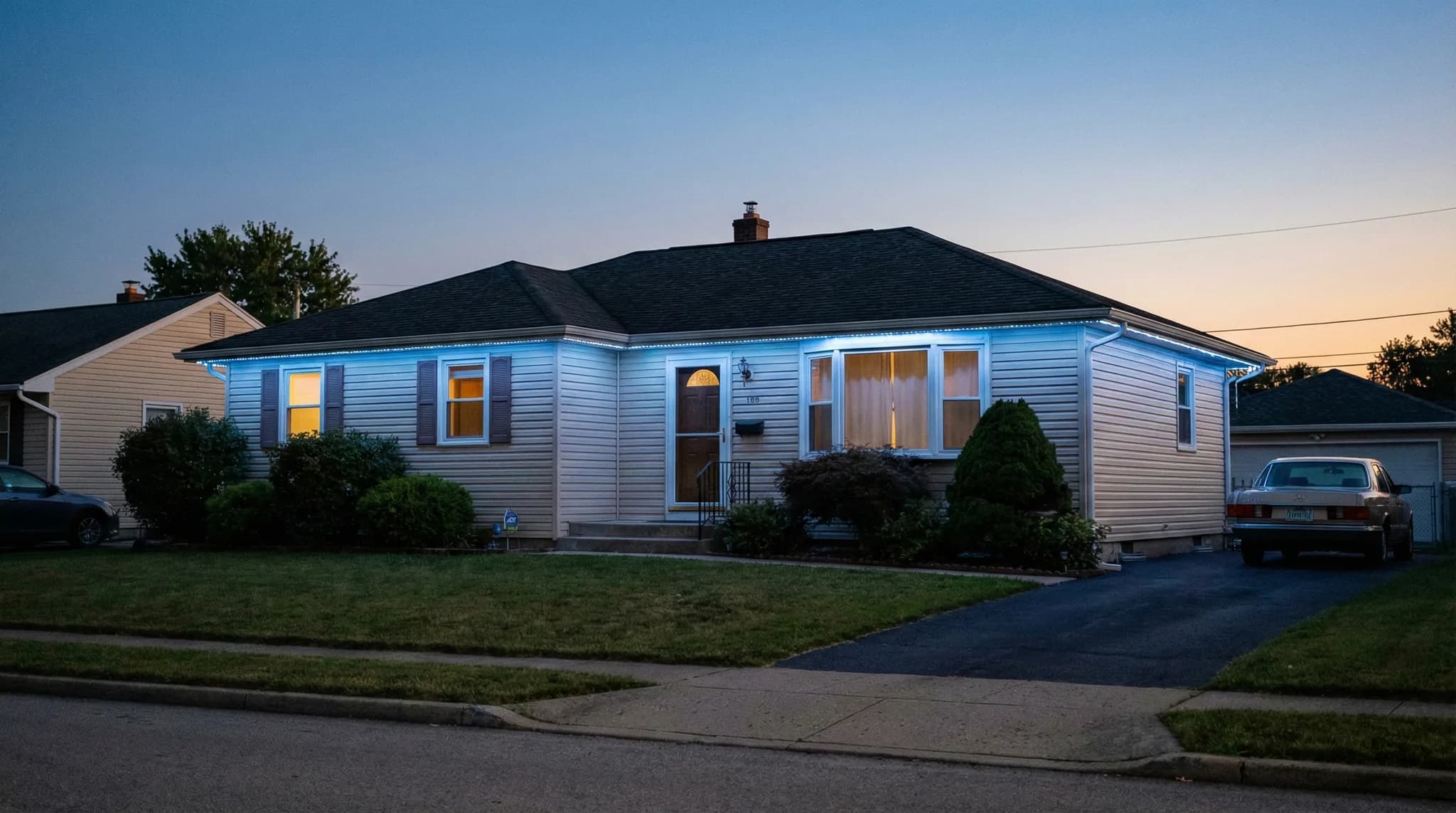
The global landscape lighting market hit $12.49 billion in 2023 and keeps climbing (Grand View Research, 2024). But a newer category — permanent LED systems mounted along rooflines — is growing even faster as homeowners look for year-round versatility beyond garden accents.
If you own a home in Sacramento, you've probably wondered which approach makes more sense. Ground-level landscape fixtures that highlight your yard? Or an app-controlled roofline system that handles holidays, security, and everyday curb appeal in one shot?
This post breaks down the two options head to head — real installation costs, energy bills at SMUD rates, lifespan, smart features, and home value impact — so you can decide which fits your property and budget.
TL;DR: Landscape lighting ($2,000–$4,500) illuminates gardens and pathways from ground level. Permanent LED systems ($3,000–$8,000) mount along rooflines for year-round color-changing architectural lighting. Permanent systems cost more upfront but eliminate annual holiday lighting expenses and offer app-controlled customization. Choose landscape for garden accents; choose permanent for whole-home versatility.
What Is the Difference Between Landscape and Permanent Outdoor Lights?
Landscape lighting sits at ground level — path lights, well lights, uplights, and spotlights positioned throughout your yard. Permanent outdoor lights are LED track systems mounted directly along rooflines, fascia, and soffits. The global outdoor lighting market is projected to reach $29.6 billion by 2030 (Grand View Research, 2024), driven partly by the rise of these permanent architectural systems.
Landscape fixtures serve a focused purpose. They draw attention to garden beds, line walkways, uplight trees, and accent water features. Most use warm white LEDs in the 2700K–3000K range. Some newer smart bulbs offer limited color options, but the core design intent is subtle, ground-level ambiance.
Permanent systems take a different approach entirely. Think Trimlight, Jellyfish, or the track-style systems companies like EXT Lighting install. These mount flush against your roofline, stay up all year, and connect to a controller that unlocks millions of RGB colors, programmable scenes, and scheduling through a phone app.
So what's the real difference in daily life? Landscape lights make your yard look polished after dark. Permanent lights transform your entire home's exterior — patriotic themes for the Fourth of July, orange and purple for Halloween, warm white for Tuesday night, all without climbing a ladder or swapping a single bulb.

Landscape lighting illuminates pathways and garden features from ground level. Photo: Pexels
For inspiration on color scenes and seasonal themes, check out our guide to the best permanent outdoor lighting colors.
How Much Does Each System Cost to Install?
Professional landscape lighting installation averages $2,000 to $4,500 nationally, with individual fixtures running $100 to $200 each (LawnStarter, 2026). Permanent LED systems range from $3,000 to $8,000 total, or roughly $20 to $40 per linear foot (HomeGuide, 2025). Both numbers shift based on your property's specifics.
For Sacramento homeowners, EXT Lighting's residential installations typically land between $3,000 and $6,000. That covers a single-story to mid-size two-story home with full roofline coverage, controller, and app setup. Larger or more complex rooflines push toward the higher end.
Landscape lighting costs depend heavily on fixture count. A basic 10-fixture path and accent package might run $2,000. A 20-plus fixture design with uplights, well lights, and a multi-zone transformer can hit $4,500 or more. Wiring burial adds labor, especially in established yards with mature root systems.
What Affects the Price of Each System?
For permanent LED systems, the biggest cost drivers are linear footage of roofline, the number of corners and gables, and how many control zones you want. A simple ranch-style home with a straight roofline costs less than a two-story with dormers and multiple roof peaks.
For landscape lighting, terrain complexity matters most. Rocky soil, long wire runs, steep slopes, and the need for dedicated transformers all add cost. Fixture quality creates a wide range too — budget path lights start around $30 each, while commercial-grade brass fixtures run $150 or more.
Here's something most comparison articles miss: permanent systems include the controller and app in the installation price. Landscape lighting smart upgrades — Wi-Fi transformers, smart bulbs, hub integrations — are almost always add-ons that increase the total by $200 to $600.
Which System Costs Less to Run in Sacramento?
LEDs use 75% less energy than traditional incandescent bulbs and last 25 times longer (U.S. Department of Energy). In Sacramento, where SMUD's residential rates average around $0.16 per kWh, a whole-home permanent LED system typically costs $5 to $7 per month to operate — less than a streaming subscription.
A 20-fixture LED landscape system draws roughly the same wattage and costs $50 to $80 per year in electricity (Angi, 2025). The running costs are comparable when both systems use LED technology.
But here's where the comparison gets interesting. Older halogen landscape fixtures — still common in Sacramento yards installed before 2018 — pull $20 to $30 per month. That's $240 to $360 annually just in electricity, before you factor in bulb replacements every 2,000 hours.
How SMUD Rates Give Sacramento Homeowners an Edge
Sacramento residents already pay less for electricity than most Californians. SMUD's rates run roughly 15% below the national average and well below PG&E's territory rates. That means every LED fixture on your property costs less to operate than it would in most other California metros.
Whether you choose landscape or permanent lights, Sacramento's electricity pricing works in your favor. Running either system here costs meaningfully less than it would in San Francisco, Los Angeles, or San Diego.
How Long Does Each System Last?
Quality LEDs are rated for 25,000 to 50,000 hours of operation — that's roughly 15 to 20 years at 8 hours per night (U.S. Department of Energy). Permanent roofline systems and LED landscape fixtures share similar bulb longevity, but their overall lifespans differ once you account for the full system.
Permanent track systems are designed as set-and-forget installations. The track, wiring, and controller are built to last 20-plus years, and most reputable installers include a lifetime warranty on parts and labor. Individual LED nodes can be swapped without replacing the whole system. Maintenance amounts to occasional cleaning — maybe once or twice a year.
Landscape lighting fixtures have durable bodies that can last 15 to 20 years, especially high-end brass or copper models. But the system as a whole demands more upkeep. Low-voltage burial wire corrodes or gets nicked by shovels and gophers. Transformers degrade. Lens covers fog. Fixtures shift from ground settling or landscaping work.
What does that mean in practice? You'll spend more time maintaining a landscape system over a decade than a permanent one. That gap widens in Sacramento, where summer heat and expansive clay soil put extra stress on buried wiring.

Permanent LED systems mount along rooflines for year-round architectural lighting. Photo: Pexels
Can You Control Colors and Scenes with Both Systems?
Permanent LED systems offer full RGB color control with over 16 million color options through a smartphone app. Landscape lighting, by contrast, is overwhelmingly fixed warm white — typically 2700K to 3000K — with limited smart-bulb alternatives that sacrifice brightness and reliability.
With a permanent system, you're not just picking a color. You're building scenes. Warm white for weeknights. Red, white, and blue for Independence Day. Orange and purple for Halloween. Green for St. Patrick's Day. Sacramento Kings purple and silver for game nights. Schedule changes weeks in advance and forget about it.
Some homeowners ask: can't I just buy smart landscape bulbs? You can, but the experience isn't comparable. Smart landscape bulbs need individual pairing, struggle with weather resistance, and lack the synchronized patterns that make permanent systems visually striking. Plus, each smart bulb adds $25 to $50 to your fixture cost.
For a deeper look at color options, check out our guide to the best permanent outdoor lighting colors for every season. And if app control matters to you, our breakdown of smart permanent outdoor lights covers scheduling, zones, and voice assistant integration.
Which One Adds More Value to Your Sacramento Home?
Outdoor lighting consistently ranks among the top curb appeal upgrades for resale value. The National Association of Realtors reports that landscape lighting recovers roughly 59% of its cost at resale (NAR Outdoor Features Report, 2023). Permanent systems, with their smart-home integration, may push that number higher.
Sacramento's median home price sits around $522,000 (Zillow, 2026). Research from the University of Texas at Arlington found that strong curb appeal can add up to 7% to a home's sale price. On a $522,000 home, that's a potential $36,500 premium — though lighting is just one piece of the curb appeal puzzle.
Here's where permanent systems have an edge that landscape lighting can't match. Smart home features — app control, scheduling, automation — can add up to 5% to home value according to Today's Homeowner (2025). Permanent LED systems check that box automatically. Traditional landscape lighting doesn't, unless you invest in aftermarket smart upgrades.
Does either system guarantee a return? No single upgrade does. But both make your home more attractive to buyers, and permanent systems offer stronger ROI math when you factor in eliminated holiday lighting costs and year-round functionality.
What Is the 10-Year Total Cost of Ownership?
Upfront price only tells part of the story. Over a decade, energy costs, maintenance, and holiday lighting expenses reshape the math significantly. A permanent LED system that costs more to install can end up cheaper than a halogen landscape setup over 10 years — by more than $3,500.
| Category | Permanent LED | Landscape (LED) | Landscape (Halogen) |
|---|---|---|---|
| Installation cost | $5,000 | $3,250 | $3,250 |
| Annual energy cost | $70 | $65 | $300 |
| Annual maintenance | $0–$50 | $200 | $300 |
| Holiday lighting savings | $200–$500/yr saved | $0 | $0 |
| 10-year total | $5,200–$5,700 | $5,900 | $9,250 |
Estimates based on Sacramento SMUD rates and typical residential systems. Holiday lighting savings reflect eliminated annual professional installation or DIY supply costs.
The permanent LED column includes a line most comparisons ignore: holiday lighting savings. If you currently pay $200 to $500 per year for professional holiday light installation — or spend that on replacement strands, clips, and your own time on a ladder — a permanent system eliminates that expense entirely. Over 10 years, that's $2,000 to $5,000 you never spend again.
The halogen landscape column is the cautionary tale. Higher energy draw plus frequent bulb changes plus transformer replacements push the 10-year cost past $9,000 — nearly double the permanent LED total.
When Does Permanent Lighting Pay for Itself?
For homeowners who currently spend $300 to $500 per year on holiday lighting, a permanent system reaches breakeven in roughly 3 to 5 years. After that, every year is pure savings plus the ongoing benefit of year-round curb appeal, security lighting, and zero seasonal hassle.
Even without holiday savings, the lower maintenance costs of permanent systems close the gap with LED landscape lighting by year 7 or 8. And compared to halogen landscape setups, permanent systems are cheaper to own by year 4 or 5. Read our full permanent lights vs. Christmas lights comparison for the detailed holiday cost math.
Can You Combine Both Systems?
Yes — and many Sacramento homeowners do exactly that. The two systems serve different zones and purposes, making them complementary rather than competing. A combined approach covers your entire property without asking either system to do something it wasn't designed for.
The strategy is straightforward. Permanent lights handle the roofline, fascia, and architectural features — plus all holiday and event lighting. Landscape lights handle the ground plane: pathways, garden beds, tree uplighting, and water features. Together, you get top-down and bottom-up illumination that no single system delivers alone.
If budget is a concern, start with one and add the other later. Most homeowners who install permanent lights first find they need fewer landscape fixtures than they originally planned — the roofline illumination casts enough ambient light to reduce the number of path and accent fixtures needed. Learn more about what the permanent light installation process looks like from start to finish.
Frequently Asked Questions
What is the difference between landscape lighting and permanent outdoor lights?
Landscape lighting uses ground-mounted fixtures — path lights, well lights, uplights, spotlights — to accent gardens, walkways, and trees. Permanent outdoor lights are LED track systems mounted along rooflines and fascia that stay up year-round. Permanent systems offer app-controlled color changes and holiday scenes. Landscape lights provide focused, ground-level ambiance in fixed warm white.
Which outdoor lighting system is more energy efficient?
Both systems are highly efficient when using LED technology. LEDs consume 75% less energy than incandescent alternatives (U.S. Department of Energy). A permanent LED roofline system costs $5 to $7 per month at SMUD rates. A 20-fixture LED landscape system costs a comparable $50 to $80 per year. The real efficiency gap appears when comparing either LED option to older halogen landscape fixtures.
Do permanent outdoor lights work as landscape lights?
Not exactly. Permanent lights mount at roofline height and illuminate downward, creating architectural accents and ambient glow. They don't replace ground-level fixtures for pathway safety, garden bed accents, or tree uplighting. However, the ambient light from a roofline system can reduce the number of landscape fixtures you need. Many homeowners use both systems together for complete coverage.
How much does outdoor lighting cost in Sacramento?
Landscape lighting runs $2,000 to $4,500 for a typical residential installation (LawnStarter, 2026). Permanent LED systems run $3,000 to $8,000 (HomeGuide, 2025), with Sacramento installations through local installers typically falling between $3,000 and $6,000 for residential homes. Both price ranges depend on property size and system complexity.
Can I install both landscape and permanent lights?
Yes. The two systems complement each other well. Permanent lights cover rooflines, fascia, and architectural features with color-changing capability. Landscape lights cover pathways, garden beds, and trees with focused ground-level accents. Starting with permanent lights first often reduces the number of landscape fixtures needed, since the roofline illumination provides ambient ground coverage. Get a free consultation to plan a combined approach.
The Bottom Line: Which System Fits Your Home?
Choose landscape lighting if your priority is garden accents, pathway safety, and subtle ground-level ambiance. Choose permanent LED systems if you want whole-home versatility — holiday scenes, everyday curb appeal, security lighting, and app control — all from a single installation.
Both systems add value to your Sacramento home. But permanent lights offer more flexibility per dollar, especially when you factor in eliminated holiday costs and lower long-term maintenance. Over 10 years, a permanent system can cost less than a halogen landscape setup while delivering far more functionality.
Ready to see what permanent outdoor lighting would look like on your home? Request a free quote and get a custom design plan for your property. Browse our Sacramento-area service locations to confirm we cover your neighborhood.