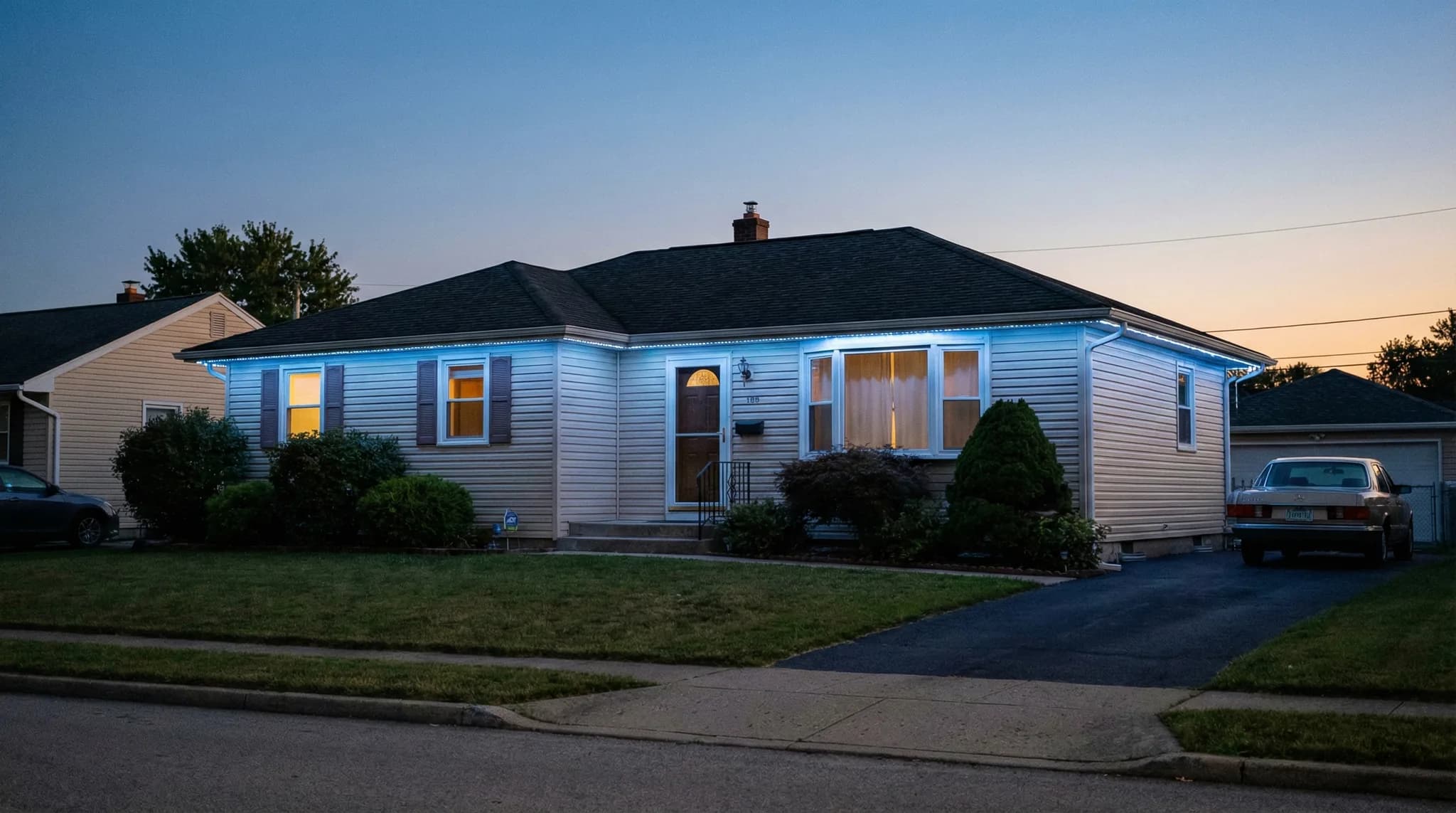
Permanent outdoor lights are permanently attached fixtures – which means they fall under your homeowners insurance dwelling coverage, not personal property coverage.
Permanent outdoor lights are covered under standard homeowners insurance dwelling coverage (Coverage A) in Sacramento. Because the system mounts directly to your fascia board with mechanical fasteners, your insurer classifies it as a permanently attached fixture – the same category as your gutters, HVAC system, and built-in cabinetry.
This matters for Sacramento homeowners investing $3,000 to $8,000 in a permanent lighting system. You need to know whether your policy covers damage or loss, whether installation affects your premium, and whether the security benefits of permanent lighting could actually lower your rates. Sacramento's insurance market is already under pressure – Insurify projects California homeowners insurance rates will rise 16% by the end of 2026 following the 2025 Los Angeles wildfire losses.
This guide covers how permanent outdoor lights interact with your homeowners insurance policy, what's covered, what's excluded, and the steps to take before and after installation to protect your investment.
TL;DR: Permanent outdoor lights fall under dwelling coverage (Coverage A) on your homeowners insurance policy because they are permanently attached to your home's structure. They're covered against standard perils like fire, wind, hail, vandalism, and fallen trees. Notify your insurer after installation to update your dwelling replacement cost. The security lighting benefits may qualify you for a 2–5% premium discount – ask your agent about smart home and security device credits. Sacramento homeowners pay an average of $1,662/year for home insurance, so even a small percentage discount adds up.
How Homeowners Insurance Covers Permanent Outdoor Lights
A standard HO-3 homeowners insurance policy – the most common policy type in Sacramento – divides your coverage into distinct categories. Where your permanent lighting system falls determines what perils are covered and how claims are handled.
Coverage A: Dwelling Coverage
Dwelling coverage protects your home's physical structure and anything permanently attached to it. According to GEICO, Hippo, and NerdWallet, this includes walls, the roof, foundation, built-in appliances, permanent fixtures like cabinetry and lighting, and attached structures like garages, porches, and decks.
Permanent outdoor lights mount to the fascia board using mechanical screws – the same board your gutters attach to. The aluminum track, LED modules, wiring, and controller are all physically fastened to the home's exterior structure. This makes the entire system a permanent fixture under Coverage A.
For a detailed look at how the mounting system attaches without touching your roof, see our guide on permanent lights and roof damage.
What Coverage A Protects Against
HO-3 policies provide “open peril” coverage on dwelling components, meaning your permanent lights are covered against any cause of loss unless your policy explicitly excludes it. Standard covered perils include:
- Fire and smoke damage
- Wind and hail – relevant for Sacramento's occasional severe storms
- Vandalism and theft
- Falling trees or branches
- Vehicle damage (e.g., a car strikes the side of your home)
- Lightning strikes
- Water damage from burst pipes (not flooding)
If a covered event damages your permanent lighting system, the repair or replacement cost is included in your dwelling claim – you do not need a separate rider or add-on policy.
Where Permanent Lights Fall in Your Insurance Policy
Why This Matters: Open Peril vs. Named Peril
Because permanent lights fall under Coverage A (dwelling), they receive open peril protection. This is broader than the named peril coverage that applies to personal property (Coverage C). Open peril means everything is covered unless your policy specifically lists it as an exclusion.
If your outdoor lighting were portable or plug-in (like string lights or temporary holiday lights), it would fall under Coverage C personal property with narrower named peril protection. Permanent installation gives your lighting system the strongest insurance protection available.
What's Not Covered: Insurance Exclusions That Apply
Even under open peril dwelling coverage, certain causes of loss are excluded from standard HO-3 policies. Sacramento homeowners should be aware of these exclusions as they relate to exterior lighting systems.
Standard Exclusions Affecting Outdoor Lighting
- Flooding – Sacramento sits at the confluence of the American and Sacramento Rivers. While roofline-mounted lights are unlikely to be affected by ground-level flooding, standard homeowners insurance never covers flood damage. FEMA flood insurance is a separate policy.
- Earthquakes – California homeowners need a separate earthquake policy (available through the California Earthquake Authority). If seismic activity damages your fascia or mounting system, your standard policy won't cover it.
- Wear and tear / gradual degradation – Normal LED dimming over time, UV fading of the mounting track finish, or gradual loosening of connections from thermal cycling are maintenance issues, not insurable events. This is where your manufacturer and installer warranty picks up the coverage.
- Pest and animal damage – Most policies exclude damage from rodents, birds, or insects. Squirrels chewing through low-voltage wiring – a known issue in Sacramento neighborhoods with mature tree canopy – falls outside insurance coverage.
- Power surges – Some policies exclude damage from electrical surges, particularly if the surge originates from within your home's electrical system rather than an external event like a lightning strike.
Pro Tip
Your installer warranty and your homeowners insurance cover different risks with zero overlap. Insurance handles sudden, accidental damage (fire, storms, vandalism). Your warranty handles manufacturing defects and component failures. You need both. Ask your installer for written warranty terms before signing – our warranty guide walks through exactly what to verify.
Insurance vs. Warranty: What Each Covers
Do Permanent Outdoor Lights Affect Your Insurance Premium?
Permanent outdoor lights can affect your homeowners insurance premium in two ways: a slight increase tied to your home's replacement value, and a potential decrease from security-related discounts. For most Sacramento homeowners, the net effect is either neutral or a small savings.
The Replacement Cost Factor
When you add any permanent fixture to your home, it increases the total replacement cost. A $5,000 permanent lighting system added to a home with $400,000 in dwelling coverage represents a 1.25% increase in replacement value.
At Sacramento's average homeowners insurance rate of roughly $1,662/year for a $300,000 dwelling policy (Insurify, 2026), a 1.25% increase in coverage translates to approximately $15–$25 per year in additional premium. Most insurers won't adjust your rate until you request a coverage update or your policy renews with an updated appraisal.
Security and Smart Home Discounts
Here's where permanent lights can offset – or even reverse – any premium increase. Insurance companies recognize that exterior lighting reduces theft and vandalism claims. According to NerdWallet and Experian, smart home and security device discounts typically range from 2% to 7% on homeowners insurance premiums.
Permanent outdoor lighting systems with smart home integration (Alexa, Google Home, app control with scheduling) may qualify for these discounts because they provide:
- Automated dusk-to-dawn exterior illumination
- App-controlled scheduling that simulates occupancy while you travel
- Integration with security systems and motion-activated cameras
- Deterrent lighting that reduces property crime risk
A 2–5% discount on a $1,662 annual premium saves $33–$83 per year. Over the 15–25 year lifespan of a permanent lighting system, that's $495–$2,075 in cumulative savings – before factoring in the other financial benefits of permanent outdoor lights.
Net Insurance Premium Impact: Permanent Outdoor Lights
Steps to Take Before Installation: The Insurance Checklist
Protecting your investment starts before the installer arrives. These steps take 15–20 minutes and ensure your permanent lighting system is fully covered from day one.
- Review your current dwelling coverage limit. Log into your insurance portal or call your agent. Verify that your Coverage A limit is high enough to cover your home's current replacement cost plus the lighting system investment. If your dwelling coverage is already at or above replacement cost, a $3,000–$8,000 lighting system may not require an adjustment.
- Ask about smart home or security lighting discounts. Before installation, call your insurer and ask: “Do you offer a discount for permanently installed exterior security lighting with app control?” Get the answer in writing. American Family Insurance, State Farm, Allstate, and Farmers all offer some form of smart home discount (American Family Insurance, 2026).
- Document your current exterior. Take dated photos of your home's exterior from all sides before installation. This creates a baseline record in case you ever need to file a claim.
- Verify your installer's insurance. Confirm that your permanent outdoor lighting installer carries general liability insurance and workers' compensation coverage. If a worker is injured on your property during installation and the installer is uninsured, your homeowners policy could be on the hook.
- Save your installation contract and warranty documents. Store digital copies alongside your insurance policy documents. The contract proves the system is professionally installed (relevant for warranty claims), and the receipt documents the replacement value (relevant for insurance claims).
Pro Tip
Time your insurance call strategically. Contact your agent after installation is complete and you have the final invoice. Provide the total system cost, confirm it's a permanent fixture attached to the fascia, and ask about both a coverage update and a security discount in the same call. Many agents can apply a smart home discount retroactively to your current policy period.
After Installation: Updating Your Policy
Once your permanent lighting system is installed, notify your insurance company within 30 days. According to Progressive and the Insurance Information Institute (III), insurers may require notification within 30 days for any improvement that increases your home's replacement cost by 5% or more. While a $5,000 lighting system on a $400,000 home is only 1.25%, bundling it with other improvements or having a lower home value could trigger the threshold.
Here's what to provide your insurer:
- Installation date and contractor name
- Total system cost (parts and labor combined)
- Description: “Permanently mounted exterior LED lighting system attached to fascia board with mechanical fasteners”
- Photos of the installed system
- Copy of the warranty documentation
Your agent will update your dwelling replacement cost estimate and recalculate your premium. If a security discount applies, it should appear on the same policy update.
How Permanent Lights Reduce Insurance Risk (and Claims)
Beyond direct premium discounts, permanent outdoor lights address several risk factors that insurers track when pricing your policy. Sacramento's property crime statistics give context to why insurers value exterior lighting.
Crime Deterrence
Our guide on outdoor lights and crime deterrence covers the data in detail, but the summary is straightforward: well-lit exteriors reduce residential burglary risk. The U.S. Department of Justice's National Crime Victimization Survey consistently identifies lighting as a factor in burglar target selection. Homes without exterior lighting are targeted more frequently than homes with consistent illumination.
Permanent lights run on automated schedules – they turn on at dusk and off at a set time every night without any action from the homeowner. Unlike motion-sensor flood lights, they provide continuous illumination that eliminates dark zones around your home's perimeter.
Reduced Slip-and-Fall Liability
Coverage E (personal liability) on your homeowners policy covers injuries to visitors on your property. A well-lit exterior reduces trip-and-fall incidents on walkways, driveways, and entry areas – the most common liability claims against homeowners. While insurers don't typically offer explicit discounts for path lighting, fewer claims keep your premiums from increasing at renewal.
Eliminated Annual Installation Risks
Temporary holiday light installation is one of the leading causes of fall-related injuries during the holiday season. The Consumer Product Safety Commission (CPSC) reports thousands of emergency room visits annually from ladder-related falls during holiday decorating. Permanent lights eliminate this risk entirely – no ladders, no rooftop walking, no annual reinstallation.
If you're still weighing the installation decision, our DIY vs. professional installation comparison explains why professional installation matters for both safety and insurance purposes.
How Permanent Lights Reduce Insurance Risk Over Time
Sacramento-Specific Insurance Considerations
Sacramento's insurance landscape has unique factors that affect how permanent outdoor lights interact with your policy. Understanding these local conditions helps you make informed decisions about coverage.
The California Insurance Market in 2026
California's homeowners insurance market is tightening. Following the 2025 Palisades and Eaton fires (approximately $41 billion in insured losses per Insurify), carriers are recalibrating risk across the state. Sacramento homeowners currently pay below the state average – roughly $1,662/year compared to the California average of $1,965 (Insurify, MoneyGeek) – but projected 16% rate increases through 2026 could narrow that gap.
In this environment, any improvement that reduces your risk profile gives you negotiating power at renewal. Permanent exterior lighting with smart controls is a documented security feature your agent can point to during underwriting reviews.
SMUD and Electrical Considerations
Most Sacramento homes are served by SMUD (Sacramento Municipal Utility District). Permanent outdoor lights run on low-voltage DC power converted from your home's standard electrical supply. The system draws minimal power – typically $3 to $8 per month at SMUD rates.
From an insurance perspective, low-voltage systems carry less electrical fire risk than high-voltage exterior lighting. The transformer steps household current down to 12V or 24V DC before it reaches the LED modules, minimizing the risk of electrical fire – a covered peril that insurers monitor closely.
Sacramento Climate and Claim Patterns
Sacramento averages 269 sunny days per year (US Climate Data), which means UV exposure is a bigger factor than rain or ice for outdoor fixtures. Insurance doesn't cover gradual UV degradation (that falls under warranty), but sudden storm damage from Sacramento's winter rain events and occasional hail is a covered peril.
Professional installation using UV-stabilized materials rated for Central Valley conditions reduces the likelihood of claims from environmental damage. Our Sacramento maintenance guide covers the specific upkeep steps that protect both your warranty and your insurance coverage.
Filing an Insurance Claim for Damaged Permanent Lights
If a covered event damages your permanent lighting system, follow this process to maximize your claim outcome.
- Document the damage immediately. Take photos and video of the affected sections. Include wider shots that show the cause of damage (fallen tree, storm debris, fire damage) alongside close-ups of the lighting system damage.
- Do not attempt repairs before filing. Making repairs before your adjuster inspects the damage can complicate your claim. The exception is emergency measures to prevent further damage (e.g., covering exposed wiring from a storm).
- File your claim promptly. Contact your insurer as soon as possible. Provide the installation date, original cost (from your saved contract), and warranty status.
- Get a repair estimate from your original installer. Your lighting installer can provide a detailed repair or replacement estimate that accounts for the specific components, track length, LED count, and labor involved. This is more accurate than a general contractor's estimate.
- Understand your deductible. Sacramento homeowners typically carry $1,000–$2,500 deductibles. If your lighting damage is the only loss and costs less than your deductible, filing a claim may not make financial sense. If the lighting is part of broader storm or fire damage, it's included in the total claim.
Permanent Lights, Home Value, and Replacement Cost
Your dwelling coverage should reflect the full cost to rebuild your home to its current condition – including all permanent fixtures. Permanent outdoor lights increase your home's replacement cost and can also increase its market value.
Research from UT Arlington shows that homes with strong curb appeal sell for approximately 7% more than comparable homes without it. Permanent outdoor lighting is one of the most visible curb appeal investments. For a deeper analysis of the financial return, see our guide on permanent lights and home value.
When updating your insurance policy, the relevant number is replacement cost (what it would cost to reinstall an equivalent system), not market value. Your installer's original invoice is the best documentation for this figure.
What EXT Lighting Provides for Your Insurance Records
EXT Lighting includes complete documentation with every Sacramento installation to support both warranty and insurance needs:
- Detailed installation invoice – Itemized parts and labor costs that document your system's replacement value for insurance purposes.
- Warranty documentation – Written lifetime warranty on parts and labor, specifying exactly what's covered and what's excluded.
- Installation photos – Before and after photos documenting the completed installation for your insurance file.
- Proof of insurance – Our general liability and workers' compensation certificates, confirming your property was protected during installation.
- System specifications – IP rating, LED rated hours, voltage, and component details your insurer may request.
This documentation package gives your insurance agent everything they need to update your policy in a single call. Ready to get started? Request a free quote and we'll walk you through the full process – including what to tell your insurance company.
Frequently Asked Questions
Does homeowners insurance cover permanent outdoor lights?
Yes. Permanent outdoor lights are classified as permanently attached fixtures and fall under Coverage A (dwelling) on a standard HO-3 homeowners insurance policy. They are protected against covered perils including fire, wind, hail, vandalism, and fallen trees. You do not need a separate rider or add-on policy.
Will installing permanent outdoor lights raise my insurance premium?
The impact is typically neutral or slightly positive. Adding a $3,000–$8,000 system increases your dwelling replacement cost by roughly 1–2%, which may add $15–$25/year in premium. However, the security and smart home discounts available for exterior lighting (2–5% per NerdWallet) often offset or exceed this increase, resulting in net savings for most Sacramento homeowners.
Do I need to tell my insurance company about permanent outdoor lights?
Yes, you should notify your insurer after installation. While a $3,000–$8,000 improvement on a $300,000+ home may not trigger mandatory notification thresholds, updating your dwelling coverage ensures you are fully reimbursed if you ever file a claim. It also gives you the opportunity to request security lighting discounts.
Can permanent outdoor lights lower my homeowners insurance?
Potentially, yes. Many insurers offer 2–7% discounts for smart home security devices, and permanently installed exterior lighting with app control may qualify. The discount depends on your specific insurer and policy. Contact your agent and ask about smart home or security device credits.
What happens if a storm damages my permanent outdoor lights?
Storm damage (wind, hail, fallen trees) is a standard covered peril under dwelling coverage. Document the damage with photos, file a claim with your insurer, and get a repair estimate from your original installer. Remember that your deductible applies – if the damage is minor and below your deductible, it may not make sense to file a claim.
Are permanent outdoor lights covered under warranty or insurance?
Both, but for different situations. Your manufacturer/installer warranty covers defects and component failures (LED burnout, controller malfunction, wiring issues). Your homeowners insurance covers sudden accidental damage from external events (storms, fire, vandalism, fallen trees). Neither covers pest damage or normal wear and tear.