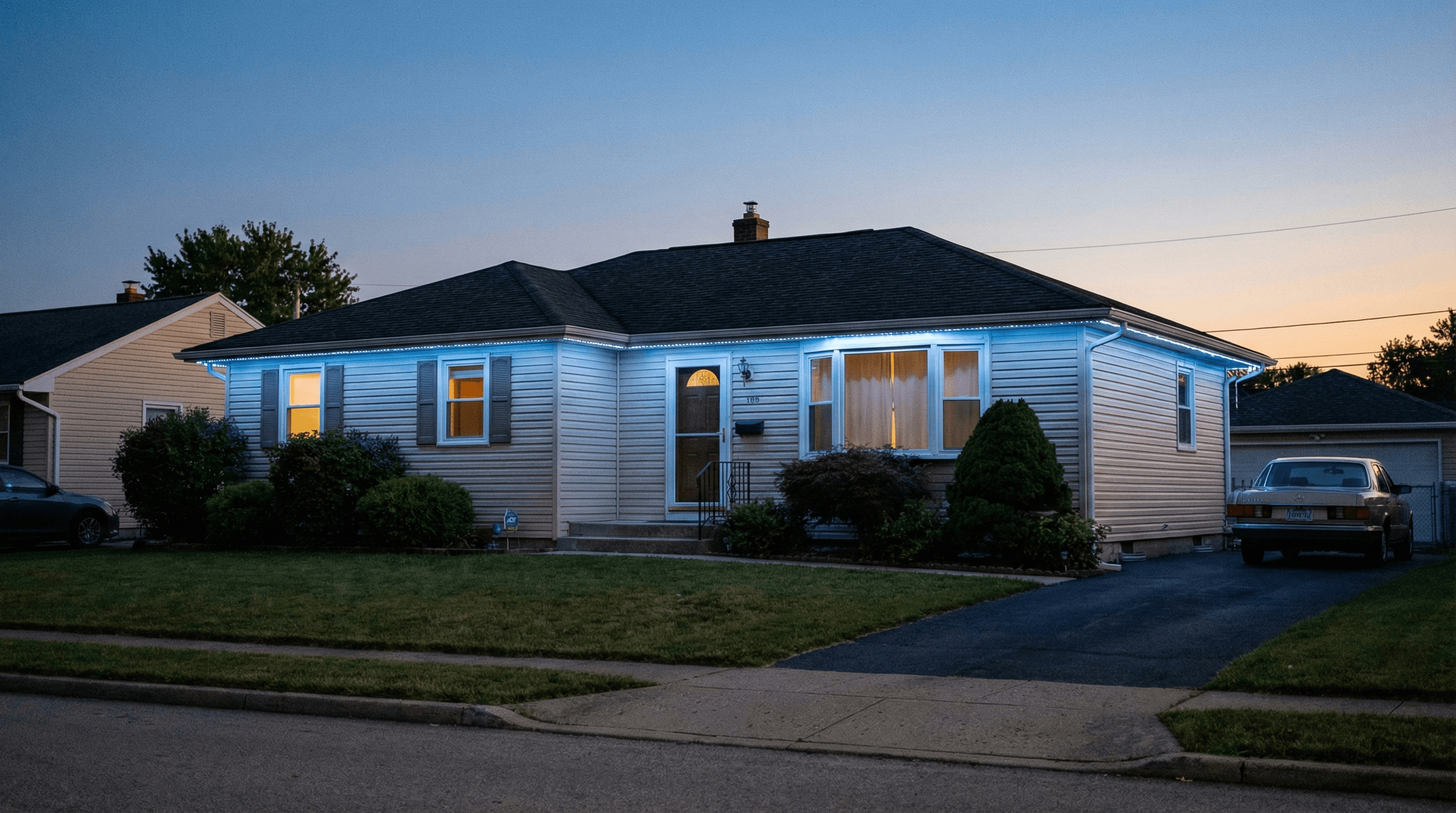
Permanent outdoor lights mount to the fascia board – the same surface that holds your gutters – not to your roof shingles, tiles, or decking.
Permanent outdoor lights do not damage your roof when installed correctly. The entire system mounts to the fascia board – the flat trim board running along the lower edge of your roofline – using mechanical screws. No shingles are lifted, no tiles are walked on, and no fasteners penetrate your roof deck or flashing.
This is the single most common concern Sacramento homeowners raise before scheduling an installation. It makes sense: your roof is a $15,000–$30,000 investment, and the last thing you want is a lighting system that compromises its integrity or voids your roofing warranty. The good news is that professional permanent light installation avoids your roof entirely.
This guide covers exactly how permanent lights mount to your home without touching the roof, what happens to your fascia board, how the process compares to the damage caused by temporary holiday light installation, and what Sacramento homeowners should verify before hiring an installer. For a step-by-step walkthrough of the full process, see our permanent light installation guide.
TL;DR: Permanent outdoor lights attach to the fascia board with screws – the same mounting surface used for gutters. They never contact your roof shingles, tiles, decking, or flashing. Professional installers use lifts or extension ladders to access the fascia without walking on the roof. The small screw holes in the fascia are sealed and do not affect roof performance. In fact, permanent lights eliminate the annual roof damage caused by temporary holiday light clips, staples, and foot traffic. Sacramento's tile roofs and composite shingle roofs are both fully compatible.
How Permanent Lights Mount Without Touching Your Roof
The mounting system for permanent outdoor lights targets one specific surface: the fascia board. This is the flat, vertical board that caps the ends of your roof rafters and runs horizontally along the bottom edge of your roofline. Your gutters attach to the same board.
Here is exactly what gets fastened and where:
- An aluminum track channel is custom-cut to match each section of your fascia. The channel comes in 100+ colors to match your existing trim or paint.
- Stainless steel or coated screws secure the channel to the fascia board every 12–18 inches. These are exterior-rated fasteners that resist rust and corrosion – critical in Sacramento's climate.
- LED modules snap into the track at preset intervals (typically 6″, 9″, or 12″ spacing). All wiring runs inside the channel, completely concealed.
- The power cable routes through the soffit (the underside of the roof overhang) to a controller mounted in the garage or attic. The soffit entry point is sealed with weatherproof caulking.
At no point during this process does the installer drill into, walk on, or modify your roof surface. The roof shingles, tiles, underlayment, decking, and flashing remain completely untouched.
Where Permanent Lights Actually Attach: Anatomy of the Roofline
What Happens to the Fascia Board After Installation
The fascia board receives screw holes every 12–18 inches along its length. This is the only physical modification to your home during permanent light installation. Here is why that is not a concern:
- Fascia boards are designed to accept fasteners. Your gutters are already screwed into the same board, typically with larger and more numerous fasteners than a lighting track requires.
- The track channel covers the screw heads. Once the aluminum channel is mounted, it sits flush against the fascia, shielding the screw entry points from rain, UV exposure, and dust.
- Exterior-rated screws prevent rot. Professional installers use stainless steel or coated screws designed for outdoor use. Cheap, unrated screws can rust and stain the fascia – this is one of the key differences between a professional and a DIY installation.
- If the system is ever removed, the screw holes are filled with exterior wood filler or caulk and painted over. The fascia returns to its original appearance.
For Sacramento homes with composite or PVC fascia boards (increasingly common in newer developments in Natomas, Elk Grove, and Rancho Cordova), the mounting process is even less invasive. Composite materials do not absorb moisture through screw holes the way raw wood can, making them ideal mounting surfaces for permanent lighting.
Pro Tip
During your consultation, ask the installer what type of screws they use. The answer should be stainless steel or exterior-coated (such as ceramic-coated or ACQ-rated). If they say “standard screws” or cannot specify, that is a red flag. Rust from cheap screws can cause staining and accelerate fascia deterioration – exactly the kind of damage that a quality installation prevents. For a full checklist, see our installer selection guide.
Permanent Lights vs. Temporary Holiday Lights: Which Causes More Roof Damage?
Temporary holiday lights are far more likely to damage your roof than a professional permanent installation. The CPSC estimates that more than 15,000 holiday decorating injuries occur each November and December alone, with nearly half involving falls from ladders and roofs (CPSC, 2023).
Beyond personal injury, temporary light installation creates multiple damage vectors that permanent systems eliminate entirely:
Roof Damage Risk: Temporary vs. Permanent Lights
Here is a breakdown of how temporary holiday lights damage roofs that permanent systems avoid:
- Staples and nails in shingles: Many homeowners and handyman services use staple guns or small nails to attach temporary light strands to roof edges. Each penetration breaks the waterproof seal on asphalt shingles, creating paths for water infiltration. According to Angi (formerly Angie's List), these punctures can void most roofing manufacturer warranties, which specifically exclude damage caused by non-roofing penetrations.
- Clip damage to shingles and gutters: Even “damage-free” plastic clips can lift shingle edges when improperly placed, crack brittle shingles in cold weather, and bend gutter lips when clipped too tightly. Over multiple years of installation and removal, this cumulative stress adds up.
- Foot traffic on the roof: Walking on asphalt shingles displaces protective granules, reducing the shingle's UV resistance and shortening its lifespan. Walking on tile roofs risks cracking tiles. The CPSC reports approximately 5,800 fall injuries per holiday season related to decorating, with 43% caused by falls from ladders (CPSC, 2023).
- Forgotten hardware: Nails, staples, and clips left behind after removal create ongoing leak points. Sacramento's winter rain season (November through March) turns every forgotten staple into a potential leak.
Permanent lights eliminate all of these risks because the system installs once, stays in place, and never requires annual roof access. For a detailed cost comparison between the two approaches, see our permanent vs. Christmas lights breakdown.
Does Permanent Light Installation Void Your Roofing Warranty?
No. Because permanent outdoor lights mount to the fascia board – not to the roof surface, decking, or flashing – a professional installation does not trigger the warranty exclusions found in most roofing manufacturer warranties.
Roofing warranties typically exclude damage caused by:
- Penetrations through the shingle or tile surface
- Fasteners driven into the roof deck outside of the original installation
- Foot traffic that displaces granules or cracks tiles
- Modifications to flashing, ridge caps, or ventilation components
Permanent lights avoid every one of these triggers. The fascia board is not part of the roof assembly covered by shingle or tile warranties – it is part of the trim/eave assembly. Gutters, downspouts, and now permanent lighting all attach to this same board without affecting roof warranty coverage.
In contrast, temporary holiday lights hung with staples or nails directly into shingles can void your roofing warranty. JP Carroll Roofing notes that puncturing shingles with non-approved fasteners is one of the most common warranty-voiding actions homeowners take unknowingly.
Pro Tip
If you have a newer roof (under 10 years old) with an active manufacturer warranty, take two steps before your permanent light installation: (1) photograph your roofline and fascia from multiple angles, and (2) note your roofing warranty policy number and any exclusions related to “attachments” or “modifications.” This documentation confirms that no roof-surface work was performed – useful if you ever need to file a roof warranty claim down the line.
Sacramento Roof Types and Permanent Light Compatibility
Sacramento's housing stock features several distinct roof types. Every one of them is compatible with permanent outdoor lights because the mounting surface is always the fascia board – never the roof material itself.
Sacramento Roof Types by Market Share
Here is how permanent lights interact with each roof type:
- Concrete and clay tile: The most common roof type in Sacramento's established neighborhoods. Installers access the fascia from extension ladders or articulating lifts – never by walking on the tiles. The tile overhang actually provides built-in weather protection for the lighting track. See our dedicated stucco and tile roof installation guide.
- Asphalt shingle: The standard roof type on homes built after 2000 in Sacramento's suburban neighborhoods. The fascia board on shingle homes is typically the most accessible, making installation straightforward.
- Composite (synthetic): Common on new construction in Roseville, Rocklin, and Lincoln. Composite roofing and composite fascia boards together create an ideal installation scenario – no moisture absorption, no rot potential.
- Metal roofing: Growing in popularity for its durability in Sacramento's heat. Metal roofs do not change the permanent light installation process because the lights still mount to the fascia, not the roof panels.
Worried About Your Roof? Get a Free On-Site Assessment
EXT Lighting inspects your fascia, measures your roofline, and confirms compatibility with your roof type – all before you commit. Sacramento, Roseville, Rocklin, and surrounding areas. No obligation.
Schedule Your Free AssessmentWhat About Fascia Damage? Is Drilling Into the Fascia a Problem?
The fascia board is specifically designed to accept fasteners. It already holds your gutter system, which uses screws or spikes that are typically larger than the fasteners used for a permanent lighting track.
Here is how the fastener load of permanent lights compares to what your fascia already supports:
| Attachment Type | Fastener Size | Spacing | Weight on Fascia |
|---|---|---|---|
| Gutters (K-style, 5″) | #10 or #12 screws | Every 24–32″ | 1.5–3 lbs/ft (with water) |
| Permanent LED Track | #8 screws | Every 12–18″ | 0.2–0.4 lbs/ft |
| Christmas Light Clips | Plastic clips or staples | Every 6–12″ | Minimal, but repeated install/remove |
The permanent LED track weighs roughly one-fifth of what your gutters weigh per linear foot (without water in the gutters – with water, the ratio is even more favorable). The fasteners are smaller than gutter screws. The fascia board handles this load without any structural concern.
The only scenario where fascia condition matters is if the board is already rotted or severely deteriorated before installation. A professional installer will inspect the fascia during the on-site assessment and flag any sections that need repair or replacement before the lighting track goes up. Addressing fascia rot before installation is actually a benefit – it solves a pre-existing problem that would eventually affect your gutters too.
How Professional Installers Avoid Roof Contact Entirely
Professional permanent light installers are trained to access the fascia without ever stepping on the roof. The specific method depends on your home's height and layout:
- Single-story homes (8–12 feet): Extension ladders placed against the fascia or wall, with rubber-tipped feet to prevent surface damage. The installer works from the ladder, never needing roof access.
- Two-story homes (18–28 feet): Articulating lifts (boom lifts) position the installer at fascia level with a secure platform. No ladder leaning on the roof, no walking on tiles or shingles. See our two-story installation guide for details.
- Complex rooflines: Homes with multiple roof planes, dormers, or varied elevations may require a combination of ladders and lifts. The installer plans the access strategy during the on-site assessment so there are no surprises on installation day.
If an installer tells you they need to walk on your roof to install permanent lights, that is a red flag. It means they either lack the proper equipment or do not understand the fascia-mount process. Our installer selection checklist covers all the right questions to ask.
Annual Damage Cycle: Temporary Holiday Lights on Sacramento Homes
A Real Sacramento Installation: The Granite Bay Tile Roof
A homeowner in Granite Bay with a two-story Mediterranean-style home had delayed getting permanent lights for two years specifically because of roof damage concerns. The home had a 7-year-old concrete tile roof with an active manufacturer warranty that the homeowner did not want to jeopardize.
During the on-site assessment, the installer documented the existing fascia condition (composite, in excellent shape), measured 210 linear feet of roofline across both levels, and confirmed that a 40-foot articulating lift would provide full access without any roof contact. Installation took 7 hours. No tiles were walked on, touched, or moved. The only modification to the home was screw holes in the composite fascia board – the same board already holding the gutter system.
Three months later, the homeowner had a separate roofing inspection (unrelated to the lights). The roofer confirmed no evidence of any damage or modification to the roof surface, tiles, flashing, or underlayment. The permanent lights and the roofing warranty coexist without conflict.
What Happens If You Remove Permanent Lights Later?
If you ever decide to remove your permanent lighting system, the process reverses cleanly:
- The LED modules are unsnapped from the aluminum track channel.
- The screws are backed out of the fascia board.
- The small screw holes are filled with exterior-grade wood filler (for wood fascia) or left as-is for composite fascia (composite does not absorb moisture through small holes).
- A coat of matching paint restores the fascia to its original appearance.
The fascia board returns to its pre-installation state. The roof, as always, was never touched. For homeowners planning to sell, the system can also be left in place as a home improvement that adds value to the property.
5 Questions to Ask Your Installer About Roof Protection
Before hiring a permanent light installer in Sacramento, ask these five questions to confirm they follow roof-safe practices:
- “Do you drill into the roof surface at any point?” The answer should be an unequivocal no. All mounting goes into the fascia board.
- “How do you access the fascia on second-story sections?” The answer should reference articulating lifts or extension ladders – never walking on the roof.
- “What type of screws do you use?” Exterior-rated stainless steel or coated fasteners. Never standard interior screws.
- “Will this affect my roofing warranty?” A knowledgeable installer will explain the fascia-only mounting and confirm no roof warranty impact.
- “What if my fascia needs repair?” A good installer identifies rotted or damaged fascia sections during the assessment and recommends repair before installation – protecting both the lighting system and your roof edge.
For a complete installer vetting checklist, see our how to choose a permanent lighting installer guide. For warranty specifics, our warranty guide breaks down what to expect from each major brand.
Frequently Asked Questions
Will permanent outdoor lights damage my roof?
No. Permanent outdoor lights mount to the fascia board, not the roof surface. No shingles or tiles are lifted, penetrated, or walked on during professional installation. The roof deck, flashing, and underlayment remain completely untouched. The fascia board is the same mounting surface your gutters use.
Do permanent lights void my roofing warranty?
No. Because permanent lights attach to the fascia – not the roof assembly – they do not trigger warranty exclusions. Roofing warranties exclude penetrations through shingles, tiles, decking, and flashing. The fascia board is part of the eave/trim assembly, not the roof system covered by your warranty.
Are permanent outdoor lights safe for tile roofs?
Yes. Professional installers access the fascia from ladders or articulating lifts without walking on the tile. No tiles are removed, lifted, or stressed during installation. The tile overhang actually provides weather protection for the mounted lighting track. See our tile roof installation guide for full details.
What about fascia damage from the screws?
The fascia board is designed to hold fasteners – it already supports your gutters with larger screws and heavier loads. The permanent LED track uses smaller #8 screws and weighs under half a pound per linear foot. If the system is ever removed, screw holes are filled and painted over. Professional installers use exterior-rated stainless steel or coated screws that prevent rust and staining.
Do temporary Christmas lights cause more roof damage than permanent lights?
Significantly more. Temporary lights require annual installation and removal that involves staples or nails in shingles, foot traffic that displaces protective granules, clip stress on gutters, and forgotten hardware that creates leak points. The CPSC reports over 15,000 holiday decorating injuries per season, with 43% caused by ladder falls (CPSC, 2023). Permanent lights eliminate this entire cycle.
Can I install permanent lights on a brand-new roof?
Yes. Installing permanent lights on a new roof is ideal timing because the fascia board is in pristine condition and the installer can coordinate with the roofing crew if both projects overlap. The permanent light installation does not affect the new roof or its warranty in any way. Many Sacramento homeowners bundle both projects during a roof replacement to save on access equipment costs.
Get Permanent Lights Without Worrying About Your Roof
EXT Lighting provides free on-site assessments across Sacramento, Roseville, Rocklin, Folsom, El Dorado Hills, and surrounding communities. We inspect your fascia, confirm roof compatibility, and design a custom lighting plan – all before you commit. Lifetime warranty on parts and labor.
Schedule Your Free Consultation