Lighting eats up 17% of all electricity in commercial buildings, according to ENERGY STAR. That's a massive line item on any business owner's utility bill. Meanwhile, the global LED lighting market is on track to hit $99.47 billion in 2025 (Precedence Research, 2025), driven largely by commercial adoption.
Sacramento businesses — from midtown restaurants to Folsom retail centers — are ditching temporary holiday lighting setups and investing in permanent outdoor LED systems. The reasons go beyond aesthetics. We're talking measurable crime reduction, energy savings of 75%, and ROI timelines that make CFOs pay attention.
This guide breaks down real cost data, Sacramento-specific compliance requirements, utility rebate programs through SMUD and PG&E, and which types of businesses see the fastest payback. Whether you run a single storefront or manage a multi-building commercial property, the numbers here will help you make a grounded decision.
For a detailed breakdown of residential pricing, see our permanent outdoor lighting cost guide.
TL;DR: Commercial permanent LED lighting costs $5,000-$25,000 one-time versus $15,000-$40,000 over 5 years for temporary seasonal lighting. LEDs cut energy use by 75% (DOE). Payback hits in 1.5-3 years. A landmark NBER study found outdoor lighting reduces nighttime crime by 39%. Sacramento businesses from restaurants to retail are switching to permanent systems for brand visibility, safety, and long-term savings.
What Is Commercial Permanent Outdoor Lighting?
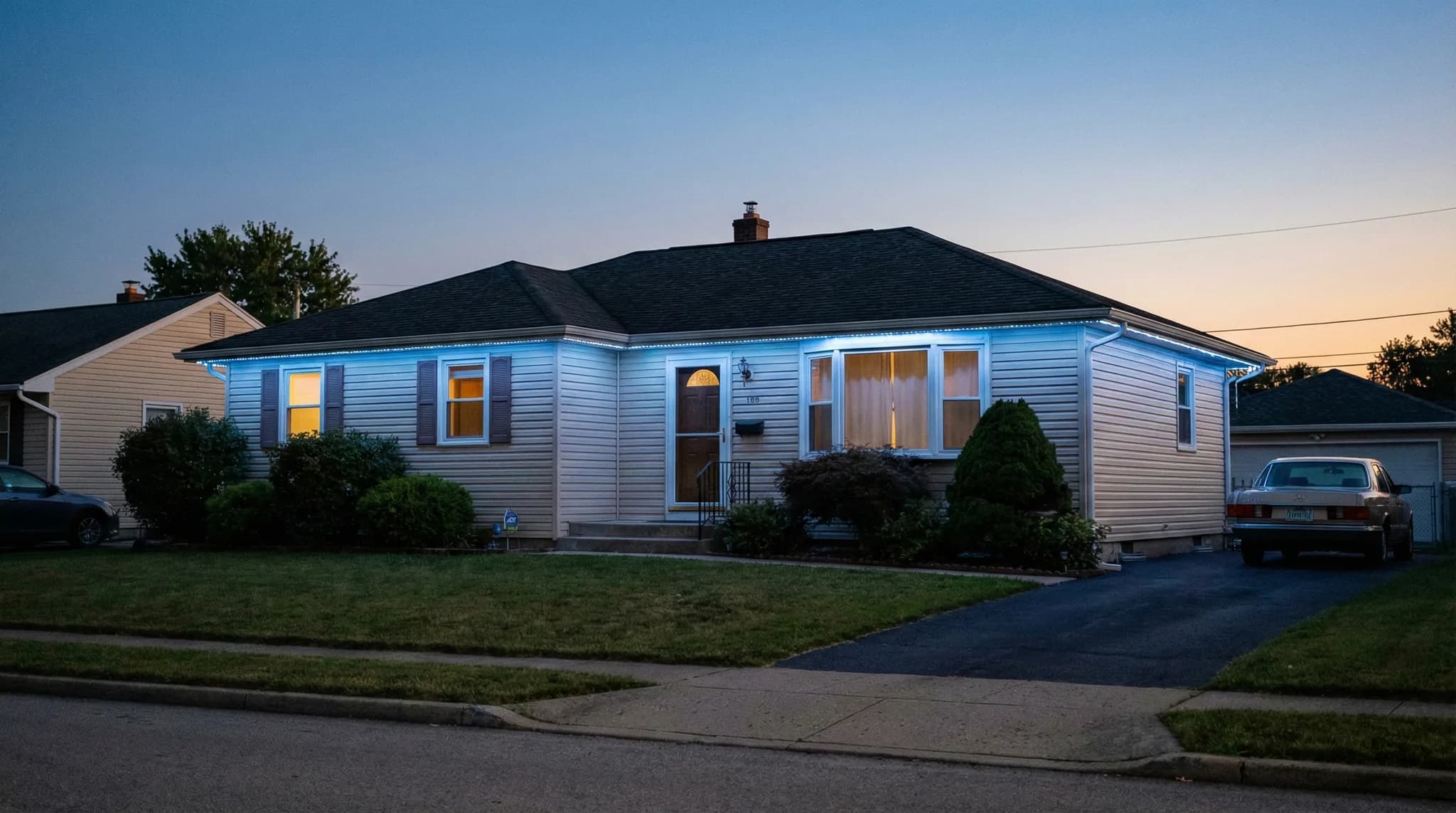
Commercial permanent outdoor lighting consists of track-mounted LED systems professionally installed along a building's roofline, fascia, or architectural features. Unlike temporary holiday lights that go up in November and come down in January, these systems stay mounted year-round and produce over 16 million colors on demand via smartphone app control.
Don't confuse these with flood lights, landscape lighting, or traditional string lights. Permanent systems sit flush against the building in low-profile aluminum channels. Most people can't even see the hardware during daylight hours. The LEDs themselves measure about 1 inch across.
Common commercial applications include roofline outlining, signage accent lighting, building perimeter definition, parking area illumination, and patio or outdoor dining ambiance. Restaurants use them to create warm dining atmospheres. Retail stores highlight window displays and entryways. Office buildings project a professional presence after dark.
How does this differ from hiring a crew every December? Permanent systems give you year-round color control. Run warm white for everyday elegance. Switch to red, white, and blue for the Fourth of July. Display your brand colors during a grand opening. The system stays put — only the programming changes.
Systems on the market include Trimlight, Jellyfish Lighting, and custom solutions from local Sacramento-area installers who source commercial-grade LED strips and controllers. The technology has matured significantly in the last five years, with IP67-rated weatherproofing now standard across most professional-grade products.

Commercial buildings with permanent LED lighting project a professional presence after dark. Photo: Pexels
How Much Does Commercial Permanent Lighting Cost?
Most commercial permanent lighting installations fall between $5,000 and $25,000, depending on building size and complexity. On a per-linear-foot basis, commercial projects typically run $20 to $50 — higher than residential due to building height, mounting surface challenges, and the need for commercial-grade electrical work.
Compare that to temporary holiday lighting for a commercial building: $3,000 to $8,000 per year when you factor in design, installation, removal, storage, and bulb replacement. Over five years, that's $15,000 to $40,000 spent on lighting you only use for 4 to 8 weeks annually. The permanent system? One payment. Done.
| Cost Factor | Permanent LED System | Temporary Holiday Lighting |
|---|---|---|
| Year 1 Cost | $5,000 - $25,000 | $3,000 - $8,000 |
| 5-Year Total | $5,000 - $25,000 | $15,000 - $40,000 |
| Annual Usage | 365 days/year | 4 - 8 weeks/year |
| Color Options | 16 million+ | 1 - 3 static colors |
| Annual Maintenance | Minimal (app updates) | Full re-install each year |
What Drives the Price for Commercial Buildings?
Building size and perimeter length are the primary cost drivers. A 2,000-square-foot retail shop with 150 linear feet of roofline sits at the lower end. A 15,000-square-foot warehouse or multi-story office building with 500+ linear feet of mountable surface pushes toward the upper range.
Mounting surface matters more than most business owners expect. Stucco and wood fascia are straightforward. Metal buildings require specialized brackets. Stone or masonry facades need anchoring systems that add labor time. Each surface type changes the installation approach and cost.
Control complexity also affects pricing. A single-zone system covering one roofline is simpler than a multi-zone setup that independently controls the front entrance, side walls, patio area, and signage accents. More zones mean more controllers and more programming time.
Electrical infrastructure is the wildcard. Buildings with accessible, up-to-code outdoor circuits keep costs down. Older buildings that need electrical panel upgrades or new dedicated circuits add $500 to $2,000 to the project.
Why Temporary Holiday Lighting Costs More Long-Term
The annual install-and-remove cycle is where temporary lighting bleeds money. You're paying for a crew, a lift truck, and 1-2 days of labor every November — then again in January. That's before you account for bulb replacement, broken strands, and storage costs.
There's also liability exposure. Every year a crew goes on your roof or uses a lift on your property, you carry liability risk. Workers' compensation claims from holiday light installation injuries are more common than most business owners realize. And after all that cost and risk? You get 4 to 8 weeks of use.
For a full side-by-side breakdown, read our permanent vs. temporary lighting comparison.
What's the ROI for Sacramento Businesses?
The payback period for most commercial LED retrofits lands between 1.5 and 3 years, with 10-year returns frequently exceeding 300% (WattMath, 2025). For Sacramento businesses, local utility rebate programs shorten that timeline even further.
SMUD and PG&E both offer rebate programs for qualifying LED upgrades, covering 20% to 50% of project costs depending on the system type and energy reduction achieved. These programs change periodically, so it's worth checking current offerings before committing to a project timeline.
Maintenance cost reduction is another overlooked ROI driver. Traditional commercial exterior lighting requires regular bulb replacement, fixture cleaning, and ballast repairs. LED permanent systems cut maintenance costs by 80-90% compared to conventional alternatives (Commercial Lighting Industries, 2025). That's real labor cost eliminated from your operating budget.
Beyond direct savings, there's the brand visibility factor that's harder to quantify but impossible to ignore. Year-round color-changing lights turn your building into a landmark. Sacramento restaurants and bars using permanent lighting for patio dining ambiance have reported increased evening foot traffic — particularly during warm-weather months when outdoor seating extends dining capacity.
Think about what a well-lit building communicates. It says "we're open, we're professional, we care about this space." A dark storefront on a commercial corridor says the opposite. In a competitive market, that visual signal has real value.
See our detailed residential pricing breakdown for comparison data on home installations.
Does Commercial Outdoor Lighting Reduce Crime?
A landmark study by the National Bureau of Economic Research found that improved lighting in roughly 80 New York City public housing developments reduced nighttime index crimes by 39% (NBER, 2019). That's not a marginal improvement. That's a fundamental shift in criminal behavior when visibility increases.
More recent data reinforces the pattern. A 2025 Philadelphia study on LED streetlight upgrades documented a 15% reduction in outdoor nighttime crime and a 21% drop in gun violence over just 10 months (Phys.org, 2025). These aren't anecdotal claims — they're controlled, peer-reviewed findings.
The New York study also surveyed residents: two-thirds felt favorably about the new lighting installations. Better lighting doesn't just reduce crime statistically. It changes how people feel about a space.
For Sacramento businesses, the implications are practical. Well-lit parking lots and building exteriors protect employees leaving after closing time. Customers feel more confident approaching a brightly lit business at night. And from a liability standpoint, adequate illumination reduces slip-and-fall claims — a real concern for restaurants, retail stores, and any business with evening foot traffic.
Would you rather deal with a liability claim from a customer who tripped in a dark parking lot, or invest in lighting that eliminates that risk entirely? The math isn't complicated.
Read our full analysis of outdoor lighting and security for residential data and Sacramento-specific crime statistics.
How Much Energy Do Permanent LED Systems Save?
LEDs use 75% less energy than traditional incandescent and halogen lighting, according to the U.S. Department of Energy. Combined with the fact that lighting accounts for 17% of commercial building electricity (ENERGY STAR), the savings potential for any business running outdated exterior lighting is substantial.
Lifespan tells an even more dramatic story. Commercial-grade LEDs last 50,000 to 100,000 hours. Incandescent bulbs? About 2,000 hours. That's a 25x to 50x difference in useful life (Commercial Lighting Industries, 2025). Fewer replacements means fewer service calls, less waste, and lower labor costs.
Maintenance savings compound over time. Businesses running traditional exterior lighting replace bulbs, clean fixtures, and repair ballasts on a regular cycle. LED permanent systems eliminate virtually all of that — an 80-90% reduction in ongoing maintenance expense.
At a national scale, the DOE estimates that widespread LED adoption could save the equivalent output of 44 large power plants and more than $30 billion annually by 2027. Your single building won't move national statistics, but it will move your utility bill — and that's what matters to your bottom line.
SMUD Commercial Rates and Sacramento Savings
Sacramento businesses served by SMUD enjoy some of California's most competitive commercial electricity rates. Compared to Bay Area utilities, SMUD customers pay significantly less per kilowatt-hour — which means the energy savings from LED conversion translate to real dollar amounts faster than they would for a San Francisco or San Jose business.
Between lower base rates and available rebate programs, Sacramento is one of the better markets in California for commercial LED upgrades. The combination of cheaper electricity and utility incentives creates a payback environment that's hard to beat in the state.
Which Sacramento Businesses Benefit Most?
Every commercial property can benefit from permanent outdoor LED lighting, but certain business types see outsized returns. Sacramento's 240+ days of sunshine per year and strong evening dining culture make this market particularly suited to permanent lighting investment — especially for businesses with outdoor customer-facing spaces.
Restaurants and Bars
Sacramento's restaurant scene thrives on outdoor dining. With 240+ days of sunshine, patio seating isn't seasonal here — it's a core revenue driver. Permanent LED lighting extends those outdoor dining hours and creates an ambiance that overhead floods or string lights can't match.
Restaurants are also using brand-specific color schemes to build identity. A warm amber glow says something different than cool blue. Seasonal themes — green and red in December, pastels in spring, orange in October — give regulars a reason to notice and talk about your space. That kind of organic word-of-mouth doesn't show up on a marketing invoice, but it drives repeat visits.

Sacramento restaurants use permanent LED lighting to extend outdoor dining hours. Photo: Pexels
Retail Storefronts
Window and signage accent lighting draws eyes on busy commercial corridors. Permanent systems let you highlight products, frame entryways, and create seasonal displays without hiring an installation crew every time a holiday rolls around.
Consider the foot traffic impact during evening shopping hours. A well-lit storefront stands out from neighboring businesses. On streets like J Street, Folsom Boulevard, or Sunrise Mall Drive, that visual differentiation matters — especially during the November-through-December holiday shopping window when competition for foot traffic is fiercest.
Office Buildings and Professional Services
For office buildings, permanent exterior lighting accomplishes three goals at once. It projects a professional image to clients and visitors. It provides after-hours security presence that discourages vandalism and break-ins. And it reinforces corporate branding on the building exterior — especially effective for businesses in multi-tenant buildings trying to stand out.
Tenant satisfaction matters, too. Property managers who invest in building aesthetics — including exterior lighting — report higher tenant retention. Nobody wants their business associated with a dark, uninviting building. The same principle applies to residential rental investments — our dedicated guide to permanent outdoor lights for rental properties covers ROI, tenant retention, and how Sacramento landlords handle approval and billing.
HOA Communities and Property Management
Property management companies overseeing commercial or mixed-use developments benefit from centralized lighting control. One system covers the entire property with consistent color schemes for holidays, community events, or branding.
Sacramento's industrial vacancy rate sat at 6.0% in Q4 2025 (Kidder Mathews). In a competitive commercial real estate market, curb appeal differentiates properties. Well-lit common areas reduce liability exposure from poorly illuminated walkways and parking lots. And centralized app control means a property manager can adjust lighting across the entire complex without dispatching a maintenance crew.
We serve commercial properties across the Sacramento metro — explore our service areas to see if your business is in range.
What About Smart Controls for Commercial Properties?
The global smart lighting market reached $22.98 billion in 2025 and is growing at a 19.77% compound annual rate (Mordor Intelligence, 2025). Smart lighting installations in commercial buildings climbed 28% in 2024 alone. This isn't emerging technology — it's the new standard for commercial properties.
Multi-zone control is where smart systems earn their keep on commercial buildings. Light the front entrance in warm white for customer appeal while running security-focused bright white on the parking lot side. Set the patio to a dimmed amber for evening dining. Each zone operates independently without affecting the others.
Scheduling automates everything. Lights turn on at sunset and off at a set time — or stay on all night in security-critical zones. Seasonal color changes happen automatically. Program your Fourth of July display in June and forget about it until the fifth.
Remote management is the feature commercial property managers appreciate most. Adjust lights from anywhere. Respond to a tenant request without a site visit. Check system status from your phone. Integration with existing building management systems is available on most commercial-grade platforms.
Learn more about smart lighting features and app control in our detailed guide.
What Are Sacramento's Commercial Lighting Requirements?
OSHA mandates minimum illumination of 3 foot-candles for general exterior commercial areas and 5 foot-candles for exit routes, per 29 CFR 1926.56. Falling below these thresholds isn't just a safety risk — it's a regulatory violation that can trigger fines and increase liability exposure.
California's Title 24 energy efficiency standards add another compliance layer for commercial lighting. These standards regulate maximum wattage per square foot and require specific controls for outdoor lighting systems. LED permanent lighting typically meets or exceeds Title 24 requirements due to its inherent energy efficiency.
Dark sky considerations are gaining traction in the Sacramento region. Some municipalities in the foothills and outlying areas have adopted light pollution ordinances that regulate upward light emission and brightness levels. If your commercial property sits in El Dorado Hills, Folsom, or other foothill communities, it's worth checking local codes before installation.
ADA compliance requires adequate illumination along all accessible pathways, ramps, and building entries. Permanent LED systems with proper placement help meet these requirements consistently — something that's harder to guarantee with aging or inconsistent conventional lighting.
Sacramento building permits for exterior lighting vary by project scope. Minor installations on existing circuits may not require a permit. Larger projects involving new electrical work or structural modifications typically do. Professional installation ensures all code and permit requirements are handled correctly from the start.
How Does the Installation Process Work for Commercial Buildings?
Most commercial permanent lighting installations are completed in 1 to 3 days with minimal disruption to daily business operations. The process follows five steps, from initial site assessment through controller programming and staff training on the system controls.
Step 1: Site assessment and custom design proposal. A lighting specialist surveys your building, measures roofline and fascia dimensions, evaluates mounting surfaces, and identifies electrical access points. You receive a detailed proposal with a visual mockup of the finished installation.
Step 2: Electrical evaluation and permit. The installer checks your building's electrical capacity and determines whether existing circuits can support the system. If new circuits or panel upgrades are needed, that work is scoped and permitted before installation begins.
Step 3: Professional mounting. LED tracks are installed along rooflines, fascia, soffits, or custom locations using surface-appropriate hardware. Most work happens from the exterior, so your business continues operating normally during installation.
Step 4: Controller and app setup. The indoor controller unit gets installed — usually in a utility closet or garage bay — and connected to your Wi-Fi network. Zones are programmed and tested individually.
Step 5: Training on controls and scheduling. Your team gets a walkthrough of the app, including how to change colors, set schedules, create custom scenes, and manage zones. Most people are comfortable with the system within 10 minutes.
The entire process, from initial inquiry to lights-on, typically spans 2 to 4 weeks depending on project complexity and permitting timelines. Read our step-by-step installation guide for more detail on what to expect.
Learn more about our commercial lighting services and what's included in every installation.
Frequently Asked Questions
How much does commercial permanent outdoor lighting cost?
Commercial permanent LED lighting installations range from $5,000 to $25,000, depending on building size, perimeter length, and mounting surface. Per-linear-foot costs run $20 to $50 for commercial buildings. Compared to temporary holiday lighting at $3,000 to $8,000 per year, most permanent systems pay for themselves within 1.5 to 3 years through eliminated annual costs.
Is permanent LED lighting worth it for a small business?
Yes. Small businesses often see the fastest payback because their buildings require less linear footage, putting installations in the $5,000 to $10,000 range. With temporary holiday lighting costing $3,000 to $5,000 annually for similar-sized buildings, the break-even point can arrive in as little as 1.5 years. The year-round brand visibility and security benefits add value beyond pure cost savings.
Do I need a permit for commercial outdoor lighting in Sacramento?
It depends on the project scope. Installations using existing electrical circuits may not require a permit. Projects involving new circuits, panel upgrades, or structural mounting typically require a building permit from the City of Sacramento or the relevant county jurisdiction. A professional installer handles the permit process, ensuring compliance with California Title 24 and local building codes.
How long does commercial LED lighting last?
Commercial-grade permanent LED systems are rated for 50,000 to 100,000 hours of operation — that's roughly 15 to 25 years of daily evening use. LEDs degrade gradually rather than burning out, so brightness and color accuracy decline slowly over time. The track and mounting hardware is typically warrantied for 10 to 15 years and built to withstand Sacramento's hot summers and wet winters.
Can permanent lights change colors for different seasons?
Yes. Modern permanent LED systems support over 16 million colors via RGBW technology, all controlled through a smartphone app. You can schedule color changes weeks or months in advance — red and green for the holidays, pastels for spring, your brand colors for everyday use. Switching takes seconds and doesn't require any physical access to the lights themselves.
Browse our full range of residential and commercial lighting services.
Making the Switch: Your Next Steps
The data points in one direction. Commercial permanent LED lighting pays for itself in 1.5 to 3 years. It cuts energy consumption by 75%. Research shows it reduces nighttime crime by up to 39%. And Sacramento businesses enjoy competitive SMUD rates that accelerate those savings.
Whether you're running a restaurant on R Street, managing retail space in Roseville, or maintaining a commercial property portfolio across the region, permanent outdoor lighting is a capital improvement that delivers measurable returns year after year.
Ready to see what it would cost for your building? Request a free commercial consultation — we'll assess your property, design a custom layout, and give you a detailed quote with no obligation.