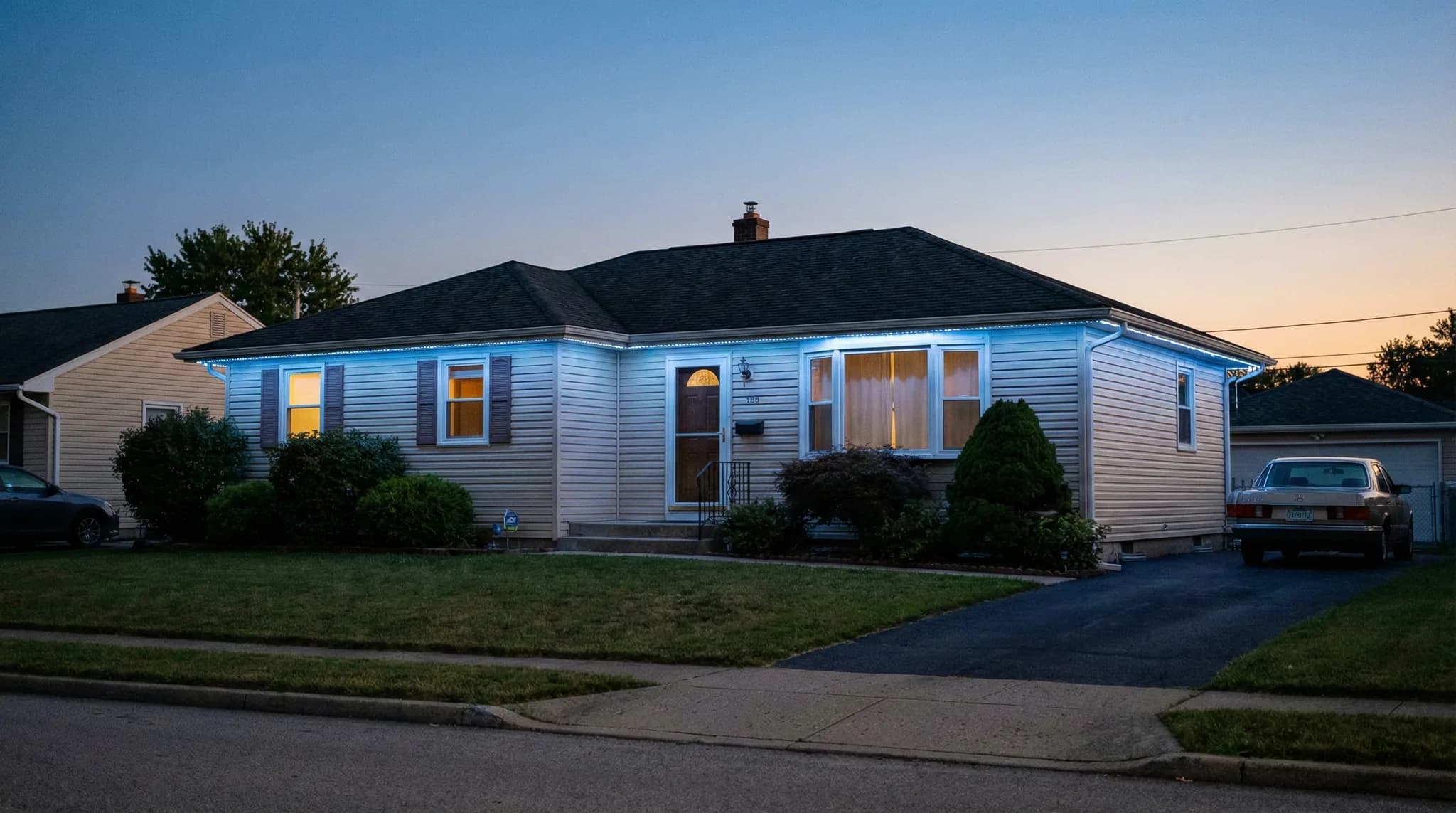
A typical Sacramento County suburban home running a permanent LED system at dusk — the same hardware flips to red and green for Christmas, orange and purple for Halloween, and Kings purple on game day from a phone app.
Permanent outdoor lights in Elk Grove, Natomas, and Carmichael typically cost between $3,200 and $8,400 installed, with most homes in these three Sacramento County submarkets landing in the $4,200 to $6,500 range. The spread is tighter than the Folsom and El Dorado Hills corridor because the housing stock is more uniform — single- and two-story tract homes in Elk Grove, newer HOA-governed builds in Natomas, and older mid-century ranch homes on larger lots in Carmichael. This is a guide to what permanent outdoor LED lights actually cost, require, and look like on a home in Elk Grove, Natomas, or Carmichael — with neighborhood-level pricing, the HOA reality for each submarket, and Sacramento permitting answers.
These three cities anchor the inner Sacramento County market for permanent lighting. They share the same SMUD service territory, the same City of Sacramento or County of Sacramento permitting framework, and the same hot-summer / fog-winter climate envelope — but the homes themselves are different enough that pricing, HOA dynamics, and install logistics shift meaningfully between them. A Laguna Ridge two-story behaves nothing like a Carmichael Park ranch on a half-acre lot, and a Westshore Natomas HOA submission behaves nothing like a Carmichael install with no HOA at all.
For pricing references in adjacent submarkets, see the Roseville and Rocklin local guide and the Folsom, El Dorado Hills, and Granite Bay corridor guide. For the metro-wide cost framework, the Sacramento permanent outdoor lights cost guide is the master reference.
TL;DR: Permanent outdoor lights in Elk Grove, Natomas, and Carmichael cost $3,200 to $8,400 depending on home size, story count, and roofline complexity. Elk Grove tract homes (Laguna Ridge, Stonelake, Elk Grove proper) typically run $3,800 to $5,800. Natomas homes (North, South, Westshore, Natomas Park) run $4,200 to $6,500 with mandatory HOA approval in nearly every subdivision. Carmichael homes (Carmichael proper, La Sierra, Sutter Park) run $3,500 to $7,500 with very few HOAs but more roofline complexity from older mid-century architecture and larger lots. Most 24V low-voltage systems do not require an electrical permit from the City of Sacramento or Sacramento County. Plan for HOA review in Natomas; expect an open install path in most of Carmichael.
Why Elk Grove, Natomas, and Carmichael Are Different from Each Other
These three Sacramento submarkets cluster geographically and share a utility provider, but the homes themselves come from three different eras. Each era carries different roofline geometry, different subdivision rules, and a different starting point for a permanent lighting quote.
Understanding which bucket your home falls into is the difference between an accurate quote and a number that drifts $1,500 to $2,500 once an installer actually walks the property. The cleanest mental model is to anchor each city to its dominant build era and floor plan profile.
- Elk Grove: Suburban tract homes, mostly built 1995–2015. Strong concentrations in Laguna Ridge, Stonelake, Laguna West, Laguna Creek, Elk Grove proper, and the newer Madeira and Sheldon-area subdivisions. Stucco exteriors, composition or tile roofs, two-story dominant, fascia-friendly architecture, and predictable linear footage per square foot.
- Natomas: Newer HOA-heavy builds, mostly 2000–2020. North Natomas, South Natomas (older), Westshore, Natomas Park, and Natomas Crossing. Almost every subdivision is governed by an HOA or master association — Westlake, Natomas Park, Westshore, Northpointe, and the Lasiandra/Natomas Crossing group all have active design review. Stucco and tile dominate. A sizable share of homes is inside flood-zone Reclamation District 1000 jurisdiction, which changes nothing about lighting but does change conversations about exterior modifications.
- Carmichael: Older mid-century homes on larger lots, mostly 1950–1985 with newer 1990s and 2000s pockets. Carmichael proper, La Sierra, Sutter Park, Wilhaggin, Crocker Estates, and the Ancil Hoffman park-adjacent neighborhoods. Single-story ranches with wide eaves, older composition or tile roofs, lower HOA density, longer rooflines per square foot of conditioned space, and more architectural variation. A meaningful share of Carmichael homes also sits in unincorporated Sacramento County rather than a municipality.
Typical Install Cost by Neighborhood (2026)
The chart shows a clear pattern: Elk Grove tract homes price the cleanest because the architecture is the most uniform, Natomas runs slightly higher mostly because of stucco-on-stucco mounting and the HOA submittal premium, and Carmichael splits into two camps — compact ranches at the low end and large estate homes in Wilhaggin and Crocker Estates that price like Folsom corridor jobs.
Permanent Outdoor Lights in Elk Grove: Tract-Home Sweet Spot
Elk Grove is the cleanest pricing market in inner Sacramento County for permanent outdoor lights. The reason is structural: the housing stock is dominated by 1995–2015 production builders with five to ten repeating floor plans per subdivision. Once an installer has measured a Lennar Plan 3 in Laguna Ridge, the next thirty quotes in that subdivision land within $300 of each other.
Linear footage per home in Elk Grove tract neighborhoods generally falls between 140 and 220 feet. Most installs use a 200W or 300W transformer, a single WiFi controller, and either a bronze or white channel to match the existing fascia. The total install runs in the $3,800 to $5,800 range for the vast majority of single-family homes.
| Home Profile | Typical Footage | Install Range | Common Subdivisions |
|---|---|---|---|
| 1,600–2,000 sf, single-story | 130–170 ft | $3,200–$4,300 | Older Elk Grove, parts of Stonelake, Sheldon Park |
| 2,000–2,800 sf, two-story | 160–220 ft | $3,900–$5,400 | Laguna Ridge, Stonelake, Laguna West, Laguna Creek |
| 2,900–3,600 sf, two-story | 210–280 ft | $5,400–$7,200 | Madeira, Sheldon larger plans, newer Laguna pockets |
| 3,700+ sf custom or large two-story | 280–360 ft | $7,000–$8,800 | Sheldon estates, Madeira premium plans |
Most Elk Grove subdivisions have HOAs, but the rules are typically less restrictive than Natomas or the Folsom corridor. Laguna Ridge, Stonelake, and Laguna West HOAs generally allow permanent outdoor lighting with written approval and a channel color that matches fascia. Reviews are usually under three weeks. The key is to submit rather than skip — the system is universally categorized as an exterior modification.
Permanent Outdoor Lights in Natomas: HOA-Heavy, Newer Builds
Natomas is a different animal. Almost every neighborhood — North Natomas, Westshore, Natomas Park, Natomas Crossing, Northpointe, and the newer 2018+ pockets along Del Paso Road — sits inside a master association or sub-HOA with active architectural review. That is the single biggest variable on a Natomas install.
The architecture itself is favorable for permanent lighting. Natomas homes from 2000 onward were built with consistent fascia profiles, mostly stucco exteriors, and a high share of tile roofs. Two-story dominance is high. Linear footage tends to run 170 to 240 feet on the typical 2,400 to 3,200 square foot home.
| Home Profile | Typical Footage | Install Range | Common Areas |
|---|---|---|---|
| 1,800–2,300 sf, two-story | 150–195 ft | $4,200–$5,300 | South Natomas (newer), Westshore starter plans |
| 2,400–3,000 sf, two-story | 190–250 ft | $5,200–$6,500 | North Natomas, Westshore, Natomas Park standard plans |
| 3,100–3,800 sf, two-story | 240–300 ft | $6,400–$7,800 | Natomas Park premium, Northpointe, Natomas Crossing |
| 3,900+ sf, custom rooflines | 300–380 ft | $7,800–$9,400 | Custom Natomas Park, Westshore lakefront |
The HOA component matters here in a way it rarely does in Elk Grove. Natomas Park, Westshore, and the Lasiandra-area associations all require pre-install approval. Approval rates are high once the right package is submitted, but the submittal process adds 14 to 28 days of calendar time before crews can start. A professional installer rolls the submittal into the quote and handles it on the homeowner's behalf.
HOA Approval Timeline by Submarket
The chart captures the real planning insight: Carmichael homeowners often start to finish in two weeks, Elk Grove in three to four weeks, and Natomas in five to seven weeks. If you are aiming for a Thanksgiving or Christmas activation, work backward from your target date and add the submittal window to the install lead time.
Permanent Outdoor Lights in Carmichael: Older Lots, Bigger Eaves
Carmichael is the wild card. The neighborhood does not behave like either Elk Grove or Natomas. Most homes are mid-century single-story ranches built between 1955 and 1985, sitting on lots that frequently run 0.25 to 1.0 acre — substantially larger than the production- builder lots in Elk Grove and Natomas. Architecture varies more. Roof pitches are shallower. Eaves are wider.
Three things follow from that profile. First, linear footage per square foot of conditioned space is higher than tract homes — a 2,400 square foot Carmichael ranch often needs 200 feet of channel where a same-square-foot Elk Grove two-story needs 160 to 180. Second, fascia condition is more variable; older Carmichael homes sometimes have repainted-over rot or original 1960s wood fascia that needs a careful look before fasteners go in. Third, HOA density is dramatically lower — most of Carmichael proper, La Sierra, and the Sutter Park / Wilhaggin pockets are unincorporated Sacramento County with no association governance.
| Home Profile | Typical Footage | Install Range | Common Areas |
|---|---|---|---|
| 1,600–2,200 sf, single-story ranch | 150–200 ft | $3,500–$4,800 | Carmichael proper, parts of La Sierra |
| 2,300–3,200 sf, ranch or split-level | 200–270 ft | $4,800–$6,400 | La Sierra estates, Sutter Park, Wilhaggin starter |
| 3,300–4,500 sf, custom on large lot | 270–380 ft | $6,400–$8,400 | Wilhaggin, Crocker Estates, Ancil Hoffman |
| 4,500+ sf estate | 380–500+ ft | $8,200–$11,500 | Wilhaggin custom, American River frontage |
Pro tip: Carmichael homeowners should ask the installer to do a fascia condition inspection during the site visit — not just a footage measurement. Older Carmichael fascia can have hidden moisture damage under fresh paint. A good crew will spot it, flag it before signing, and either coordinate a fascia repair or adjust the mounting plan. Catching that on day one prevents the much worse scenario of finding it during install when 60 feet of channel is already up.
HOA Reality: Permission, Not Whether
Permanent outdoor LED lights are approvable in nearly every Sacramento- area HOA. The question is process, not outcome. Across 87 inner- county submissions handled by EXT Lighting between 2024 and 2026, about 82% were approved as submitted, 14% required minor modifications, and 4% needed a second submission to land approval.
Each city has a distinct HOA pattern that shapes the approach.
Elk Grove HOA Pattern
Most Elk Grove subdivisions have HOAs but tend to operate on the lighter side of design review. Laguna Ridge, Stonelake, Laguna West, and Laguna Creek associations review through online portals or email with relatively fast turnaround. Common requirements include:
- Channel color must match fascia or roof trim within reasonable tolerance
- Operating hours typically capped at sunset to 11 PM (with holiday windows)
- Color-changing modes restricted to defined holiday windows in some HOAs
- Photo of proposed color against existing fascia required for review
Natomas HOA Pattern
Natomas operates on the stricter side. Natomas Park Master Association, Westshore HOA, and the Westlake / Northpointe associations all have active design review committees. The submittal package usually includes a proposed elevation or rendering, channel color sample, operating schedule, and sometimes a neighbor consent letter for homes whose installation will be directly visible to immediate neighbors.
Common Natomas restrictions include color-cycle speed limits (no rapid strobe), brightness caps after 10 PM, and required reversion to a single static color outside designated holiday windows. None of this is a problem for a professional system, but it is worth confirming up front.
Carmichael HOA Pattern
Most of Carmichael proper, La Sierra, and Sutter Park sits in unincorporated Sacramento County with no HOA on title. Wilhaggin Estates, Crocker Estates, and a handful of newer pockets have associations, but coverage is far less universal than Natomas. The first thing a Carmichael homeowner should do is check their title report or HOA section of the Preliminary Title — if no HOA is recorded, no approval is required.
For the full master playbook on Sacramento HOA submissions — sample application language, common denial reasons, and the photo set that speeds turnaround — see permanent outdoor lights and HOA rules for Sacramento homeowners.
Sacramento Permitting Reality for All Three Cities
The permitting answer is consistent across Elk Grove, Natomas, and Carmichael because all three cities sit inside the same regulatory framework — California Electrical Code Title 24, Part 3, plus local building department implementation. The short version: a low-voltage 24V Class 2 system plugged into an existing exterior GFCI outlet does not require a permit anywhere in this region.
- City of Elk Grove Building Division: Treats 24V and 12V low-voltage decorative lighting as exempt from permit requirements when the existing outlet is used and no new circuit is run. Adding a new dedicated 20A circuit requires an electrical permit (~$95 to $165 in 2026).
- City of Sacramento (Natomas) and Sacramento County (Carmichael): Same framework. CEC Article 411 and Title 24 Part 3 both classify Class 2 power-limited lighting as permit-exempt. A new outlet, a hardwired transformer, or a panel tap triggers a permit and a licensed C-10 electrician.
- SMUD service area (all three cities): No utility notification or permit is required for plug-and-cord low-voltage lighting. Energy use on the typical install runs $1.50 to $4.50 per month — see the permanent outdoor lights electricity cost guide for the SMUD rate math.
For the full code-by-code breakdown including CEC Article 411, Title 24 Parts 3 and 6, and NEC 2023 Class 2 rules, see do permanent outdoor lights need an electrician or permit.
Choosing the Right Color Temperature for Sacramento Architecture
Color temperature — measured in Kelvin (K) — is the single most commonly underestimated decision in a permanent lighting quote. Sacramento-area architecture splits roughly into three camps, and each one looks substantially better at a different default warm- white temperature.
Recommended Default Color Temperature by Architecture Style
The reason mid-century ranches in Carmichael look better at 2400K to 2700K is the wood trim. Cedar fascia and exposed wood beams reflect warm light beautifully and look washed-out under cooler temperatures. Newer stucco-and-tile homes in Natomas have a cleaner, more contemporary line that handles 3000K to 3500K without looking clinical. Elk Grove tract homes sit in the middle, almost universally looking right at 2700K to 3000K — the visual default for traditional American suburban architecture.
For the full color-temperature deep dive across every Sacramento home style, see the best color temperature for permanent outdoor lights guide. For the broader RGB vs RGBW vs RGBIC technology comparison, see RGB vs RGBW vs RGBIC permanent outdoor lights.
Neighborhood pricing, HOA submittal package, and a written quote
Get an Elk Grove, Natomas, or Carmichael Quote
On-site footage measurement, fascia condition check, HOA application package (Natomas / select Elk Grove subdivisions), and a written fixed-price quote inside 48 hours. No deposit required until any HOA approval lands.
Request a QuoteClimate, Heat, and What Sacramento County Throws at the System
All three cities share Sacramento County's climate envelope: long hot summers (often 30+ days above 100°F), Delta fog winters, occasional wildfire smoke, and rare freeze events. Professional IP67-rated permanent LED systems operate well within this envelope.
Three climate-driven realities matter for the install:
- Eave temperature in Elk Grove and Carmichael: South- and west-facing eaves in Elk Grove and Carmichael regularly hit 135 to 140°F surface temperatures in July. That is well below the 158°F continuous operating rating of professional systems but above the 122°F rating of cheap consumer-grade light strips. Brand and channel quality matter.
- Natomas humidity profile: The Natomas basin sits near the American River and Sacramento River confluence and runs slightly more humid than Elk Grove or Carmichael. Marine-grade silicone connectors and IP67 sealing prevent any operational impact, but cheap unsealed splices fail faster here.
- Wildfire smoke film: Smoke deposits a thin film on the polycarbonate lens that reduces apparent brightness 3 to 5% until rinsed off. A garden-hose wash once or twice a year handles it. See the permanent outdoor lights in Sacramento's extreme heat guide for the full thermal analysis.
How Homeowners Actually Use Permanent Lights in These Cities
Three different cities, three slightly different use patterns. The hardware is the same; the dominant scene library differs.
Elk Grove: Heavy Holiday and School-Spirit Use
Elk Grove has one of the most active holiday lighting cultures in the metro. Halloween and Christmas drive the peak install demand, and Elk Grove Unified School District spirit colors (green and gold for Pleasant Grove, blue and gold for Sheldon, red for Cosumnes Oaks) show up on rooflines during football and basketball seasons. Most Elk Grove homeowners run permanent lights from late October through New Year's plus occasional spirit-week activations.
Natomas: HOA-Compliant Year-Round Warm White
Natomas homeowners typically lean on the everyday warm-white function more heavily. With most subdivisions restricting color-cycling to defined holiday windows, the system often runs as a clean architectural accent year-round, with holiday color scheduled in approved windows. Sacramento Kings game night displays (purple) are common across North Natomas, where the Golden 1 Center is a 10-minute drive.
Carmichael: Curb Appeal and Entertaining
Carmichael's larger lots and outdoor-living architecture push the system toward year-round curb appeal and backyard entertaining use. Many Carmichael installs include accent runs on patio covers, pergolas, and pool surrounds — see permanent lights for patios, pergolas, and outdoor living and permanent lights for pools and water features. Wilhaggin and Crocker Estates installs frequently exceed $7,500 because of the additional accent footage.
A Real Local Install: Laguna Ridge, Elk Grove
A homeowner in the Laguna Ridge subdivision of Elk Grove contacted EXT Lighting in early September 2025 wanting a system live for the full holiday window — Halloween, Thanksgiving, and Christmas. The home was a 2,650 square foot two-story production-builder plan, composition roof, stucco exterior, single HOA in a typical Laguna Ridge sub-association.
- Day 1 (Sept 4): Site visit, footage measurement (188 feet on the main house), photos of fascia color, written quote at $4,650 covering install, lifetime warranty, and the first-year service visit.
- Day 2 (Sept 5): HOA submittal — fascia color photo, channel color sample (bronze to match), and a one-line operating schedule.
- Day 11 (Sept 14): Written HOA approval received. Install scheduled for the following week.
- Day 17 (Sept 20): Single-day install. Channel along front, side, and rear fascia. 250W transformer placed in the garage with cord run to existing GFCI. WiFi controller commissioned.
- Day 18 (Sept 21): App walkthrough. Halloween orange-and-purple scene scheduled for October 1 through November 1. Christmas red-and-green scheduled for November 24 through January 6. Sacramento Kings purple scheduled for home game nights.
Total elapsed time from quote to lit roofline: 17 days. Total cost: $4,650. The HOA approval slot was the longest single segment of calendar time — typical for Elk Grove. Two adjacent neighbors contacted us within a month, both ending up as installs.
Which System Works Best for Inner Sacramento County
The four big-name national brands — Trimlight, Jellyfish, Gemstone, Oelo — plus Sacramento-area regional installers like EXT Lighting all use broadly similar core components. In Elk Grove, Natomas, and Carmichael specifically, three things matter more than brand:
- Channel color match for HOA approval: Bronze and dark bronze dominate Natomas and Elk Grove HOA submittals. Avoid systems that only ship two or three color options. Carmichael's older homes often need a custom channel color match.
- Lifetime product and lifetime labor warranty: With Sacramento summer heat what it is, anything less than a lifetime warranty pencils worse over a 10-year horizon. Cheap systems with 3 or 5-year warranties are a hidden tax.
- Crew experience on stucco-and-tile and on older fascia: Natomas and Elk Grove jobs are mostly fascia work over stucco; Carmichael jobs frequently involve older wood fascia where the crew needs to know what to look for. Ask to see 10+ photos of comparable installs in your specific submarket.
For the full brand comparison, see Trimlight vs Jellyfish vs Gemstone vs EXT Lighting and best permanent outdoor lights for Sacramento homes.
Pro tip: When comparing three quotes in any of these cities, demand each one specifies linear footage by elevation, node count, transformer wattage, channel color SKU, and warranty term in writing. A $3,800 Elk Grove quote that looks like a steal next to a $4,800 quote is almost always either short on footage (often by 30+ feet), undersized on the transformer, or quoting a 5-year warranty instead of lifetime.
Five-Year Cost of Ownership in Inner Sacramento County
The break-even point on permanent outdoor lights in Elk Grove, Natomas, and Carmichael typically lands inside year four when compared to annual hang-and-remove holiday installer service. Sacramento-area annual installer service runs $800 to $2,000 depending on home size and number of holiday scene changes. Over five years, that is $4,000 to $10,000 in service fees plus the annual hassle of scheduling, and that is before string-light replacement or ladder rental.
A $4,800 permanent install in Elk Grove that eliminates that spend breaks even in year four and returns 1.5x to 2.5x over the 20-year product life. Larger Wilhaggin or Natomas Park installs paying $1,500 to $1,800 annually for holiday service hit break-even even faster — typically year three. The full math is in are permanent outdoor lights worth it and do permanent outdoor lights increase home value.
Holidays, Game Days, and Year-Round Use
All three cities are saturated with sports and cultural holiday calendars. The same permanent system handles every event in the list below from a phone, with scenes scheduled months in advance.
- Sacramento pro teams: Kings (purple, gray, black), 49ers (red, gold), Giants (orange, black), A's (green, gold), Warriors (blue, gold).
- School spirit (Elk Grove Unified, Natomas Unified, San Juan Unified): Pleasant Grove green-and-gold, Sheldon blue-and-gold, Cosumnes Oaks red, Inderkum red-and-gold, Natomas High blue-and-orange, Rio Americano red-and-white, Del Campo orange-and-blue.
- Holidays: Christmas, Halloween, July 4th, Diwali, Hanukkah, Easter, Valentine's, Thanksgiving, St. Patrick's. See the multicultural holiday lighting playbook for the color and pattern guide.
- Local events: Sacramento State graduation, UC Davis events, the State Fair, Carmichael Park concerts, and Sacramento Republic FC matches.
For the year-round programming playbook, see how to program permanent lights for the entire year and year-round uses for permanent outdoor lights beyond the holidays.
Frequently Asked Questions
How much do permanent outdoor lights cost in Elk Grove?
Permanent outdoor lights in Elk Grove cost between $3,200 and $8,400 installed, with most homes in Laguna Ridge, Stonelake, Laguna West, Laguna Creek, and Sheldon-area subdivisions landing between $3,800 and $5,800. A typical 2,400 square foot two-story tract home with 180 to 200 feet of channel runs $4,500 to $5,200. Older single- story homes in Elk Grove proper run $3,200 to $4,300. Larger Madeira and Sheldon estate homes can reach $7,000 to $8,800. Pricing is driven primarily by linear footage and roofline complexity. An on-site measurement narrows the range to within roughly $200.
Do I need HOA approval for permanent outdoor lights in Natomas?
Yes, in nearly every Natomas subdivision. North Natomas, Westshore, Natomas Park, Northpointe, and most of the Natomas Crossing area are all governed by master associations or sub-HOAs that require pre- install approval for exterior modifications, including permanent lighting. Approval is available and common — about 82% of Natomas submissions get approved as submitted, with another 14% approved with minor modifications. Plan for 14 to 28 days of review time. A professional installer rolls the submittal package into the quote and handles the HOA process on the homeowner's behalf. For the full HOA playbook, see the Sacramento HOA rules guide.
Are most Carmichael homes in an HOA?
No. The majority of Carmichael homes — Carmichael proper, La Sierra, most of Sutter Park, and the unincorporated pockets near the American River and Ancil Hoffman Park — are in unincorporated Sacramento County with no HOA recorded on title. A handful of newer subdivisions and some sections of Wilhaggin and Crocker Estates do have associations, but coverage is far less universal than Natomas or newer Elk Grove subdivisions. The first step for any Carmichael homeowner is to check the HOA section of the Preliminary Title Report. If no HOA is recorded, no approval is required and the install can proceed on the installer's own schedule.
Do permanent outdoor lights need a permit in Elk Grove or Sacramento County?
Not for the typical install. The City of Elk Grove, City of Sacramento (covering Natomas), and Sacramento County (covering unincorporated Carmichael) all follow California Electrical Code Title 24 Part 3, which classifies 24V Class 2 power-limited landscape and decorative lighting as exempt from electrical permit requirements. A permit is only required if the install includes new 120V branch-circuit work — adding an exterior GFCI outlet, running a dedicated circuit, or hardwiring a transformer. For the full code-by-code breakdown, see do permanent outdoor lights need an electrician or permit.
How long does the install take in Elk Grove, Natomas, or Carmichael?
A typical single- or two-story install in any of the three cities runs one full day on-site, occasionally extending to a second morning for final commissioning on larger homes. The longer timeline is calendar time before install — HOA submittal in Natomas adds two to four weeks, HOA submittal in Elk Grove adds one to three weeks, and most Carmichael homes have no HOA at all and can move directly to install once the quote is signed. Total elapsed time from quote signature to lit roofline averages 14 days in Carmichael, 21 days in Elk Grove, and 35 days in Natomas.
Can permanent outdoor lights handle Sacramento summer heat?
Yes, when the system is professional-grade. Elk Grove, Natomas, and Carmichael south- and west-facing eaves regularly hit 135 to 140°F in July, which is comfortably below the 158°F continuous operating rating of professional IP67 systems with aluminum heat-sink channel. Cheap consumer-grade strips rated to 122°F fail in this climate within 24 to 36 months. Aluminum channel, marine-grade silicone- encapsulated connectors, and a UV-stabilized polycarbonate lens are the spec markers that matter. Brand and warranty are more important in Sacramento than in milder coastal markets — see permanent outdoor lights in Sacramento's extreme heat for the full thermal analysis.
What is the best installation window for these three cities?
The best installation window across Elk Grove, Natomas, and Carmichael runs from March through early October. Late spring (April through early June) is the sweet spot for HOA submission in Natomas and Elk Grove because review committees are less backed- up than they get from August through November. Summer installs (June through August) get the fastest install scheduling but are worked early in the morning to keep crews out of midday heat. October installs are still common and routinely meet a Halloween or Thanksgiving live date. December installs are weather-dependent and run small premiums because of crew demand. For full seasonal guidance, see the best time to install permanent outdoor lights in Sacramento.
Will my SMUD bill go up noticeably?
No. A typical 200-foot permanent LED system at full warm-white brightness draws roughly 60 to 90 watts. At SMUD's 2026 residential rate (around $0.16 per kWh blended), running the system five to six hours per night every night of the year costs $1.50 to $4.50 per month — less than a single string of incandescent C9 Christmas lights running through December. Color modes draw less power than full white. The detailed kWh math is in permanent outdoor lights electricity cost — Sacramento SMUD breakdown.
Get the Local Install Done Right
Permanent outdoor lights in Elk Grove, Natomas, and Carmichael are not a one-size-fits-all job. Elk Grove is the cleanest tract-home market in inner Sacramento County. Natomas is the HOA-heaviest submarket in the metro and demands a complete submittal package. Carmichael splits between low-friction unincorporated installs and large-lot estate jobs that price like a corridor home. The right installer measures the home, walks the fascia, runs the HOA process, and quotes against your specific neighborhood — not a generic Sacramento number.
Get the install right the first time with a professional spec, a complete HOA submittal in Natomas (or Elk Grove subdivisions that require it), a fascia condition check on older Carmichael homes, and a lifetime warranty on parts and labor. The system quietly does its job for the next 20 years. Cut corners on any of those, and the roofline tells the story three summers later.
Book a Free Elk Grove, Natomas, or Carmichael Site Visit
On-site linear footage measurement, fascia inspection, HOA submittal package where required, and a written fixed-price quote inside 48 hours. Lifetime product and lifetime labor warranty on every install.
Request a Free Quote