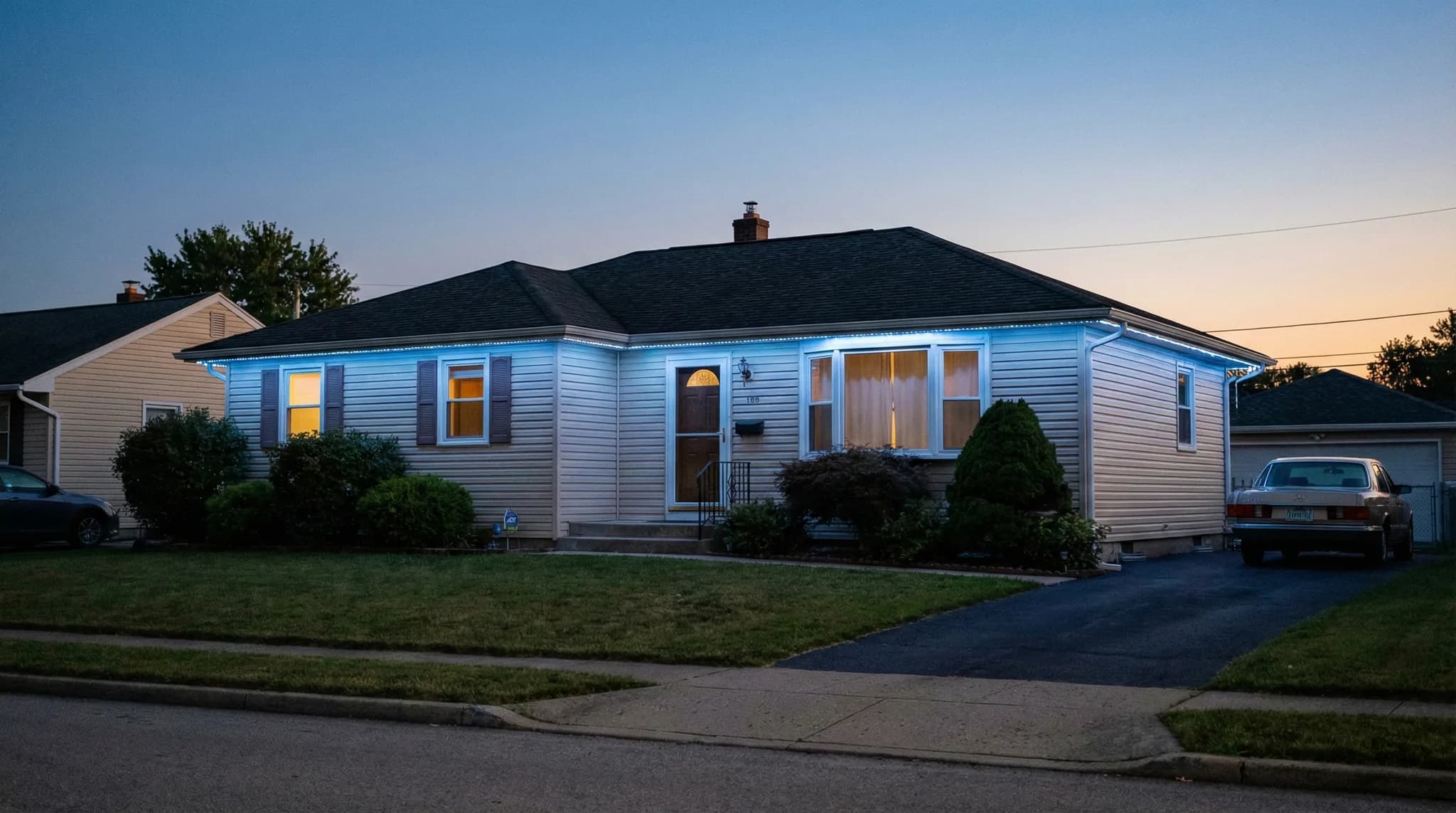
Sacramento's most sought-after neighborhoods – Serrano in El Dorado Hills, West Roseville, Whitney Ranch, Empire Ranch in Folsom – share something in common beyond great schools and high property values. They're almost all governed by homeowners associations. Roughly 1,500 HOAs cover 135,000 housing units across Sacramento, Placer, El Dorado, and Yolo counties, according to Abridged.org. If you want permanent outdoor lights on your home, chances are you'll need HOA approval first.
The good news? Permanent lighting systems are designed in a way that makes HOA approval straightforward. The track-mounted fixtures sit flush against your roofline, use warm white LEDs as their default, and run on app-controlled schedules that prevent late-night disturbances. Most boards approve them without pushback once they see the details.
This guide walks through HOA prevalence in the Sacramento metro, what boards typically restrict, your legal rights under California law, and a step-by-step process for getting your application approved.
TL;DR: About 1,500 HOAs govern 135,000 housing units in the Sacramento metro area (Abridged.org). Permanent outdoor lights typically pass architectural review because they're low-profile, default to warm white, and meet California Title 24 energy standards. Submit your application with product specs, a photo mockup, and your installer's credentials. California law requires your HOA to respond within 45 days.
How Common Are HOAs in Sacramento's Permanent Lighting Service Area?
Extremely common. California has approximately 51,250 HOA communities covering more than 14 million residents, making it the most HOA-dense state in the country (CAI Foundation for Community Association Research, 2024). Within the Sacramento metro, roughly 1,500 associations manage 135,000 housing units across four counties. If you live in a subdivision built after 1990, you almost certainly have CC&Rs.
The concentration is even higher in the suburbs where permanent lighting is most popular. Roseville, Folsom, El Dorado Hills, and Rocklin have some of the highest HOA penetration rates in the region. Placer County alone has 33,855 units under HOA governance – 27% of all homes in the county (Abridged.org).
HOA Coverage by County
| County | HOA Communities | Housing Units | % of Homes in HOA | Median Monthly Fee |
|---|---|---|---|---|
| Sacramento | 755 | 61,230 | 18% | $158/mo |
| Placer | – | 33,855 | 27% | $148/mo |
| El Dorado Hills* | 41+ | – | High | Varies |
*El Dorado Hills has 41 listed HOA/ACC communities per EDHCSD data. Sources: Abridged.org, CAI Foundation.
Here's what that means in practical terms: 64.7% of newly constructed homes in 2023 were built within HOA communities (CAI Foundation, 2024). If your home is in a newer Sacramento-area development – Stanford Ranch, Westpark, Broadstone – HOA approval is a step you can't skip.
What Do HOAs Typically Restrict When It Comes to Exterior Lighting?
Most HOA lighting rules focus on preventing nuisance, not banning lights outright. DarkSky International recommends outdoor fixtures at 3000K or lower with shielded, downward-directed output – and that's exactly what well-designed permanent systems deliver by default. Understanding your board's specific restrictions helps you frame your application as a compliance win rather than a request for an exception.
Brightness and Lumens
Many CC&Rs cap exterior fixture brightness or require "residential-scale" output. Permanent LED systems typically run at moderate lumens per node – bright enough for curb appeal and security, but well below floodlight territory. The app lets you dim output to any percentage, so you can adjust to match whatever threshold your board sets.
Color Temperature and Appearance
Warm white in the 2700K–3000K range is the default for most permanent systems and the preferred range for most HOAs. Boards that restrict "decorative lighting" are usually targeting bright blue, red, or flashing displays – not the soft amber-white glow of a well-tuned LED roofline. Check out our color guide for details on choosing the right look.
Light Trespass
This is the big one. Light trespass – your fixtures spilling light onto a neighbor's property – triggers more complaints than any other lighting issue. Permanent systems mount along the roofline and project downward against the fascia or soffit. They don't throw light sideways or across property lines the way pole-mounted or landscape spotlights can.
Fixture Design and Aesthetics
HOAs care about visual consistency. Temporary string lights, clip-on fixtures, and mismatched hardware look messy from the street. Permanent track systems are a single clean line that matches your trim color. When the lights are off during the day, most people can't tell the system is there at all. That's a major selling point in your application.
Timing and Schedules
Some CC&Rs require automatic shutoff or dimming after 10 or 11 PM. With app-controlled scheduling, you can program exact on/off times, dimming curves, and even seasonal presets. Include your planned schedule in your HOA application to show the board you've thought this through.
What's worth noting: most HOA lighting restrictions were written with temporary holiday displays and aftermarket floodlights in mind. A professional permanent system actually exceeds what most CC&Rs require. The approval conversation isn't about getting an exception – it's about demonstrating compliance.
What Does California Law Say About HOA Architectural Review?
California law protects homeowners during the HOA approval process. The Davis-Stirling Act (Civil Code 4765) says board decisions must be "made in good faith and may not be unreasonable, arbitrary, or capricious" (Cal. Civ. Code 4765(a)(2)). In plain terms: your HOA can't say no without a real reason. That matters if your board pushes back.
Your Rights Under Civil Code 4765
- Fair and expeditious review. Your HOA must provide a "fair, reasonable, and expeditious procedure" for reviewing architectural applications (4765(a)(1)).
- Written denials with reasons. If your application is denied, the board must put it in writing and cite the specific rule or guideline you violated (4765(a)(4)). A vague "we don't allow that" isn't sufficient.
- No unreasonable decisions. The board can't act arbitrarily. If your system meets every stated requirement in the CC&Rs and the board still says no, you have grounds to challenge.
- Timeline protections. Most CC&Rs give the board 30–60 days (45 is common) to respond. Failure to act within the stated window may constitute automatic approval, depending on your association's governing documents.
AB 130: New Limits on HOA Fines
Governor Newsom signed AB 130 in June 2025, capping most HOA violation fines at $100 per occurrence. While this doesn't directly change architectural review, it limits the financial pressure an HOA can apply if you're in a dispute over an improvement. Before this law, some associations used escalating fines as a heavy-handed enforcement tool.
Title 24 Energy Compliance
California's Title 24 energy code requires outdoor light fixtures to be high-efficiency. LED systems meet this standard by default. So if your HOA asks whether the lights meet building code, you can point to Title 24 as a simple answer. Professional-grade permanent systems are built to meet or exceed these rules.
How Do You Get Permanent Outdoor Lights Approved by Your HOA?
The approval rate climbs when you treat your application like a professional proposal, not a casual request. About 37% of California homes belong to HOA communities (CAI Foundation, 2024). Homeowners who include product specifications and visual mockups in their submissions report smoother review experiences. Here's a step-by-step approach that works.
Step 1: Read Your CC&Rs and Architectural Guidelines
Before you do anything else, pull up your association's CC&Rs and any separate architectural guidelines document. Search for terms like "exterior lighting," "holiday lights," "fixtures," and "modifications." Know exactly what rules apply before you start drafting your application.
Step 2: Get a Professional Quote with Specifications
A professional installer provides product spec sheets, fixture dimensions, color temperature data, and mounting details. This documentation does double duty – it informs your purchase decision and gives the HOA board exactly what they need to evaluate your request. You can request a free quote to get these materials.
Step 3: Prepare a Photo Mockup
Take a daytime photo of your roofline. Ask your installer for a rendering or mockup showing the track placement and nighttime appearance. Board members who can visualize the finished product are far less likely to object. A good mockup addresses the "what will this look like?" concern before it's ever raised.
Step 4: Highlight HOA-Friendly Features in Your Application
Your written application should emphasize the specific features that align with common CC&R requirements:
- Default warm white (2700K–3000K) color temperature
- Low-profile, flush-mounted track that matches trim color
- Downward-directed light with no trespass onto neighboring properties
- App-controlled scheduling with automatic shutoff capability
- Professional installation by a licensed and insured contractor
- LED efficiency meeting California Title 24 standards
- No visible wiring or conduit from street level
Step 5: Submit and Follow Up
Submit your application through your HOA's official channel – usually a form on a management portal or an email to the architectural committee. Keep a copy with a timestamp. If you haven't heard back within 30 days, send a polite follow-up referencing the timeline in your CC&Rs. Remember, California law requires a "fair, reasonable, and expeditious" process.
Why Do Permanent Lights Actually Help HOA Communities?
HOA boards exist to protect property values and neighborhood aesthetics – and permanent lights support both goals. Homes in HOA communities sell for at least 4% more (roughly $13,500) than comparable non-HOA homes, according to a study in the Journal of Urban Economics (Clarke & Freedman, 2019). Uniform, professional lighting strengthens the curb appeal that drives those premiums.
Property Value and Curb Appeal
The numbers are clear. 97% of National Association of Realtors members say curb appeal is important in attracting buyers, and 92% recommend sellers improve their exterior appearance before listing (NAR 2025 Remodeling Impact Report). Permanent lighting adds a visible upgrade that benefits every home on the street, not just the one with the lights.
When multiple homes in a neighborhood install permanent systems, the overall look becomes more cohesive. That's exactly the kind of improvement HOA boards are supposed to encourage. Curious about the financial picture? Our ROI analysis breaks down the long-term value.
Security Benefits the Whole Neighborhood
A 2019 randomized controlled trial conducted in New York City and funded by the National Bureau of Economic Research found that areas with improved outdoor lighting experienced a 36% reduction in nighttime index crimes (NBER/University of Chicago, 2019). That's not a marginal effect – it's a significant deterrent. A well-lit roofline signals that someone is home and paying attention.
For more on how lighting fits into a home security strategy, see our outdoor lights and security guide.
Eliminating the Temporary Light Problem
Every HOA board dreads the annual cycle: holiday lights go up in November, and a handful of homes still have them dangling in March. Enforcement is awkward and time-consuming. Permanent systems eliminate this entirely. The fixtures are always installed, always neat, and switch between white and seasonal colors through the app – no ladder, no sagging clips, no violation letters.
Resident Satisfaction
89% of HOA residents rate their experience as "very good" or "excellent," according to a CAI/Zogby survey. Boards that approve improvements residents actually want – rather than defaulting to "no" – tend to maintain that satisfaction. Permanent lighting is a low-risk approval that homeowners genuinely appreciate.
What If Your HOA Denies Your Application?
Denials happen, but California law limits how far an HOA can go. Under Civil Code 4765(a)(2), decisions must not be "unreasonable, arbitrary, or capricious." If your permanent lighting system meets every written standard in the CC&Rs and the board still denies it, you have options.
Request the Specific Reason in Writing
California law requires a written denial citing the exact rule you violated. If you receive a vague rejection – or no written response at all – send a formal letter requesting the specific CC&R section and the factual basis for denial. This creates a paper trail and puts the board on notice that you know your rights.
Request Reconsideration
Most CC&Rs include a reconsideration or appeal process. Use it. Address the stated objection directly. If the board cited color concerns, include your warm-white spec sheet. If they cited aesthetics, submit the photo mockup. If they cited a rule that doesn't actually apply to your system, point that out respectfully but clearly.
Attend the Board Meeting
Board meetings are typically open to homeowners under the Davis-Stirling Act. Showing up in person (or on Zoom, if your board offers it) lets you present your case directly. Bring printed materials. Be specific, be brief, and be polite. Board members are your neighbors, not adversaries.
Escalation Options
If informal resolution fails, California homeowners can pursue mediation or, in some cases, file a complaint with the Department of Real Estate or pursue legal action under Davis-Stirling. With AB 130 capping fines at $100 per violation, the financial stakes of a dispute are lower than they used to be. That said, most permanent lighting applications don't reach this point.
Frequently Asked Questions
Do permanent outdoor lights need HOA approval in Sacramento?
In most cases, yes. Any exterior modification in an HOA community typically requires architectural committee review. About 1,500 HOAs govern 135,000 housing units across the Sacramento metro (Abridged.org). Submit a formal application with product specs, a photo mockup, and your planned lighting schedule before installation.
How long does HOA approval take for permanent lights?
Most CC&Rs give the architectural committee 30–60 days to respond, with 45 days being the most common window. California Civil Code 4765 requires a "fair, reasonable, and expeditious" process. If your board doesn't respond within the stated period, check your CC&Rs for any automatic approval provision.
Can my HOA ban permanent outdoor lights entirely?
HOAs can regulate exterior lighting but must do so through rules that are reasonable and consistently applied. A blanket ban on all exterior lighting modifications would be difficult to enforce under California's "not unreasonable, arbitrary, or capricious" standard (Civil Code 4765). If your system meets all stated criteria and the board still denies it, you have reconsideration and legal options.
What color temperature do HOAs prefer for outdoor lights?
Warm white in the 2700K–3000K range is the most widely accepted color temperature for permanent outdoor lighting. This range aligns with DarkSky International recommendations and matches the look of traditional incandescent exterior fixtures. Most permanent systems default to this range and can display seasonal colors when appropriate.
Will permanent lights increase my HOA property values?
Research supports a positive relationship between exterior improvements and home values. HOA homes already sell for at least 4% more than comparable non-HOA properties (Clarke & Freedman, Journal of Urban Economics, 2019). Permanent lighting strengthens curb appeal – a factor that 97% of Realtors call important for attracting buyers (NAR, 2025). Learn more in our ROI breakdown.
Get Your Permanent Lights Approved and Installed
Living in an HOA doesn't mean giving up on permanent outdoor lighting – it just means following a process. And that process works in your favor when the system you're proposing is professional-grade, low-profile, energy-efficient, and app-controlled.
Start by reading your CC&Rs. Then get a professional quote with the spec sheets and mockups you'll need for your application. Our installation process guide covers what happens from first consultation to finished system.
Ready to get started? Request a free quote or explore our residential permanent lighting services to see what's possible for your home. We'll provide everything you need for a smooth HOA approval – including the documentation your architectural committee wants to see.