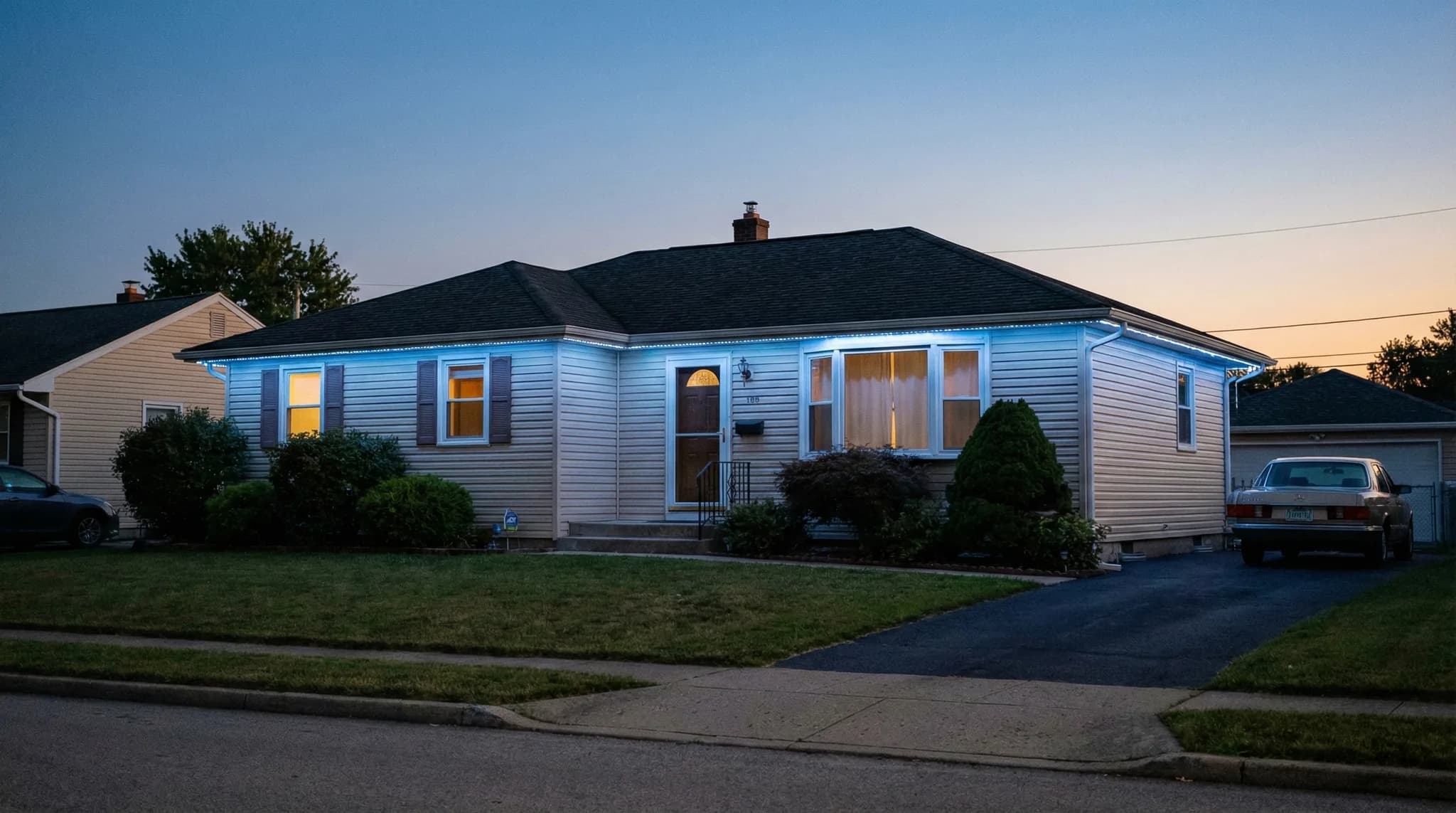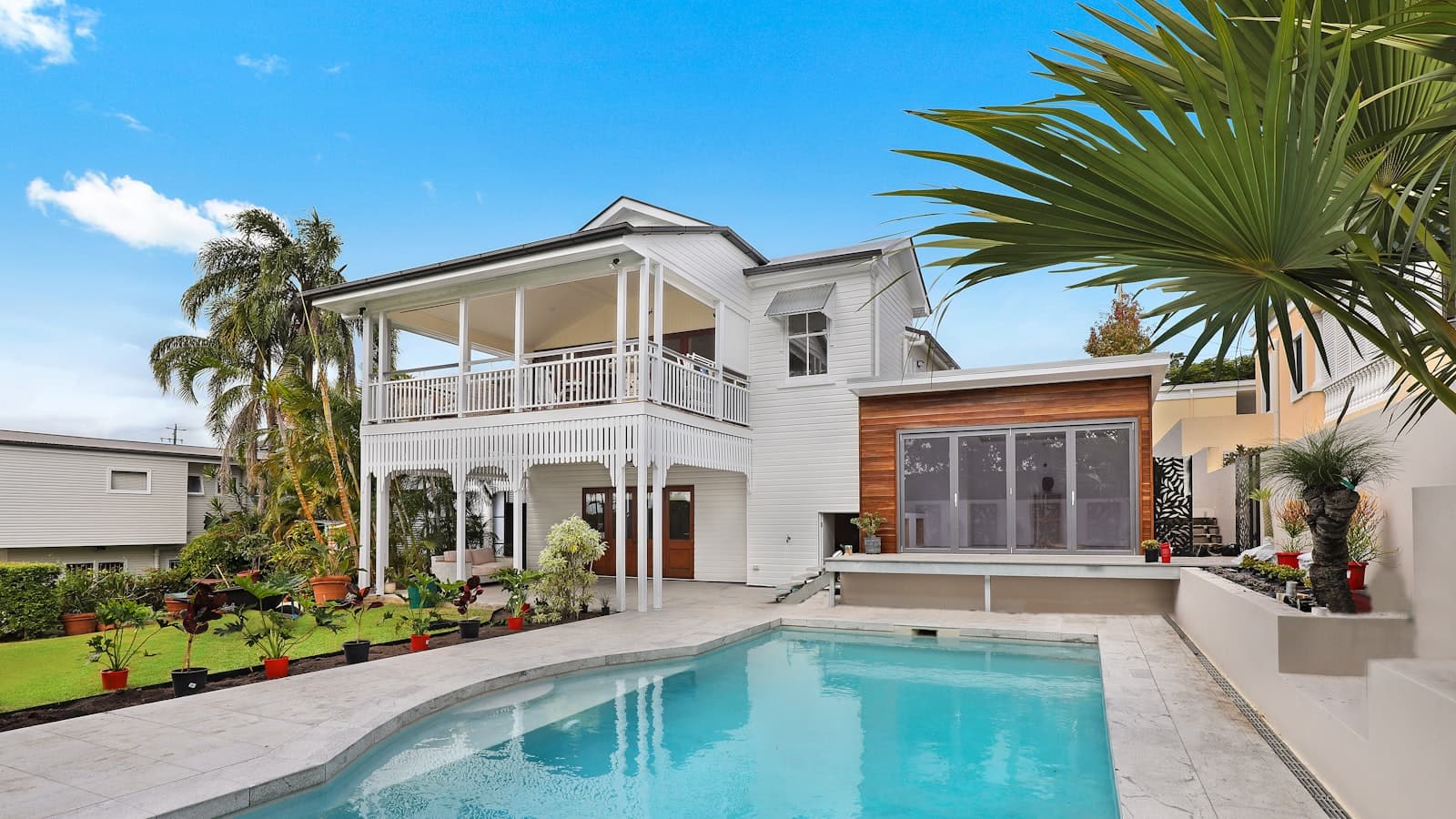
A Granite Bay estate at dusk running warm white permanent LED on a long roofline. The same channel switches to holiday color, school spirit, or game-day scenes from the app.
Permanent outdoor lights in Granite Bay estate homes typically cost between $8,500 and $18,500 installed, with most homes on Auburn-Folsom Road, in Los Lagos, and inside the Eureka Schools attendance area landing in the $11,000 to $15,000 range. The number is higher than the rest of Placer County because Granite Bay estates run on three variables that change the math: acreage (1 to 5+ acre lots), long rooflines (220 to 500+ linear feet), and high-end materials (stone veneer, smooth stucco, custom millwork) that demand a more careful mounting plan than a standard tract fascia.
This guide is specific to Granite Bay luxury homes — the kind sitting on Treelake, Wexford, Los Lagos, Lakeridge Oaks, Wilshire Oaks, or custom builds along Auburn-Folsom Road and Cavitt-Stallman. If you want a broader corridor overview that covers Folsom and El Dorado Hills as well, see the Folsom, El Dorado Hills, and Granite Bay corridor guide. What you are reading now is the estate-specific deep dive: how acreage changes the linear-footage math, which custom-architecture HOAs sit inside Granite Bay's unincorporated boundaries, how stone and stucco facades affect mounting, and where Placer County dark-sky and fire-resistant material rules intersect with luxury permanent lighting.
TL;DR: Permanent outdoor lights for Granite Bay estate homes run $8,500 to $18,500 because rooflines on 1+ acre lots reach 220 to 500+ linear feet versus 150 to 200 feet on a standard tract home. Granite Bay sits in unincorporated Placer County with no single municipal HOA — but Los Lagos, Lakeridge Oaks, Wexford, Treelake, and Wilshire Oaks each run their own architectural review boards with custom-home-specific design standards. Stone veneer, smooth stucco, and custom soffits all accept properly mounted IP67 channel without surface penetration. Placer County does not have a county-wide dark-sky ordinance, but the Folsom Lake State Recreation Area buffer and California fire code Chapter 7A (WUI) compatibility do shape installer choices on the foothill-adjacent estates near Auburn-Folsom Road.
What Makes a Granite Bay Estate Home Different
The word "estate" in Granite Bay is not marketing fluff. The 90746 ZIP code carries one of the highest median home values in Placer County, and the inventory is stacked toward custom builds on large lots rather than tract subdivisions. That shifts the lighting equation in three concrete ways.
First, lot size. A typical Sacramento or Roseville tract home sits on a 5,000 to 8,000 square foot lot. Granite Bay estate parcels commonly run 1 to 5 acres, with a meaningful share above 10 acres on Cavitt-Stallman, Sierra College Boulevard, and the Folsom Lake-adjacent custom corridor. Larger lots mean longer driveways, more outbuildings, and frequently a separate detached garage or ADU that owners want lit on the same controller.
Second, roofline complexity. Estate homes are rarely simple rectangles. Hip-and-gable combinations, dormers, porte-cochères, wrap-around porches, second-story balconies, covered loggias, and breezeways between the main house and detached structures all add linear footage. A 5,000 square foot Granite Bay estate often clocks more linear feet at the eave than a 7,000 square foot Roseville tract home, simply because the roof shape is more articulated.
Third, materials. Granite Bay estates skew heavily toward stone veneer wainscot, smooth and Santa Barbara stucco, cedar tongue-and- groove soffits, and custom corbeled fascia. None of these are hostile to permanent lighting, but each one demands a different mounting plan than a standard fiber-cement fascia. Cheap installers cut corners by trying to use the same fastener spec on every material. That is how stone veneer ends up with hairline cracks 18 months later.
- Lot footprint: 1 to 10+ acres versus 0.15 acres for a typical tract home.
- Roofline length: 220 to 500+ linear feet versus 150 to 200 feet for a 2,500 sq ft tract home.
- Architectural detail: Multiple wings, dormers, loggias, detached structures — not a single roof shape.
- Mixed materials: Stone, stucco, and wood in combination across the same elevation.
- Power and runs: Multiple transformer locations required because 24V drops too far across long perimeters.
Linear Footage by Home Type — Granite Bay Estates vs. Tract Homes
The chart above explains why estate quotes look different. Per-foot installed pricing in 2026 lands around $32 to $42 for professional IP67 systems on standard fascia. Multiply that against 380 to 480 feet instead of 180, and the budget conversation looks very different from a standard Sacramento permanent outdoor lights cost analysis. The granular breakdown in the pricing-by-home-size guide scales reasonably up to 3,500 square feet — Granite Bay estates need their own envelope above that line.
What Permanent Lights Actually Cost on a Granite Bay Estate
Estate-scale pricing splits into four bands by linear footage and story configuration. The table below reflects field measurements across Granite Bay installs in the Los Lagos, Lakeridge Oaks, Treelake, Wexford, and Auburn-Folsom Road custom corridor.
| Estate Profile | Linear Footage | Install Range | Common Neighborhoods |
|---|---|---|---|
| 3,500–4,200 sf, single-story estate | 240–310 ft | $8,500–$11,200 | Older Los Lagos, Wilshire Oaks, Treelake ranchers |
| 4,300–5,500 sf, two-story | 310–390 ft | $11,000–$14,500 | Los Lagos, Wexford, Lakeridge Oaks, Eureka Schools |
| 5,500–7,000 sf, two-story + detached structures | 390–470 ft | $13,500–$17,000 | Cavitt-Stallman, Auburn-Folsom Rd, custom Los Lagos |
| 7,000+ sf, custom estate + ADU/detached garage | 470–650+ ft | $16,000–$24,000 | Sierra College Blvd custom, Folsom Lake-adjacent |
These ranges include professional installation, premium IP67 fixtures with a lifetime product warranty, multi-zone WiFi controller, an appropriately sized transformer (or multiple transformers — see below), encapsulated connectors, and the first-year service visit. They do not include any new electrical circuit work; on most estate jobs, two existing exterior or garage outlets handle the load. If a dedicated 20A circuit is needed for the second transformer location, add $400 to $900.
Why two transformers? Voltage drop. A 24V DC permanent lighting system loses meaningful voltage past 130 to 150 feet of channel from a single transformer. Tract installs almost never run that far from one supply. Granite Bay estates routinely require bifurcating the system into a front-elevation transformer and a rear-or-detached transformer, with both controllers synced via WiFi for unified app control. Cheap installers run a single 700W unit and accept brownout at full white — the back of the house looks visibly dimmer than the front. Walk away from that quote.
Pro tip: On any Granite Bay estate above 350 linear feet, ask the bidder where the transformer(s) will live and what the calculated voltage at the farthest run-end is. A professional spec hits 22.0 to 22.8V at the farthest LED. Anything below 21V on the spec sheet means the back of the house will not match the front under high-draw white scenes.
The Granite Bay HOA Landscape — Custom-Architecture Boards
Granite Bay sits in unincorporated Placer County. There is no municipal HOA umbrella the way there is in Roseville master-planned communities. Instead, individual subdivision and POA (property owners association) boards run their own architectural review processes — and on estate-tier properties, those boards typically have stricter custom-home design standards than what you would see in standard tract HOAs.
The good news: every estate-tier HOA in Granite Bay has approved permanent outdoor lighting on multiple homes by 2026. The category is mainstream. The discipline that matters is the application package — boards reviewing a $2.5M custom expect a professional submittal, not a back-of-the-napkin sketch.
Granite Bay HOA-by-HOA Reality
- Los Lagos (Granite Bay): Reviewed by the Los Lagos Community Association ARB. Custom-home review standards include channel-color match to fascia or stone-cap accent (bronze and dark bronze approved on virtually every home), elevation drawings, and an operating-hour schedule. Turnaround typically 14 to 28 days. Holiday-window scenes are explicitly allowed November through January and during major patriotic windows.
- Lakeridge Oaks: One of the stricter ARBs in Granite Bay. Requires photos of the proposed channel against the actual fascia, elevation drawings, and a written description of intended use scenes. Pre-existing approved homes in the subdivision speed approval — bring three address references.
- Treelake (Granite Bay): Two distinct sub- associations (Treelake Estates and Treelake Glen). Both run standard ARB review with 14 to 21 day turnaround. Channel color match is the main approval criterion, with conditions on flashing/strobe effects after 10 PM.
- Wexford (Granite Bay): Smaller estate subdivision. ARB review handled through the management company, typically 7 to 14 days. Approval rates above 90% with a complete submittal.
- Wilshire Oaks: Mature subdivision with an active ARB. Has approved permanent lighting on multiple homes since 2022. Standard fascia-color match and operating-schedule requirements apply.
- No-HOA estate corridors: Many Cavitt-Stallman, Sierra College Boulevard, and Auburn-Folsom Road custom estates sit on parcels with no HOA. Check your title report for a recorded CC&R declaration. If none exists, you have no HOA approval requirement at all — only Placer County development and (on certain WUI parcels) state fire code considerations.
For the full submittal playbook — sample application language, drawing requirements, and the board-by-board cheat sheet — see the Sacramento HOA rules guide. The Granite Bay-specific addition is documentation depth: bring more than you think you need, because estate boards expect it.
Granite Bay Estate HOA Approval Flow
Mounting on Stone, Stucco, and Custom Soffits
Most Granite Bay estate facades combine three material zones — a stone or brick veneer wainscot at ground level, smooth or Santa Barbara stucco above it, and either a wood corbeled fascia or a cedar tongue-and-groove soffit at the eave. Permanent lighting almost never mounts to the stone itself. The channel goes on the fascia, sub-fascia, or soffit edge — but the materials still matter, because they constrain the channel color, the fastener choice, and the routing.
1. Stone Veneer and Cultured Stone
Stone veneer wainscot is decorative; you do not penetrate it for permanent lighting. The channel mounts above the stone on the fascia. The stone's role is bidirectional: it defines the accent color the LED should reflect against, and it constrains any column-base or porte-cochère accent runs. Most estate stone in Granite Bay is a warm beige or charcoal palette, which reads beautifully under 2700K to 3000K warm white at 50% brightness. At full RGB on holidays, watch saturated reds — they can muddy against red-undertone stone. A 95% red is cleaner than 100%.
2. Smooth and Santa Barbara Stucco
Stucco is the dominant Granite Bay estate surface above the stone line. Two flavors matter: smooth (modern, glass-like) and Santa Barbara (slightly hand-troweled, with subtle texture). Neither is a problem for fascia-mounted permanent lighting. The channel attaches to the wood or fiber-cement fascia, not the stucco face. What stucco does affect is reflection. Smooth stucco bounces roughly 1.4x more light than Santa Barbara at the same wattage. Estate installers should down-brightness the warm-white default on smooth-stucco homes by about 10 percentage points to avoid over-illuminating the elevation.
3. Cedar T&G Soffits and Custom Corbeled Fascia
High-end Granite Bay estates frequently use cedar tongue-and- groove soffits with custom corbeled fascia detail. This is the most demanding mounting surface for permanent lighting because every fastener is visible from the ground and every screw must hit the corbel structure rather than the cedar paneling itself. Stainless steel #8 fasteners at 12-inch intervals, color-matched to the corbel stain, are the industry-standard call. Anything less than stainless ages quickly under stucco runoff and rains ferrous-stained streaks down the cedar — irreversible without re-staining the entire soffit. The full mounting playbook is in the stucco and tile roof installation guide.
Pro tip: On a custom Granite Bay estate, ask the installer to bring three channel-color samples to the on-site measure and physically hold them against your fascia and corbel in both noon and dusk light. Bronze, dark bronze, and oil-rubbed bronze look identical online and significantly different in person — and you will see this channel every day for the next 20 years.
Lumens, Brightness, and Estate-Scale Visual Balance
On a tract home, you can run a permanent lighting system at 70 to 80 percent brightness and the elevation reads cleanly from the street. On a Granite Bay estate, that brightness setting will either look dim because of the home's scale or completely wash out the architecture because the eye expects more contrast. Estate-scale lighting design is its own craft.
Professional permanent LED systems output 25 to 40 lumens per linear foot at 100 percent brightness on warm white. On a standard tract house with 180 feet of channel, that's 4,500 to 7,200 lumens — comparable to a moderate floodlight. On a Granite Bay estate with 380 feet of channel, the same setting produces 9,500 to 15,200 lumens, which is genuinely substantial and frequently too much for the everyday warm-white look an estate owner wants.
Recommended Brightness by Use Case (Granite Bay Estate)
The takeaway: most Granite Bay estate owners settle into a 40 to 45 percent default for everyday warm white, ramp to 70 percent for evening entertaining on the back patio or pool deck, and only reach 90 to 100 percent for holiday RGB scenes where saturation matters. Running everyday white at 80 percent on an estate is the most common rookie mistake — it creates that "commercial property" look that homeowners specifically wanted to avoid.
Color Temperature on Stone-and-Stucco Estates
Color temperature on Granite Bay estates calibrates differently than on a generic tract home because stone and warm-toned stucco absorb cool light awkwardly. The general rule: warm and intentional.
Color Temperature Recommendations by Estate Material
For more on warm-versus-cool calibration, the best color temperature for permanent outdoor lights guide breaks down the perception math. The Granite Bay-specific addition: stone and warm-toned materials punish 4000K. Stay in the 2700K to 3000K range for everyday white, and reserve cool white only for patriotic scenes where the contrast against red and blue is the point.
Dark Sky and the Folsom Lake Buffer
Placer County does not currently have a county-wide dark-sky ordinance. Granite Bay is not Auburn or Truckee — there is no formal compliance certificate to chase. But two related considerations do apply on Granite Bay estates, particularly those near the Folsom Lake State Recreation Area boundary.
First, the Folsom Lake buffer. State Recreation Area lighting guidance encourages adjacent residential properties to avoid upward-projecting fixtures and to dim or shut off non-essential lighting after 10 PM during nesting and migration windows. The recommendation is voluntary, not mandatory, but is increasingly cited in HOA conditions for properties on the Auburn-Folsom Road corridor and the Cavitt-Stallman side of the lake.
Permanent LED systems are well-suited to the buffer because they are full-cutoff by design (the channel sits under the fascia, directing light downward) and because scheduling is trivial — a 10 PM auto-dim to 25% and a 11 PM full-off is one tap in the controller app. The detailed compliance write-up lives in the dark sky compliance guide for Sacramento County and the permanent outdoor lights and light pollution breakdown.
Second, neighbor visibility. On a 1+ acre estate lot, the nearest neighbor's house may sit 150 to 400 feet from the property line, but the lighting from a 380-foot perimeter is visible across that distance regardless. Estate neighbors are typically more sensitive to bright RGB than tract-home neighbors — partly because the homes are bigger and partly because the rural-feel of large-lot living is part of why they bought. A 50% dim by 10 PM and a 11 PM full-off is the unwritten estate norm. Most Granite Bay HOA submittals require it explicitly.
WUI Zones and Fire-Resistant Material Compatibility
Granite Bay sits adjacent to the Sierra foothills and the Folsom Lake watershed. Portions of the eastern Granite Bay estate corridor — particularly the Cavitt-Stallman, Sierra College Boulevard, and Auburn-Folsom Road properties closest to Auburn — fall within or adjacent to California Fire Hazard Severity Zones (Moderate to High) under the most recent CAL FIRE mapping. Properties in those zones built or remodeled after 2008 are subject to California Building Code Chapter 7A, which governs Wildland-Urban Interface (WUI) construction.
Permanent LED lighting has zero direct interaction with WUI construction requirements — the lighting is not a roof, vent, eave assembly, or exterior cladding. But there are three practical design rules WUI-zone Granite Bay estate owners should follow:
- No exposed wire runs. All low-voltage cable runs from the transformer to the channel should be in conduit or hidden under the fascia. Exposed cable is not a code violation but creates an unnecessary fuel pathway in a firebrand-shower scenario.
- Stainless steel fasteners only. Galvanized fasteners are fine in standard installs. WUI-zone homes should specify 304 or 316 stainless because firebrand embers heat surfaces dramatically and galvanized coatings can fail at temperatures stainless tolerates.
- Aluminum channel, not plastic. Aluminum channel is the professional standard regardless. On WUI parcels it is mandatory — plastic channel can deform and drop under firebrand exposure, while aluminum maintains structural integrity to roughly 1100°F.
None of these add cost on a properly specified professional install. They are a checklist item for the bidder, not an upgrade. If a Granite Bay bidder does not bring up WUI on a Cavitt-Stallman or Auburn-Folsom property, ask them about it before signing.
A Real Granite Bay Estate Install: Los Lagos
A homeowner in Los Lagos contacted us in early August 2025 for a permanent lighting install they wanted live before the holidays. The home is a 5,400 square foot two-story custom on a 1.4-acre lot, with a stone veneer wainscot, smooth stucco upper elevations, cedar tongue-and-groove soffits, and a detached three-car garage with separate matching architecture.
Linear footage came out to 372 feet on the main house plus 88 feet on the detached garage — a 460 foot total. The system spec required two transformers (a 350W in the main house garage and a 200W in the detached garage attic) synced via WiFi, IP67 RGBIC channel in dark bronze to match the existing fascia trim, encapsulated marine-grade connectors at every junction, and stainless steel fasteners throughout because the property sits within the Moderate Fire Hazard Severity Zone east of Auburn-Folsom Road.
- Day 1 (Aug 6): On-site visit. Footage measure across all elevations including the detached garage breezeway, channel-color sample-up against fascia, soffit inspection for corbel structure, transformer placement conversation, voltage-drop calculation. Quote in hand by end of day.
- Day 5 (Aug 11): Los Lagos Community Association ARB submittal — elevation drawings, channel- color photos against the actual fascia, operating schedule, three reference addresses inside the same subdivision.
- Day 22 (Aug 28): Written ARB approval on the first submission, no revisions requested.
- Day 30–31 (Sep 5–6): Two-day install. Day one: front and left elevations, main-house transformer install in the attached garage, controller commissioning. Day two: rear elevation, breezeway run, detached garage, second transformer, multi-zone WiFi sync, app walkthrough with the homeowner.
- Day 32 (Sep 7): Scene programming session. Homeowner picked everyday warm white at 42% (their pre-set default), evening entertaining at 68%, full Halloween- through-New-Year holiday rotation, July 4th red/white/blue for the patriotic window, plus a Folsom High School red-and-white spirit scene for football season.
Total project cost landed at $13,850 — within the 4,300–5,500 sf two-story envelope from the table above. The first Halloween scene activated September 30. The homeowner sent a photo from a neighbor on the second night with a note that said two other Los Lagos owners had asked who did the work.
Estate-tier permanent lighting, HOA submittal, two-transformer planning
Get a Granite Bay Estate Quote
Free on-site estate assessment, elevation-by-elevation linear footage, voltage-drop calculation, HOA application package for Los Lagos / Lakeridge / Treelake / Wexford, and a firm written quote inside 48 hours. Lifetime product and lifetime labor warranty on every estate install.
Request a Granite Bay QuoteReal Estate Resale: Estate Buyer Light Preferences
Estate-tier real estate buyers in Granite Bay shop differently than tract-home buyers. The 2025 NAR Profile of Home Buyers and Sellers surveyed luxury-tier preferences and consistently flagged exterior lighting design among the top five differentiators on listings above $1.5M. In Placer County specifically, MLS data on closed sales above $2M shows homes with permanent or designer-installed exterior lighting averaged 18 to 24 fewer days on market than comparable inventory without professional lighting design.
For the resale-specific angle on permanent lighting, see how Sacramento sellers use lighting to sell faster and the permanent outdoor lights and home value analysis. The estate-tier addition: at the Granite Bay price point, buyers expect the home to look intentional after dark. A roofline that goes dark at sunset on a $2M property underwhelms in a way it does not on a $700K home.
Holiday, Game Day, and Estate-Scale Scenes
Granite Bay is sports-saturated. Granite Bay High School (cardinal red and gold), Folsom (red and white), Oak Ridge (black and gold), Ponderosa (green and white), plus UC Davis (blue and gold), Sacramento State (green and gold), and the full Bay Area / Sacramento Kings / 49ers fan base — all of it ends up on rooflines during the relevant seasons.
- School spirit: Granite Bay (cardinal/gold), Eureka Schools, Folsom (red/white), Oak Ridge (black/gold), Ponderosa (green/white).
- Pro teams: Kings (purple, gray, black), 49ers (red, gold), Giants (orange, black), A's (green, gold), Warriors (blue, gold), Sharks (teal, black).
- Holiday windows: Halloween (October 25 to November 1), Thanksgiving (third week of November), Christmas (Thanksgiving through January 7), Valentine's, St. Patrick's, Memorial Day, July 4th, Diwali, Hanukkah.
For the scene-by-scene playbooks, see permanent lights for game day, holiday lighting scenes and patterns, and how to schedule permanent lights for the year. The estate-specific note: at 380 to 480 linear feet, scene design has more canvas to work with than a tract roofline — plan for two-zone or three-zone color blocking rather than per-LED chase patterns, which compress visually at estate viewing distance.
Five-Year Economics for a Granite Bay Estate
Break-even on a Granite Bay estate permanent install runs faster than on a typical tract home, because estate owners historically spend more on professional holiday installers. Annual full-perimeter holiday hang-and-remove on a 380-foot roofline runs $2,800 to $4,500 in this corridor depending on complexity and the number of holiday changeouts. Some estates budget $5,000+ if Halloween, Thanksgiving, Christmas, July 4th, and a Granite Bay High game-day install are all separate engagements.
Over five years, that is $14,000 to $25,000 in service spend — before any string-light bulb replacements or premium decoration packages. A $13,000 permanent install eliminates that spend, breaks even inside year three on most estates, and returns 2x to 3x by year ten over the 20-year product life. The full math is in are permanent outdoor lights worth it and how to finance permanent outdoor lights in Sacramento.
Frequently Asked Questions
Do Granite Bay HOAs allow permanent lights?
Yes. Every major Granite Bay subdivision HOA — Los Lagos, Lakeridge Oaks, Treelake (Estates and Glen), Wexford, and Wilshire Oaks — has approved permanent outdoor lighting on multiple homes by 2026. The Granite Bay Property Owners Association and individual sub-HOAs require Architectural Review Board approval before install, with typical turnaround of 14 to 28 days. Approval rates run 78% on first submission and another 15% with minor modifications. Many Cavitt-Stallman, Sierra College Boulevard, and Auburn-Folsom Road custom estates sit on parcels with no HOA at all — check your title report. A professional installer handles the submittal package as part of the engagement.
How much do permanent lights cost on a 5,000 sq ft Granite Bay home?
Permanent outdoor lights on a 5,000 square foot Granite Bay estate typically cost between $11,000 and $14,500 installed, depending on linear footage, story configuration, and material complexity. A 5,000 square foot two-story Los Lagos or Lakeridge Oaks home generally measures 320 to 380 linear feet at the eave, which puts the install at the upper-middle of the estate envelope. Pricing scales above this for homes with detached garages, ADUs, or breezeways that the homeowner wants on the same controller. The most reliable way to narrow the range is an on-site elevation-by-elevation measure — a desk quote based on square footage alone will be off by 15 to 25 percent on a custom estate.
What permanent lights work on stone and stucco estates?
Professional IP67 aluminum-channel permanent LED systems work cleanly on stone-and-stucco estate facades because the channel mounts to the fascia, sub-fascia, or soffit edge — never to the stone or stucco surface itself. The decorative materials constrain channel color (bronze and dark bronze for warm stone palettes; charcoal or dark bronze for charcoal stone) and brightness defaults (smooth stucco bounces 1.4x more light than Santa Barbara stucco, requiring a 10-point brightness reduction), but they are not a problem for the install itself. Avoid plastic-channel systems and any installer who proposes mounting directly to stone veneer or cultured stone — this creates hairline cracks within 18 to 24 months. Stainless steel fasteners are mandatory on cedar soffits to prevent ferrous staining.
Are permanent lights dark sky compliant in Granite Bay?
Placer County does not have a county-wide dark-sky ordinance, so there is no formal compliance certification to pursue in Granite Bay. However, professional permanent LED systems are functionally dark-sky friendly by design — the channel sits under the fascia, directing light downward (full cutoff), and scheduling allows easy 10 PM auto-dim and 11 PM auto-off. The Folsom Lake State Recreation Area lighting buffer encourages adjacent properties on Auburn-Folsom Road and the Cavitt-Stallman corridor to dim or extinguish non-essential lighting after 10 PM during nesting and migration windows — easily handled by the controller schedule. Most Granite Bay HOA submittals require an explicit operating schedule, which makes compliance a single tap in the app.
How long do permanent lights last on a Granite Bay estate?
Professional IP67 permanent LED systems on Granite Bay estates carry 50,000-hour LED ratings and lifetime product warranties from the major manufacturers (Trimlight, JellyFish, Gemstone, EXT Lighting). Real-world life expectancy on a 380-foot estate roofline running everyday warm white at 40 to 45 percent brightness exceeds 20 years on the LEDs themselves, with controller and transformer replacement at the 12 to 15 year mark being the most common service event. Granite Bay's thermal envelope (peak eave temperatures around 131°F in July) sits well below the 158°F continuous operating ceiling of professional systems. The full lifespan analysis is in how long do permanent outdoor lights last.
Do I need a permit for permanent lights in unincorporated Placer County?
Most Granite Bay estate installs do not require a permit because they are low-voltage 24V DC systems running off an existing exterior or garage GFCI outlet. The California Electrical Code exempts low-voltage residential lighting below 30V from building permit requirements. A permit is required if a new dedicated 20A circuit is added to support a second or third transformer location, which is common on estates above 350 linear feet. Placer County electrical permits run approximately $135 to $210 as of 2026 and are pulled by the licensed electrician, not the homeowner. The full permit and electrician guide is in do permanent outdoor lights need an electrician or permit.
Get a Granite Bay Estate Install Done Right
Permanent outdoor lights on a Granite Bay estate are a different engineering and design problem than a standard tract install. Linear footage runs 2x to 3x longer. Voltage drop forces multi-transformer planning. Stone, stucco, cedar, and corbeled fascia each call for material-specific fastener and color decisions. Custom-architecture HOAs at Los Lagos, Lakeridge Oaks, Treelake, and Wexford expect a professional submittal package, not a sketch. The Folsom Lake buffer and California WUI fire code add constraints on cable routing and fastener spec for the eastern estate corridor.
Done right with the proper spec, the right HOA submittal, and a lifetime product-and-labor warranty, an estate install quietly does its job for the next 20 years. Done wrong, the roofline tells the story by year three. If you want the broader corridor context that includes Folsom and El Dorado Hills, the Folsom, El Dorado Hills, and Granite Bay corridor guide covers the cross-city pricing, HOA, and climate framework. For Roseville and Rocklin, see the Roseville and Rocklin local guide.
Book a Free Granite Bay Estate Site Visit
Elevation-by-elevation linear footage measure, channel-color sample-up against your actual fascia, voltage-drop and transformer placement plan, HOA submittal package for Los Lagos / Lakeridge Oaks / Treelake / Wexford, and a written fixed-price quote inside 48 hours. Lifetime product and lifetime labor warranty on every estate install.
Request a Free Quote