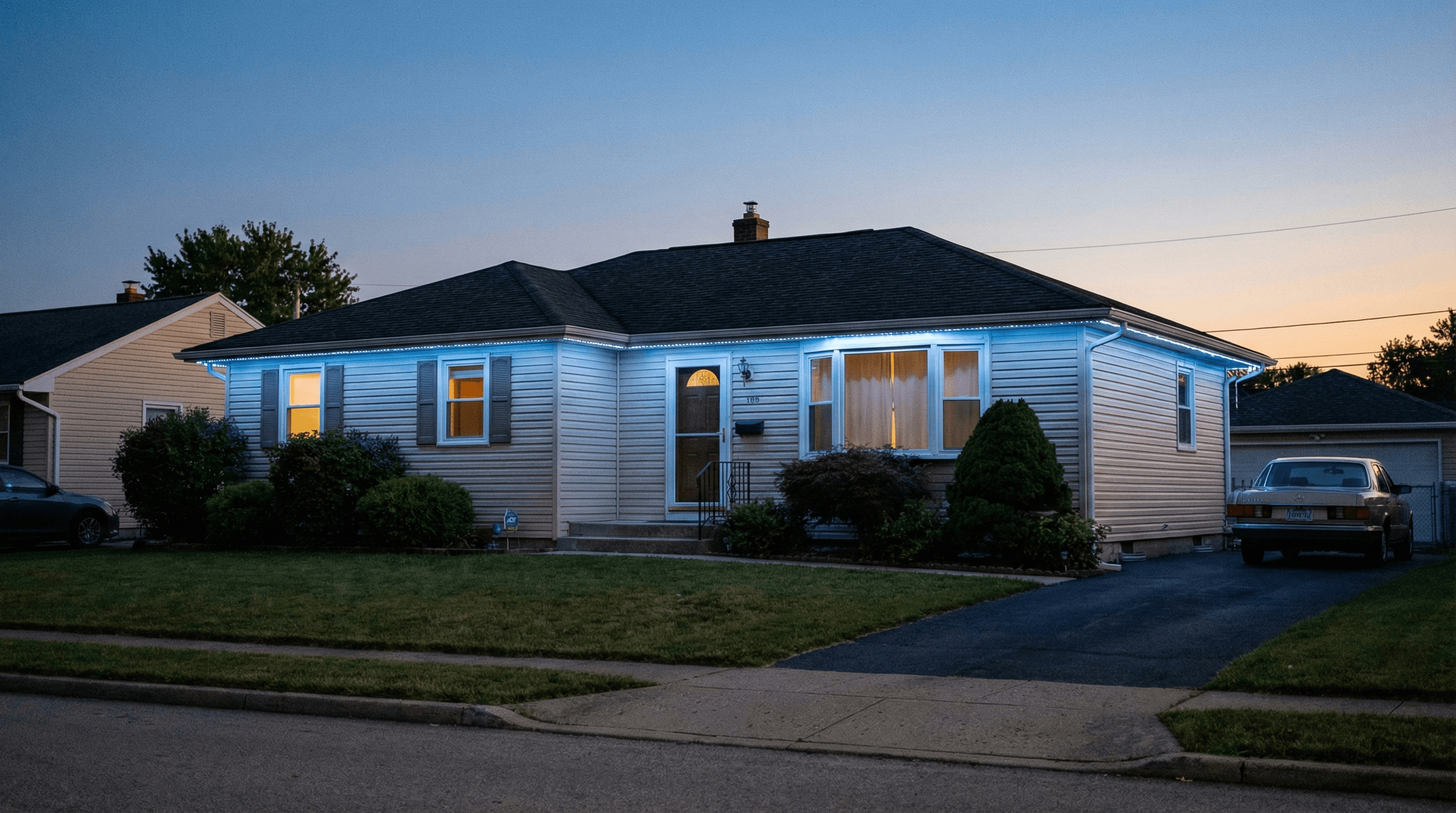
Modern permanent LED lighting systems give Sacramento homeowners full control over brightness, color temperature, and direction – the three factors that determine whether outdoor lights become a neighborhood nuisance.
Permanent outdoor lights do not have to cause light pollution or neighbor complaints. The same programmable controls that let you set holiday colors and automate schedules also let you dial brightness down to 10%, choose warm color temperatures below 3000K, and direct light downward along your roofline – all from your phone. Sacramento homeowners who configure their systems thoughtfully end up with better curb appealand better neighbor relationships than homes running cheap, unshielded floodlights.
Light trespass – light that spills past your property line onto a neighbor's windows, yard, or bedroom – is the single biggest driver of outdoor lighting complaints in residential areas. DarkSky International estimates that at least 30% of all outdoor lighting in the United States is wasted, much of it spilling sideways or upward instead of illuminating the intended area (DarkSky International, 2024). That wasted light costs American homeowners roughly $3.3 billion in energy annually and generates 21 million tons of carbon dioxide.
This guide covers the specific settings, design choices, and California regulations Sacramento homeowners should know to get the full benefit of permanent outdoor lights without creating problems for the neighborhood. If you are still deciding whether permanent lights are right for your home, start with our complete ROI analysis.
TL;DR: Permanent outdoor lights give you more control over light pollution than any other exterior lighting option. Set brightness to 40–60% for daily use (full brightness only when needed), choose warm white (2700K) as your default color, and use your app's scheduling features to dim or shut off lights after 10–11 PM. Sacramento and California municipalities can enforce nuisance lighting complaints, and many HOAs in Roseville, Rocklin, and Folsom have specific outdoor lighting rules. The good news: permanent LED systems with app control make compliance effortless compared to traditional floodlights or string lights with no dimming capability.
What Counts as Light Pollution from Residential Outdoor Lights
Light pollution from residential properties falls into three categories, each with different impacts on neighbors and different solutions:
- Light trespass: Light that crosses your property boundary and illuminates a neighbor's home, yard, or windows. This is the most common source of complaints. A bright, unshielded flood light aimed at your driveway that also lights up your neighbor's bedroom window is the classic example.
- Glare: Excessive brightness that causes visual discomfort. When a neighbor looks toward your home and is blinded by exposed LED bulbs at full intensity, that is glare. It reduces visibility rather than improving it.
- Skyglow: Light directed upward that brightens the night sky. While individual homes contribute less skyglow than commercial buildings, a neighborhood full of upward-facing landscape lights and unshielded porch fixtures adds up.
Permanent outdoor lights mounted along the roofline naturally direct light downward and outward from the fascia board. This built-in directionality is a structural advantage over ground-mounted floodlights and landscape uplights, which aim light upward by design. For a comparison of permanent roofline lights versus landscape lighting, see our landscape lighting vs. permanent outdoor lights guide.
Three Types of Residential Light Pollution
How Permanent LED Lights Reduce Light Pollution vs. Traditional Fixtures
Permanent outdoor LED systems have four built-in advantages over traditional exterior lighting when it comes to controlling light pollution. These are not optional add-ons – they come standard with every modern permanent lighting system.
- App-controlled brightness (0–100%): You can set your lights to 30% brightness for a soft ambient glow or 100% for a party. Traditional floodlights run at full power with no dimming – they are either on or off. Brightness control is the single most effective tool for preventing light trespass.
- Color temperature selection: Permanent LED systems let you choose from millions of colors, including warm whites in the 2700K range that DarkSky International recommends for outdoor use. Warm-toned light scatters less in the atmosphere than cool white (5000K+) light, producing less skyglow and less visual disruption for neighbors. For color selection ideas, see our lighting colors guide.
- Scheduling and automation: Program lights to dim to 20% at 10 PM, shift to a soft amber at midnight, and turn off entirely at 1 AM – all automatically. No other exterior lighting type offers this level of scheduling precision. Our smart lighting features guide covers the full automation capabilities.
- Downward-facing fascia mount: Because permanent lights mount to the fascia board beneath the roofline, the light naturally projects downward and outward toward the ground. Ground-level landscape uplights and wall-mounted floodlights aim in the opposite direction – upward – which is the primary cause of residential skyglow and glare.
Brightness Control: Permanent LEDs vs. Traditional Outdoor Lights
The combination of these four features means permanent LED systems are the only exterior lighting option that gives homeowners complete control over every variable that contributes to light pollution. Smart floodlights offer dimming and scheduling, but they still project light outward from a wall mount rather than downward from the roofline.
Pro Tip
Set your default nightly brightness between 40–60% for everyday use. This provides attractive curb appeal and enough visibility for safety without creating the harsh, full-intensity look that generates neighbor complaints. Save 100% brightness for parties, holidays, or special occasions. Most Sacramento homeowners find that 50% brightness on warm white (2700K) looks better than full power anyway – it creates a warm glow rather than a stadium-light effect. Learn more about optimizing your electricity costs by adjusting brightness.
California Light Trespass Laws and Sacramento Regulations
California does not have a single statewide residential light trespass statute, but multiple legal frameworks give neighbors and municipalities the ability to address problem lighting:
- Nuisance law (California Civil Code Section 3479): Light that unreasonably interferes with a neighbor's use and enjoyment of their property can be classified as a private nuisance. Neighbors can file a civil complaint, and courts can order the offending lights to be modified, shielded, or removed.
- Sacramento County Nuisance Code (Title 16, Chapter 16.18): The county's neighborhood nuisance ordinance covers physical conditions on properties that become public or private nuisances in unincorporated Sacramento County. Persistent, unshielded lighting that disturbs neighbors can fall under this code.
- City of Sacramento lighting requirements (Section 15.40.030): The city requires that exterior lighting shall be directed away from adjacent residential uses and that lighting shall reflect away from residential areas and public streets.
- West Sacramento example (nearby reference): The city sets a specific limit of 0.3 foot-candles at the property line – meaning your outdoor lights cannot deliver more than 0.3 foot-candles of illumination measured at your neighbor's property boundary.
- HOA CC&Rs: Many Sacramento-area HOAs in Roseville, Rocklin, Folsom, and El Dorado Hills include outdoor lighting restrictions. These typically address brightness, color, timing, and visible fixtures. Our HOA rules guide for Sacramento covers the most common restrictions.
The practical takeaway: while California's residential lighting regulations are less prescriptive than commercial codes, your neighbors do have legal options if your outdoor lights are unreasonable. The good news is that permanent LED systems make compliance simple – dim the brightness, warm the color temperature, and set a schedule.
Sacramento-Area Light Trespass Thresholds
The 5 Settings That Prevent Neighbor Complaints
Sacramento homeowners with permanent outdoor lights can eliminate virtually all light pollution concerns by configuring five specific settings in their lighting app. These settings take less than 10 minutes to configure and apply to every light on your system simultaneously.
1. Set Default Brightness to 40–60%
Full brightness (100%) is designed for parties, holidays, and security situations – not nightly operation. Running your lights at 40–60% provides the warm curb appeal most homeowners want without projecting intense light toward neighboring properties.
At 50% brightness, a typical permanent LED system draws roughly half the wattage of full power, which also reduces your monthly electricity cost. A full-home system that costs $8/month at 100% brightness would run approximately $4/month at 50%.
2. Choose Warm White (2700K) as Your Default
DarkSky International recommends 2700K or lower for outdoor lighting because warm-toned light scatters less in the atmosphere than cool white or daylight-temperature LEDs (DarkSky International, 2024). Cool white LEDs (5000K+) produce more blue light, which scatters more broadly in the atmosphere, contributes more to skyglow, and is more likely to disrupt circadian rhythms in both humans and wildlife.
Permanent LED systems default to warm white on most installations. The 2700K setting also happens to be the most popular daily color among Sacramento homeowners – it matches the warm glow of traditional incandescent lighting without the energy waste.
3. Schedule an Automatic Dim or Shutoff After 10–11 PM
The hours between 10 PM and 6 AM are when outdoor lighting complaints are most likely. Neighbors are trying to sleep, bedrooms face the street, and any light spill is maximally noticeable against a dark sky.
Configure a schedule that drops brightness to 15–20% at 10 PM (or turns lights off entirely). If you want to maintain some security lighting overnight, a dim amber or warm white at 15% provides enough visibility for security cameras without illuminating the neighborhood. For full automation options, see our home automation integration guide.
4. Avoid Flashing, Strobing, or Rapid Color Changes After Dark
Static color displays at moderate brightness rarely generate complaints. Flashing or strobing effects – even at low brightness – are the fastest way to trigger neighbor frustration and HOA violations. Most Sacramento-area HOAs specifically prohibit flashing or strobing exterior lights.
Save dynamic effects for holidays and special events, and keep them to reasonable hours. A slow color fade (like a gradual shift between two complementary colors over 30 seconds) is far less disruptive than rapid flashing.
5. Test Your Lights from the Neighbor's Perspective
After installation, walk across the street and look at your home from your neighbor's front yard (or ask them to look). Check for:
- Visible bright spots that create glare
- Light spilling onto their windows, driveway, or yard
- Any upward light escaping above the roofline
If you see any of these issues, adjust the brightness down or tweak individual light zones in your app. This 5-minute test prevents months of neighbor tension.
Pro Tip
When your permanent lights are first installed, invite your closest neighbors to see them that evening. Show them the app and how you can adjust brightness and color. Ask if the current setting bothers them from their property. This one conversation prevents 99% of future complaints – and most neighbors end up asking who your installer was. For help picking the right installer who will set these defaults correctly, see our Sacramento installer selection guide.
Want Neighbor-Friendly Permanent Lights? Get a Free Design Consultation
EXT Lighting configures every system for responsible brightness, warm color defaults, and automated scheduling – so your lights look great without creating problems. Free on-site consultations across Sacramento, Roseville, and Rocklin.
Schedule Your Free ConsultationDarkSky International's 5 Principles Applied to Permanent Outdoor Lights
DarkSky International (formerly the International Dark-Sky Association) publishes five principles for responsible outdoor lighting. Here is how each principle applies to permanent LED systems and what Sacramento homeowners should know:
| DarkSky Principle | What It Means | Permanent LED Compliance |
|---|---|---|
| 1. Use light only if needed | Every fixture should have a clear purpose | Schedule lights to turn off when not needed; zone control lets you light only occupied areas |
| 2. Direct light downward | Shield and aim to prevent upward or sideways spill | Fascia-mount design naturally aims light downward; no upward spill by default |
| 3. Keep light levels low | Use the minimum brightness needed | 0–100% dimming via app; set defaults to 40–60% |
| 4. Control timing | Use light only when necessary | Automated schedules dim or shut off after hours; motion-activated modes available |
| 5. Use warm color (2700K max) | Minimize blue light content | Warm white (2700K) available as default; most homeowners already prefer it |
Permanent LED systems are one of the few residential lighting products that can satisfy all five DarkSky principles simultaneously. Traditional floodlights fail on principles 2, 3, and 4. Solar path lights fail on principles 3 and 4. Landscape uplights fail on principle 2. Only permanent fascia-mounted LEDs with app control check every box.
Color Temperature and Why It Matters for Your Neighbors
Color temperature is measured in Kelvin (K) and describes how “warm” or “cool” a light appears. Lower Kelvin numbers mean warmer, more amber-toned light. Higher numbers mean cooler, more blue-white light.
Here is why this matters for light pollution:
- 2700K (warm white): Produces a soft, amber-toned glow similar to traditional incandescent bulbs. Scatters minimally in the atmosphere. DarkSky International recommends this or lower for all outdoor residential lighting. This is the default setting most EXT Lighting customers use nightly.
- 3000K (soft white): Slightly brighter and whiter than 2700K. Still acceptable for residential use but produces marginally more atmospheric scatter than 2700K.
- 4000K–5000K (neutral to cool white): Commonly used in commercial and street lighting. Produces noticeably more blue light, which scatters broadly and creates more skyglow. The American Medical Association has flagged LEDs above 3000K for their potential to disrupt circadian rhythms in both humans and wildlife (AMA, 2016).
- 5000K+ (daylight): The most problematic for residential settings. Creates the harsh, blue-white light associated with gas station canopies and commercial parking lots. Never appropriate for nightly residential use.
Color Temperature Spectrum: Residential Outdoor Lighting
Permanent Lights and Security: Bright Enough Without Blinding the Block
One of the most common objections to dimming outdoor lights is the security concern: “Won't lower brightness make my home less safe?” The answer is no, and the research backs this up.
The relationship between outdoor lighting brightness and crime deterrence is weaker than most people assume. A 2015 review by the Campbell Collaboration analyzed 13 studies on street lighting and crime and found that improved lighting does reduce crime in the areas studied – but the effect was tied to uniform, consistent coverage rather than raw brightness. Overly bright lights actually create deep shadows and hiding spots that make security worse, not better.
Permanent LED systems at 40–60% brightness provide even, consistent illumination along the entire roofline with no dark gaps. This uniform coverage is more effective for security than a single 100-watt floodlight blasting one corner of the house while leaving three sides dark. For a deeper look at the security benefits, see our outdoor lights and security guide.
How to Handle a Neighbor Complaint About Your Permanent Lights
If a neighbor does raise a concern about your permanent lights, the conversation is straightforward because you have immediate, app-based control over every variable. Here is a step-by-step approach:
- Listen without being defensive. They may have a legitimate issue – maybe one section of your lights faces their bedroom window directly.
- Walk to their property line together. See what the lights look like from their perspective. Often the issue is one or two specific light zones, not the entire system.
- Make adjustments in real time. Open your lighting app, dim the problematic zone to 20–30%, and ask if that resolves it. This typically takes 60 seconds.
- Set a schedule if timing is the issue. If their concern is lights being on past midnight, add a schedule to dim or shut off the facing section after 10 PM.
- Follow up in a week. Check back to confirm the adjustment worked. This builds goodwill and prevents the issue from escalating to an HOA complaint or code enforcement call.
The fact that you can resolve the issue in real time – without calling an electrician, climbing a ladder, or replacing fixtures – is one of the underappreciated advantages of permanent LED systems over traditional lighting.
Sacramento-Specific Considerations: Climate, Neighborhoods, and Wildlife
Sacramento's specific geography and climate create a few light pollution factors that homeowners in other regions do not face:
- Long summer evenings (June–August): Sunset does not occur until 8:15–8:35 PM during Sacramento's peak summer months. Many homeowners set their permanent lights to turn on at sunset automatically – which means less total dark-sky impact during summer but earlier activation during winter (sunset around 4:50 PM in December).
- Valley air quality: Sacramento sits in the Central Valley, where temperature inversions can trap particulate matter close to the ground. Light pollution is amplified in hazy or smoky conditions (common during fire season) because particles scatter light more effectively. Using warm 2700K settings during smoke season reduces this effect compared to cool white.
- Wildlife corridors: Homes near the American River Parkway, creeks, and open space preserves should be especially conscious of light output. Artificial light at night disrupts migratory bird navigation, insect behavior, and mammal activity patterns. Sacramento County's proximity to these corridors makes responsible lighting a legitimate ecological concern, not just a neighbor-relations issue. See our guide on permanent lights and insects for related information.
- Dense suburban neighborhoods: Areas like Land Park, Curtis Park, East Sacramento, and midtown Sacramento have smaller lot sizes where homes are closer together. Light trespass is more likely when homes are 10–15 feet apart versus 30+ feet apart in Granite Bay or El Dorado Hills. Homes in dense neighborhoods should run lower default brightness (30–40%) compared to homes on larger lots.
Permanent Lights vs. Other Outdoor Lighting: Light Pollution Comparison
How do permanent LED systems compare to other common residential lighting options on light pollution factors? Here is a side-by-side breakdown:
| Lighting Type | Dimmable | Color Temp Control | Scheduling | Light Direction | Trespass Risk |
|---|---|---|---|---|---|
| Permanent LED (fascia) | 0–100% | Full (2200K–6500K) | App + automation | Downward | Low |
| Wall-mount floodlight | No (most) | Fixed | Timer / motion | Outward / up | High |
| Landscape uplights | Some | Fixed | Timer | Upward | High |
| Solar path lights | No | Fixed | Dusk-to-dawn | Downward (low) | Low |
| String / Christmas lights | No | Fixed | Timer at best | Omnidirectional | Medium |
The key distinction: permanent LED systems are the only option that combines dimming, color temperature control, scheduling, and downward-facing installation. Every other lighting type is missing at least two of these four factors.
Maintaining Responsible Lighting Over Time
Setting up your permanent lights responsibly at installation is the first step. Maintaining those settings over time requires minimal effort but does need occasional attention:
- Review schedules twice a year: Adjust your auto-on time when daylight saving time changes. Sacramento's sunset shifts by nearly four hours between summer and winter – your schedule should shift with it.
- Check brightness after firmware updates: Occasionally, a lighting system firmware update may reset custom brightness levels to factory defaults. After any update, verify your default brightness is still at your preferred level. For more maintenance tips, see our Sacramento maintenance guide.
- Re-evaluate if you add landscaping: New trees, hedges, or structures can change how light reflects and distributes. A tree removal, for example, might expose a neighbor's window that was previously shielded.
- Talk to new neighbors: When a new family moves in next door, mention your permanent lights and offer to adjust if needed. Proactive communication prevents reactive complaints.
Frequently Asked Questions
Do permanent outdoor lights cause light pollution?
Permanent outdoor lights can contribute to light pollution if set to maximum brightness with cool white color temperatures and left on all night. However, their built-in controls – app-based dimming, color temperature selection, and automated scheduling – make them the easiest outdoor lighting type to configure responsibly. At 40–60% brightness with warm white (2700K) and a 10 PM dim schedule, permanent LEDs produce less light pollution than a single unshielded floodlight.
Can my neighbor legally complain about my outdoor lights in Sacramento?
Yes. Under California Civil Code Section 3479, persistent light that unreasonably interferes with a neighbor's use of their property can be classified as a private nuisance. The City of Sacramento also requires exterior lighting to be directed away from adjacent residential properties. Most Sacramento-area HOAs have additional outdoor lighting restrictions. The fastest resolution is a direct conversation and an adjustment via your lighting app.
What brightness level should I set my permanent lights to at night?
For daily evening use, 40–60% brightness provides attractive curb appeal without creating glare or light trespass. After 10 PM, dimming to 15–20% (or off) minimizes impact on sleeping neighbors. Save 100% brightness for holidays, parties, or specific security situations.
What color temperature is best for reducing light pollution?
DarkSky International recommends 2700K (warm white) or lower for all outdoor residential lighting. Warm-toned light scatters less in the atmosphere than cool white (4000K+), produces less skyglow, and is less disruptive to human and wildlife circadian rhythms. Most permanent LED systems offer 2700K as a default or preset option.
Are permanent outdoor lights allowed by Sacramento HOAs?
Most Sacramento-area HOAs allow permanent outdoor lights, especially when set to static warm white at moderate brightness. The most common HOA restrictions target flashing or strobing effects, excessively bright displays, and blue or cool-white color temperatures. Check your specific CC&Rs and read our Sacramento HOA lighting rules guide for common provisions.
Do warm white LEDs provide enough light for home security?
Yes. Security effectiveness depends on consistent, even coverage rather than raw brightness. Permanent LEDs at 40–60% warm white illuminate the entire perimeter uniformly, which is more effective than a single bright floodlight that creates harsh shadows. Security cameras also perform better under even, warm lighting than under high-contrast bright spots with dark surroundings.
Beautiful Lights That Your Neighbors Will Actually Appreciate
EXT Lighting designs every system with responsible brightness defaults, warm color temperatures, and automated scheduling built in. Free consultations across Sacramento, Roseville, Rocklin, Folsom, and El Dorado Hills. Lifetime warranty on parts and labor.
Get Your Free Lighting Design