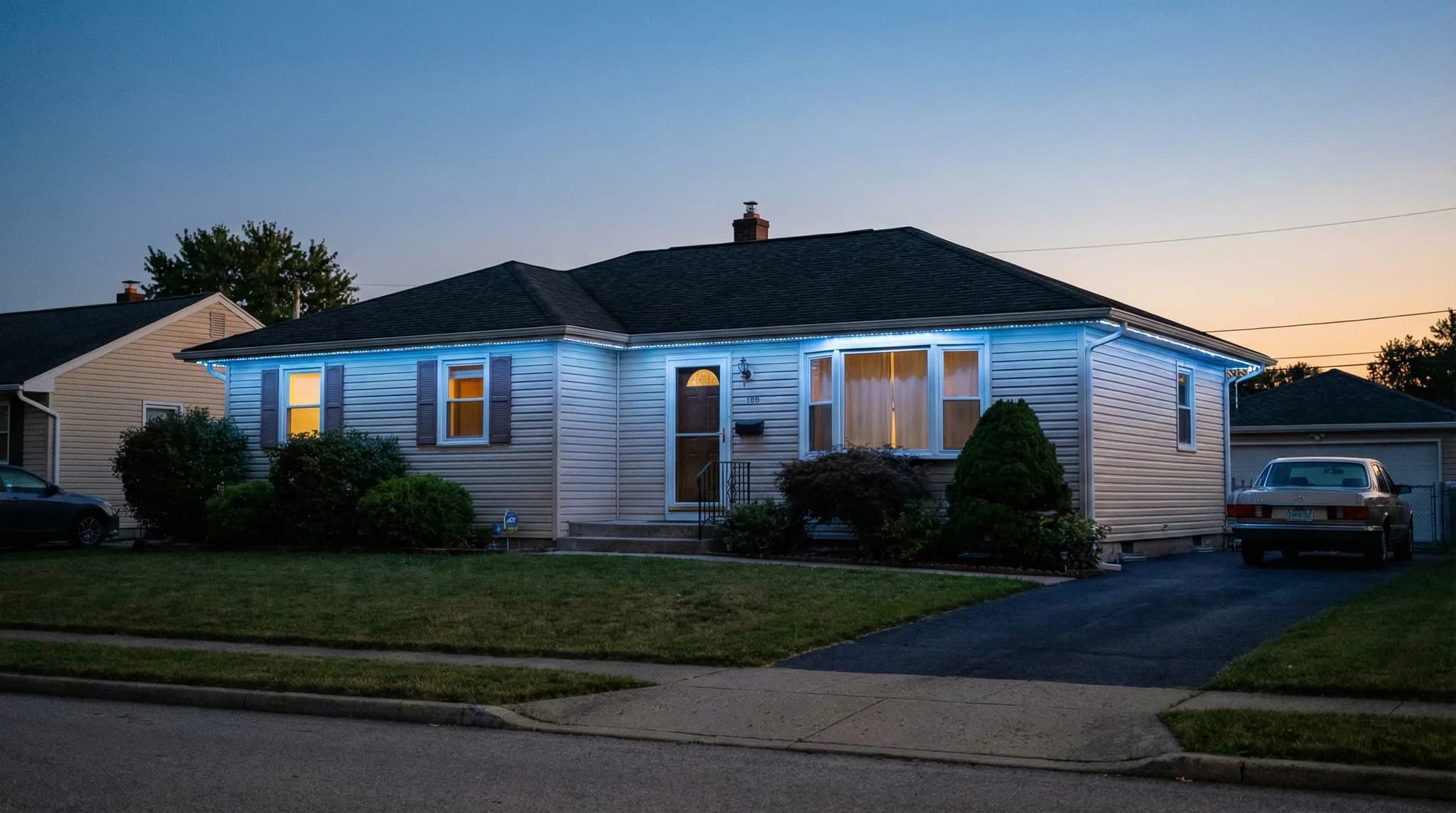
A foothills home in the Lincoln–Loomis–Auburn corridor running its permanent LED system in everyday warm white at twilight — the same channel that flips to holiday color or wildfire-aware low brightness from the app.
Permanent outdoor lights in Lincoln, Loomis, and Auburn typically cost between $3,500 and $9,500 installed in the Placer County foothills, with most homes landing in the $4,800 to $7,200 range. The corridor sits higher, drier, and more wildfire-exposed than Sacramento proper, which changes three things: the fixtures need to clear Cal Fire WUI fire-rating expectations, the HOAs in Sun City Lincoln Hills and Twelve Bridges expect a real Architectural Review Committee submittal, and the long roof runs on Heritage Oak Trail and Lake of the Pines homes push linear footage above what you see in Roseville or Rocklin. This is the Placer County foothills installation guide for permanent LED lighting.
The Lincoln–Loomis–Auburn corridor — together with Penryn and Newcastle on the Hwy 193 ridge between them — has quietly become one of the strongest micro-markets for permanent outdoor lights in the greater Sacramento region. Larger lots, custom architecture, a 55+ community at the heart of Lincoln, and a homeowner base that takes holiday and seasonal lighting seriously all point in the same direction: install once, schedule the year, never climb a ladder. This guide walks through what the install actually looks like in the foothills, with the HOA, fire, and pricing realities specific to Placer County.
For the broader Sacramento metro pricing math, jump to the Sacramento permanent outdoor lights cost guide or the pricing-by-home-size breakdown. For neighboring Placer markets, see the Roseville and Rocklin local guide and the Granite Bay estate homes guide.
TL;DR: Permanent outdoor lights in Lincoln, Loomis, and Auburn run $3,500 to $9,500 installed, with most foothills homes between $4,800 and $7,200. Sun City Lincoln Hills, Twelve Bridges, Lincoln Hills Country Club, and Heritage Oak Trail all sit inside active HOAs that require Architectural Review Committee approval — turnaround averages 14 to 30 days. Auburn neighborhoods (Old Town, North Auburn, Christian Valley) are mostly HOA-free, but Lake of the Pines, Bowman, and the Auburn Greens condos do have associations. The Placer County WUI overlay covers most of Auburn, Penryn, Newcastle, and the eastern half of Loomis — meaning Class A fire-rated fixtures, ember-resistant junction boxes, and IP67 marine-grade connectors are not optional, they are the spec floor. Low-voltage 24V installs do not need a permit in unincorporated Placer or in Lincoln; new dedicated circuits do.
Why Lincoln, Loomis, and Auburn Are Different
The three cities sit on a transition line between the Sacramento Valley floor and the Sierra foothills. Elevations climb from 160 feet in west Lincoln to 1,255 feet at the Auburn courthouse. That single fact reshapes everything about a permanent outdoor lighting install compared to Elk Grove or Natomas — climate, fire risk, architecture, and HOA culture all shift as you head east on Hwy 193.
The practical effect on a quote: linear footage averages run higher because lots are larger, accessory dwellings and detached garages appear more often, and the wildfire-urban-interface (WUI) overlay forces the fixture spec upward. A 2,400 square foot home in Lincoln that would run 180 linear feet in Roseville often measures 210 feet in Twelve Bridges because of an attached casita or longer covered patio. An Auburn custom on a 2-acre lot regularly hits 280 to 350 feet by the time you account for a detached garage, breezeway, and accent runs at the front gate.
- Lincoln: Sun City Lincoln Hills (Del Webb 55+ master plan), Twelve Bridges, Lincoln Hills Country Club, Catta Verdera, Verdera, and the older Lincoln Crossing and Joiner Ranch subdivisions. Roughly 70% of homes sit inside a structured HOA.
- Loomis: Heritage Oak Trail, the Loomis Village downtown core, Loomis Basin estate properties on Brace Road and Penryn Road, plus newer subdivisions east of King Road. Mostly unincorporated parcels in Placer County, fewer master HOAs, but Heritage Oak Trail and a handful of newer subdivisions do require ARC approval.
- Auburn: Old Town Auburn (historic district), North Auburn, Christian Valley, Bowman, Lake of the Pines (Auburn-Grass Valley line), Auburn Greens condos, plus rural Hwy 49 and Auburn-Folsom Road custom estates. Old Town Auburn is in a designated historic preservation district — separate review process. The rest is mostly HOA-free.
- Penryn and Newcastle: Smaller communities along Hwy 193 between Loomis and Auburn. Almost entirely unincorporated Placer County, no HOA on most lots, large parcels, full WUI overlay. The lighting brief is simpler on HOA but harder on fire-spec.
Median Home Price by Foothills City (Early 2026)
The price chart matters because the same patterns that drive median home value — bigger lots, more custom architecture, longer rooflines — also drive linear footage. A Penryn or Newcastle estate on three acres often carries 320 to 450 feet of channel once you include the main house, detached garage, casita, and entry-gate accent run. That puts it firmly in the upper third of the corridor pricing envelope below.
What Permanent Outdoor Lights Cost in the Placer Foothills
Pricing for permanent LED lights in Lincoln, Loomis, Auburn, Penryn, and Newcastle is driven by the same three variables as anywhere in Sacramento — linear footage, story count, and design complexity — plus a fourth that is foothills-specific: WUI fire-spec compliance. The table below is built from corridor install data over the last 24 months and reflects everything from a starter Lincoln Crossing tract home to a Bowman Lane custom on five acres.
| Home Profile | Typical Footage | Install Range | Common Neighborhoods |
|---|---|---|---|
| 1,800–2,400 sf, single-story | 100–180 ft | $3,500–$5,200 | Sun City Lincoln Hills, Lincoln Crossing, Auburn Greens, North Auburn ranch |
| 2,500–3,200 sf, two-story | 180–240 ft | $5,000–$7,200 | Twelve Bridges, Verdera, Heritage Oak Trail, Christian Valley |
| 3,300–4,200 sf, two-story + complex roof | 240–320 ft | $7,000–$9,500 | Catta Verdera, Lincoln Hills CC custom, Lake of the Pines, Bowman |
| 4,300+ sf, multi-structure / acreage | 320–500+ ft | $9,200–$15,500 | Penryn estates, Newcastle ridge homes, Auburn-Folsom Rd custom, Loomis Basin |
Reading the table: ranges include professional installation, IP67 Class A fire-rated fixtures with a lifetime product warranty, a 200W to 500W transformer, a WiFi controller, the first-year service visit, and HOA submittal support where applicable. They do not include any new electrical work; if a dedicated 20A circuit is required for a second transformer location on a long roofline, add $400 to $850.
Two-story homes in Twelve Bridges, Catta Verdera, and the Lincoln Hills Country Club section regularly land in the $6,500 to $8,500 zone once you add accent runs at the patio cover and pool deck. That tracks with the broader permanent outdoor lights for two-story homes numbers — shifted upward modestly because of the multi-story premium on rear elevations that face downhill on the typical Twelve Bridges view lot.
Pro tip: Demand that any quote in this corridor lists linear footage by elevation, fixture fire rating (Class A, B, or C), transformer wattage, and channel color. A Sun City Lincoln Hills home that comes in $1,200 cheaper than the next quote almost always reflects either a Class C fixture (not WUI-compliant), a smaller transformer that browns out at full white, or a quietly omitted 30 feet of fascia on the rear elevation.
The HOA Landscape: Sun City Lincoln Hills, Twelve Bridges, Heritage Oak, Lake of the Pines
HOA reality varies dramatically across the corridor. Lincoln has the densest HOA coverage of any city in Placer County. Loomis is mixed. Auburn is mostly HOA-free except for a few specific subdivisions and the historic Old Town district. Knowing where your home sits is the first step.
The good news: permanent outdoor LED lighting is approvable in every major foothills HOA when you submit the right package. The key word is submit — the systems fall under exterior modifications, which means written approval is required before the installer starts.
HOA-by-HOA Reality Check
- Sun City Lincoln Hills (Del Webb, 55+): The Architectural Review Committee runs one of the more structured ARC processes in the region. CC&R restrictions explicitly cover exterior lighting, holiday lighting timing, and channel color matching. Expect 14 to 21 days for review. Submission requires a fascia-color photo of the proposed channel, an elevation drawing, a written operating schedule, and a fixture spec sheet showing WUI Class A rating. Holiday-only color displays are allowed during defined seasonal windows; everyday operation must be warm white unless ARC explicitly permits otherwise. Channel color must match fascia within a narrow tolerance — bronze and dark bronze are by far the most common approvals.
- Lincoln Hills Country Club (separate from Sun City): Custom-home enclave on the north side of Sun City with its own HOA. Stricter than the Del Webb ARC on architectural integration but more permissive on lighting hours. Renderings or photo mock-ups are sometimes requested. Approval rate above 90% with a complete package.
- Twelve Bridges and Verdera (Lincoln): Master-plan HOAs that cover most of central and eastern Lincoln. The Verdera ARC has historically been more receptive to permanent lighting than Sun City; Twelve Bridges runs about even with Sun City. Standard 14-to-28-day review window. Both HOAs request a written operating schedule and channel-color match.
- Catta Verdera (Lincoln): Gated golf-course community. Quieter ARC process — submittal goes to a sub-committee that meets twice monthly. Expect 21 to 35 days. Channel color tolerance is tight; warm-bronze fascia is the dominant palette.
- Heritage Oak Trail (Loomis): One of the few structured HOAs in Loomis. ARC requires a photo of the proposed channel against the fascia, an elevation drawing, and a written schedule. Review averages 14 to 21 days. Heritage Oak has approved permanent lights on most submissions, but explicitly disallows color animation outside listed holiday windows.
- Lake of the Pines (Auburn-Grass Valley line):Gated community on the Nevada County / Placer County boundary. LOP has its own Architectural Review Committee with notably tight turnarounds (10 to 14 days) when the package is complete. Review focuses on lake-facing brightness, channel color, and dark-sky compatibility for the lake buffer area. Approval rates above 85%.
- Auburn Greens (Auburn condos): Older HOA with covenants written before permanent LED lighting existed. ARC approvals are happening but require careful application — the systems are categorized as exterior modifications under generic language, not as decorative or holiday lighting.
- Old Town Auburn historic district: Not an HOA but a designated historic preservation overlay administered by the City of Auburn. Permanent lights on contributing historic structures require a Certificate of Appropriateness — separate process from any HOA, applied through the Auburn Historic Design Review Commission. Most submissions are approvable but require additional documentation.
- Unincorporated Placer County (most of Loomis, Auburn, Penryn, Newcastle): No HOA on most parcels. Check the title report for any recorded covenants. If none exist, no association approval is required — only Placer County permit rules, which generally do not touch low-voltage lighting.
For the full approval playbook — sample application language, common denial reasons, and the exact attachments that speed turnaround — see the HOA rules guide for Sacramento homeowners.
How to Submit a Sun City Lincoln Hills ARC Application
Sun City Lincoln Hills is the single most-submitted HOA in this corridor. The committee meets twice per month, and a complete package on the first submission is the difference between a Halloween live date and a January install. The submittal that consistently clears the committee on the first round contains:
- The standard ARC application form, available on the Sun City Lincoln Hills association website, with the box for "permanent exterior lighting" checked under exterior modifications.
- An elevation drawing or marked-up photo showing where the channel will run on each elevation. Front, both sides, and rear are required separately. A simple line drawing is acceptable.
- A photo of the proposed channel color held against the existing fascia. Bronze and dark bronze are the most frequently approved colors; white is almost never approved unless the home already has white trim.
- A fixture spec sheet from the manufacturer confirming Class A fire rating, IP67 rating, and the 50,000-hour LED life. This is the single most under-supplied attachment and the most common reason for a deferred review in the Sun City corridor.
- A written operating schedule covering everyday warm white hours, holiday color windows, and a hard off time (typically 11 PM to dawn).
- The installer's contractor license and insurance certificate. Sun City requires both before any approved install can begin.
HOA Approval Outcomes on Foothills Installs
The corridor approval rate is slightly tighter than the Folsom–El Dorado Hills corridor, mostly because Sun City Lincoln Hills runs a more documentation-heavy process than Serrano. The denial rate is still very low, and complete first submissions clear in the standard 14-to-28-day window.
Wildfire, WUI Overlay, and Cal Fire Realities
This is the section that separates a foothills install from a valley install. Cal Fire's Fire Hazard Severity Zones (FHSZ) cover most of unincorporated Placer County, the eastern half of Loomis, almost all of Penryn and Newcastle, and the rural ring around Auburn. Sections of Twelve Bridges and the eastern Sun City Lincoln Hills edge are also inside the WUI overlay.
For permanent outdoor lighting, the WUI framework matters in three ways: fixture fire rating, junction-box ember resistance, and operating-mode planning during PSPS or red-flag warning events. The Cal Fire defensible-space and California Building Code Chapter 7A rules do not directly regulate decorative LED lighting, but they establish the engineering envelope your fixtures need to clear.
1. Class A Fire-Rated Fixtures
Professional permanent outdoor lighting fixtures intended for WUI-zone homes carry an ASTM E108 Class A fire rating, the same rating expected of roofing in fire-prone areas. The aluminum channel, polycarbonate lens, and silicone connectors do not contribute to flame spread. Cheap consumer-grade strips with unrated PVC sheaths and exposed solder joints fail this test and should not be installed in any FHSZ-covered property.
Ask for the manufacturer's ASTM E108 test report, not just a marketing claim. A reputable permanent lighting brand will hand it over without hesitation. A reseller who hesitates is selling consumer-grade product into a foothills application.
2. Ember-Resistant Junction Boxes and Connectors
The most common fire-failure mode in WUI-zone exterior lighting is not the lights themselves — it is unrated outdoor junction boxes catching ember intrusion. Spec NEMA 4X-rated junction enclosures with gasketed lids, IP67 silicone-encapsulated connectors at every splice, and a stainless-steel backing plate where the transformer mounts to siding. None of these add meaningful cost on a professional install — they are the standard.
3. PSPS and Red-Flag Operating Modes
Public Safety Power Shutoffs (PSPS) hit Auburn, Penryn, and Newcastle several times in most years. A permanent LED system on a foothills home should be paired with two operating considerations: a small UPS or generator interlock so the controller does not lose its schedule, and a manually-triggered "low brightness, warm white only" mode for red-flag warning nights when the community generally dials back exterior brightness. This is more about neighborhood norms than regulation, but it is a sign of a thoughtful install.
The full power-outage and PSPS playbook is in permanent outdoor lights and power outages.
Estimated WUI Overlay Coverage by Foothills City
The chart explains why foothills permanent lighting quotes are not directly comparable to Roseville quotes on price alone. A Penryn install at 92% WUI coverage carries a fixture spec floor that a Roseville install does not. If your Penryn quote is the same as your Roseville quote, something is missing from the spec.
Permits: City of Lincoln, City of Auburn, Placer County, Town of Loomis
Most low-voltage permanent lighting installs in this corridor do not require a permit. The long answer depends on what gets added beyond the low-voltage run itself.
- City of Lincoln Building Division: Treats 24V Class 2 low-voltage lighting as non-permit-required when an existing exterior outlet is used and no new circuit is run. Adding a new dedicated 20A circuit triggers an electrical permit (approximately $145 to $215 as of 2026).
- Town of Loomis: Follows the California Electrical Code framework. Low-voltage installs below 30V are exempt for standard residential applications. New circuits still require a permit pulled by the licensed electrician.
- City of Auburn: Permit framework matches Lincoln for low-voltage exempt installs. Old Town historic district properties have an additional Certificate of Appropriateness requirement administered by the Auburn Historic Design Review Commission, but that is preservation review, not an electrical permit.
- Placer County (unincorporated Loomis, Penryn, Newcastle, Auburn-Folsom Road, Christian Valley): Same framework — low-voltage exempt, new circuits permitted. Many installs use an existing exterior or garage GFCI outlet with no new wiring at all.
For deeper code coverage see do permanent outdoor lights need an electrician or permit.
Foothills Architecture, Tile Roofs, and Hillside Access
Foothills architecture trends toward longer rooflines, more gables, and a higher share of tile roofs than valley homes. Three install realities matter on most Lincoln–Loomis–Auburn properties.
1. Tile Roofs Are Common
Roughly 50 to 60 percent of homes in Twelve Bridges, Catta Verdera, Heritage Oak Trail, and Lake of the Pines have concrete or clay tile roofs. The channel mounts to the fascia or sub-fascia, never to the tile surface. A roof-aware channel profile tucks under the drip edge with stainless steel screws at 12-inch intervals. If an installer wants to route mounts up onto the tile field, walk away. See the full stucco and tile roof installation guide for specifics.
2. Hillside and View-Lot Access
Twelve Bridges, Catta Verdera, Lincoln Hills Country Club, Bowman, and most Auburn ridge homes have rear elevations that drop away from the house. Mounting heights on the downhill side regularly exceed 26 feet. A professional crew brings a boom lift or sectional extension ladders with outrigger stabilizers. Cut-rate crews work from a single extension ladder on a slope and skip fastener spacing — the result shows up three summers later as sagging channel.
3. Heat, Smoke, and Foothills Climate
Auburn's elevation gives it cooler summer nights than Lincoln, but daytime peaks still hit 100°F+ for 25 to 35 days per year, with eave surface temps reaching 130 to 140°F. Lincoln runs slightly hotter at the eave because the elevation drop pulls valley heat in. Professional IP67 systems are spec'd to 158°F continuous — comfortably above peak. Wildfire smoke from Sierra fires is a regular August–October event. Smoke deposits a thin film on the polycarbonate lens that reduces apparent brightness by 3 to 5 percent until rinsed. See permanent outdoor lights in extreme heat for the thermal details.
A Real Foothills Install: Sun City Lincoln Hills
A homeowner in the Sun City Lincoln Hills community contacted us in late August 2025 hoping to be lit by Halloween. The home is a 2,250 square foot single-story Del Webb plan with a tile roof, three gable returns on the front elevation, and a covered patio with a cedar tongue-and-groove ceiling.
Linear footage measured 165 feet at the eave plus 32 feet of patio accent runs, totaling 197 feet. The system spec was a 200W transformer mounted on stainless backing inside the garage, an 8-zone WiFi controller, IP67 RGBIC channel in dark bronze to match the existing fascia, ASTM E108 Class A fire-rated fixtures (the eastern Sun City edge is in the WUI overlay), and silicone- encapsulated connectors at every junction.
- Day 1 (Aug 25): Site visit, elevation photos, footage measurement, design pass. Homeowner signed the quote three days later.
- Day 5 (Aug 29): Sun City Lincoln Hills ARC submittal — channel-color photo against fascia, elevation drawing, fixture spec sheet (Class A rating documented), operating schedule (warm white nightly to 10 PM, holiday color windows listed by month), installer contractor license and insurance certificate.
- Day 19 (Sept 12): Written ARC approval received on first submission. No modifications requested.
- Day 26–27 (Sept 19–20): Two-day install. Day one covered the front and right elevations plus transformer install. Day two handled the rear elevation, patio accent run, and controller commissioning.
- Day 28 (Sept 21): App walkthrough, scene programming for Halloween, Thanksgiving, Christmas, and a custom "low-brightness red-flag mode" the homeowner requested for fire-watch nights. First-year service visit scheduled for September 2026.
Total project cost landed at $5,150 — middle of the 1,800–2,400 sf single-story range. The Halloween scene went live on October 1. Three Sun City neighbors had asked for the installer's name within a week.
Game Day, Holidays, and Foothills Seasonal Programming
Lincoln, Loomis, and Auburn are sports-and-community-saturated towns. Lincoln High football, Del Oro High (Loomis), Placer High (Auburn), and the broader UC Davis / Sacramento State / Sac Kings / 49ers fan base all show up on rooflines during game weeks. A permanent system handles all of it from a phone.
- School spirit: Lincoln High (red and gold), Del Oro (red and white), Placer (green and white), Granite Bay (cardinal and gold), plus UC Davis (blue and gold) and Sacramento State (green and gold).
- Pro teams: Kings (purple, gray, black), 49ers (red, gold), Giants (orange, black), Athletics (green, gold), Warriors (blue, gold). All have pre-built scene templates in professional apps.
- Community holidays: Lincoln Showcase, Loomis Eggplant Festival, Auburn Endurance Capital events, Placer Wine Trail weekends, plus the standard Halloween / Thanksgiving / Christmas / Hanukkah / Diwali / Lunar New Year / Memorial Day / Fourth of July rotation.
For the scene-by-scene playbook, see permanent lights for game day, holiday lighting scenes and patterns, and how to schedule permanent lights for the year.
Foothills pricing, HOA playbook, WUI fire-spec compliance
Get a Lincoln, Loomis, or Auburn Quote
Free on-site assessment, elevation-by-elevation linear footage, Sun City Lincoln Hills and Twelve Bridges ARC support, Class A fire-rated fixture documentation, and a firm written quote inside 48 hours. No deposit until HOA approval lands.
Request a QuoteFive-Year Cost of Ownership in the Foothills
The break-even point on permanent lighting in the Lincoln–Loomis– Auburn corridor is typically faster than the Sacramento metro average for one practical reason: the corridor is full of homeowners who hire holiday installers every November and pay them to come back to take everything down in January. Annual hang-and- remove service in this corridor runs $850 to $2,200 depending on home size and whether multiple holiday scenes are part of the package.
Over five years, that is $4,250 to $11,000 in service fees — before any string-light bulb replacement, ladder rental, or lost weekend time. A $5,500 permanent install that eliminates that spend breaks even inside year four and returns 2x to 3x over its 20-year product life. The math is worked out in detail in are permanent outdoor lights worth it and do permanent outdoor lights increase home value.
Cumulative Cost: Permanent vs. Annual Holiday Service (10-Year View)
The chart assumes a 2,400 sf two-story corridor home, $5,500 permanent install, $50 annual energy, and $1,200 annual hang-and- remove service. Larger Lake of the Pines or Penryn estates that pay $1,800 to $2,200 annually for holiday service hit break-even in year three.
Choosing the Right Corridor Installer
The four big national brands — Trimlight, JellyFish, Gemstone — plus regional installers like EXT Lighting use broadly similar core components. Three things matter more than brand in the foothills: WUI fixture documentation, HOA submittal experience, and tile-roof and hillside competence.
- WUI fire-spec documentation: Ask for the ASTM E108 test report. Class A or nothing in any FHSZ-covered home.
- HOA submittal experience: The Sun City Lincoln Hills, Twelve Bridges, and Heritage Oak Trail ARCs each have quirks. An installer who has cleared 10+ submissions in the corridor is a different proposition from one who has never done one.
- Tile roof and hillside competence: Catta Verdera, Twelve Bridges, Bowman, and Lake of the Pines all have homes that require boom lifts or specialty ladders. Ask to see 10+ photos of comparable corridor installs at similar mounting heights.
For a deeper installer-vetting checklist, see how to choose a permanent outdoor lighting installer and the brand-by-brand breakdown in Trimlight vs JellyFish vs Gemstone vs EXT Lighting.
Frequently Asked Questions
Who installs permanent outdoor lights in Lincoln CA?
Several professional companies install permanent outdoor lights in Lincoln CA — including EXT Lighting and a small number of Placer County–based crews working with the major brand systems (Trimlight, JellyFish, Gemstone, Everlights, Oelo). The right installer for Lincoln has documented experience clearing Sun City Lincoln Hills, Twelve Bridges, Catta Verdera, and Lincoln Hills Country Club ARC submittals, carries a current C-10 electrical or C-7 low-voltage contractor's license, and ships ASTM E108 Class A fire-rated fixtures for any home in or near the WUI overlay. Vet on three things: license number on file with the California State License Board, photos of 10+ comparable corridor installs, and a written warranty covering both product and labor for the system life.
Do Sun City Lincoln Hills HOAs allow permanent lights?
Yes. Sun City Lincoln Hills allows permanent outdoor lights with prior Architectural Review Committee approval. The CC&Rs cover exterior lighting, and the ARC requires a written application before any install can begin. Approval rates on complete first- round submissions run 74% as submitted and another 17% with minor modifications based on 2024–2026 data. The submittal package needs a fascia-color channel photo, an elevation drawing, a fixture spec sheet showing Class A fire rating, a written operating schedule, and the installer's license and insurance. Plan for a 14 to 21 day review window. The committee almost universally requires warm-white default operation outside defined holiday windows.
How much do permanent lights cost in Auburn?
Permanent outdoor lights in Auburn cost between $3,500 and $9,500 installed, with most homes landing between $4,500 and $7,000. A single-story North Auburn ranch home with 150 to 180 feet of channel typically runs $4,200 to $5,400. A two-story Christian Valley or Bowman home with 220 to 260 feet runs $6,200 to $7,800. Lake of the Pines estates and Auburn-Folsom Road customs frequently land in the $8,500 to $12,500 range. Auburn pricing usually sits slightly above Lincoln because the WUI overlay covers a much higher share of homes (78% vs. 22%), and Class A fire-rated fixtures are the spec floor on most installs. An on-site measurement narrows the range to within roughly $300.
Are permanent lights good for foothills wildfire areas?
Yes — when the system is professional-grade and properly installed. Professional permanent LED systems intended for WUI-zone homes carry an ASTM E108 Class A fire rating, the same rating expected of roofing in fire-prone areas. The aluminum channel, polycarbonate lens, and silicone-encapsulated connectors do not contribute to flame spread. Junction boxes are NEMA 4X- rated to resist ember intrusion. The systems also support thoughtful operating modes: a low-brightness red-flag warning scene that homeowners can trigger from the app when Cal Fire issues an elevated fire-weather alert. A cheap consumer-grade strip with PVC sheath and exposed solder joints, on the other hand, is not appropriate for any Penryn, Newcastle, or rural-Auburn home in the WUI overlay.
Do Loomis homes need HOA approval for permanent lights?
Most do not. The majority of Loomis homes — downtown Loomis, Brace Road, Penryn Road, the Loomis Basin estate properties, and most unincorporated parcels — sit on land with no HOA recorded on title. Heritage Oak Trail and a small number of newer subdivisions do have active Architectural Review Committees that require pre-install approval, and those follow a similar 14-to-21 day review framework as Lincoln. The first step for any Loomis homeowner is to check the HOA section of the Preliminary Title Report. If no HOA is recorded, no approval is required, and the install can proceed on the homeowner's schedule.
Can I run permanent lights in Old Town Auburn historic district?
Yes, but the process is different from a standard HOA submittal. Old Town Auburn properties listed as contributing historic structures fall under the Auburn Historic Design Review Commission and require a Certificate of Appropriateness before any exterior modification. Permanent LED lighting is approvable in Old Town — the design considerations focus on channel color (matte bronze or black, never white), fastener visibility, and fixture profile that does not detract from the historic facade. Plan for a 30 to 45 day review window and budget for an additional design pass if the commission requests changes. Non-contributing structures in Old Town follow standard City of Auburn permit rules.
Will my permanent lights work during a PSPS event?
Permanent outdoor LED systems run on grid power through a low- voltage transformer, so during a Public Safety Power Shutoff they go dark unless paired with a backup source. Auburn, Penryn, Newcastle, and the eastern Loomis area see PSPS events several times in most years. The two practical solutions: a small UPS on the controller (preserves the schedule and brings the lights back instantly when grid power restores) or a generator interlock at the main panel (powers the entire exterior outlet bank during the outage). For a deeper PSPS playbook see permanent outdoor lights and power outages.
What is the best time of year to install permanent lights in the foothills?
The best installation window in Lincoln, Loomis, and Auburn runs from March through early October, with late spring (April through early June) as the sweet spot. ARC committees in Sun City Lincoln Hills, Twelve Bridges, Heritage Oak Trail, and Lake of the Pines are notably less backed-up in spring than in the August-through- November rush. Summer installs get the earliest crew availability but are worked early in the morning to avoid afternoon heat on south-facing roofs. October installs reliably hit a Halloween or Thanksgiving live date when the ARC submittal goes in by early September. December installs are possible but weather-dependent and run 10 to 20 percent crew-demand premiums. See the full seasonal installation guide.
Will my SMUD or PG&E bill go up noticeably?
No. A typical 200-foot permanent LED system at full warm-white brightness draws roughly 60 to 90 watts. At PG&E's 2026 residential rate (Lincoln, Loomis, Auburn are PG&E territory, not SMUD), running the system five to six hours per night every night of the year costs $2.20 to $5.40 per month — less than a single string of incandescent C9 Christmas lights running through December. Color modes draw less power than full white because not every diode runs at full output simultaneously.
Get the Foothills Install Done Right
Permanent outdoor lights in Lincoln, Loomis, and Auburn are not the same job as a starter tract home in Roseville. Larger linear footage, stricter HOAs at Sun City Lincoln Hills and Twelve Bridges, hillside access, tile roofs, and the WUI fire-spec floor all matter. Do the install right the first time with a Class A fire-rated system, a complete ARC submittal, and a lifetime warranty on parts and labor — and the foothills home quietly does the holiday and game-day rotation for the next twenty years. Cut corners on any of those four, and the roofline tells the story three summers later.
If you are ready to talk specifics on a Sun City Lincoln Hills, Twelve Bridges, Catta Verdera, Heritage Oak Trail, Lake of the Pines, Christian Valley, or Penryn property, we handle the site visit, elevation-by-elevation footage measurement, ARC submittal package, WUI fire-spec documentation, tile-roof-aware install, and first-year service visit as a single engagement.
Book a Free Lincoln, Loomis, or Auburn Site Visit
On-site linear footage measurement, elevation photos, ARC submittal package, WUI Class A fixture documentation, and a written fixed-price quote inside 48 hours. Lifetime product and lifetime labor warranty on every foothills install.
Request a Free Quote