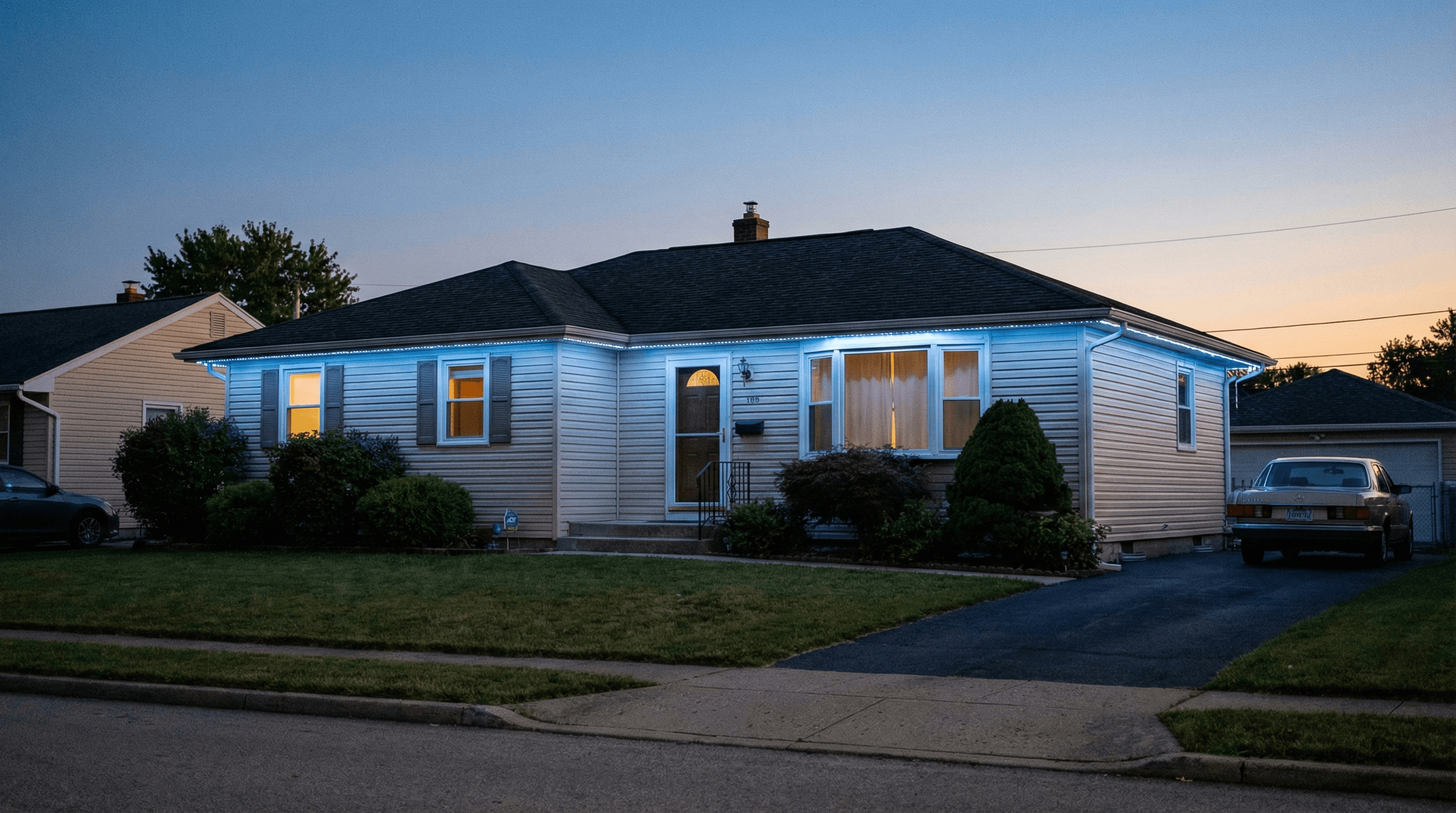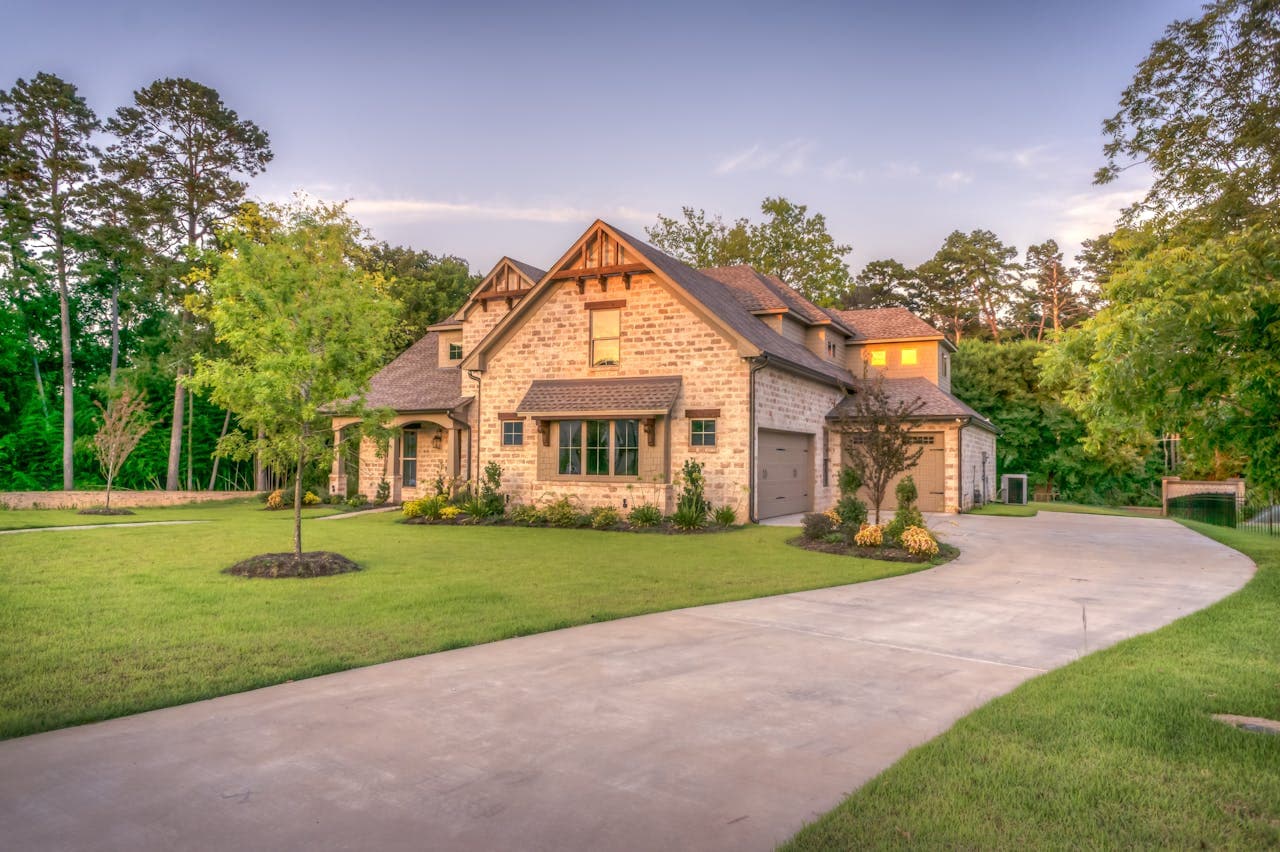
Permanent LED lights along driveways and walkways eliminate dark zones between the street and your front door – improving safety, curb appeal, and property value year-round.
Permanent outdoor lights for driveways and walkways solve the most overlooked safety problem on Sacramento properties: the dark gap between where your car stops and where your front door begins. The National Safety Council reports that falls are the third leading cause of preventable injury death in the United States, with over 48,000 fatalities in 2024 alone. A significant portion of outdoor falls happen on residential properties where pathways, steps, and driveways lack adequate lighting.
Sacramento homeowners already investing in permanent roofline lighting systems often miss the opportunity to extend that same system down their driveways and along walkways. The result is a beautifully lit roofline above a pitch-dark path below – which defeats half the purpose of exterior lighting.
This guide covers how permanent LED lighting works for driveways and walkways in the Sacramento area, what installation options exist, what the safety and property value benefits look like, and how to plan a system that ties into your existing or planned roofline lighting.
TL;DR: Permanent LED driveway and walkway lights integrate with your roofline lighting system to eliminate dark zones on your property. Sacramento homeowners typically add driveway/walkway lighting for $1,500–$4,000 depending on length and complexity. The lights run on the same low-voltage system and app controller as roofline lights, giving you color-changing capability, scheduling, and motion-sensor integration. Beyond safety, lit pathways increase curb appeal and can boost property value by 1–3% according to real estate lighting studies. Installation takes 1–2 days and requires no disruption to existing hardscape.
Why Driveways and Walkways Are the Biggest Lighting Blind Spot
Most Sacramento homes have some form of front porch light. Many now have permanent LED roofline lighting. But the 30–80 feet between the street and the front door – the driveway, walkway, steps, and transition zones – often sits in near-total darkness after sunset.
This creates three distinct problems that permanent driveway and walkway lighting directly addresses.
The Safety Gap
The CDC reports that more than 800,000 Americans require hospitalization annually due to fall injuries, with outdoor residential falls accounting for a significant share. Sacramento's older neighborhoods – Land Park, Curtis Park, East Sacramento, and Midtown – often have uneven concrete walkways, mature tree roots pushing up pavers, and stepped transitions between driveway and yard that become invisible after dark.
Among adults over 65, falls have increased by 60% in deaths and 20% in emergency department visits over the past decade, according to CDC data. Adequate pathway lighting is one of the simplest fall prevention measures available.
The Security Gap
While we cover permanent outdoor lights and home security in detail in a separate guide, the driveway and walkway deserve special attention. These are the primary approach paths to your home. A well-lit roofline with a dark driveway creates exactly the kind of contrast that works against security – the bright light above prevents your eyes from adjusting to the dark pathway below.
Proper driveway and walkway lighting eliminates blind spots without creating the harsh glare that actually reduces visibility. The goal is even, consistent illumination across every surface someone walks on.
The Curb Appeal Gap
Real estate professionals consistently rank exterior lighting among the top curb appeal improvements. According to Flexfire LEDs' research on curb appeal lighting, homes with well-designed exterior lighting systems sell faster and at higher prices. But a lit roofline above a dark driveway looks incomplete – like painting the front of your house but not the sides.
Extending permanent lights to your driveway and walkways creates a complete lighting picture that helps your home sell faster and increases perceived value from the moment a buyer pulls up.
How Permanent Driveway and Walkway Lighting Works
Permanent driveway and walkway lights use the same core technology as roofline permanent lighting systems – individually addressable RGB LEDs mounted in a weatherproof aluminum track. The difference is in the mounting location and fixture style.
Mounting Options for Driveways
Driveway permanent lights typically install in one of three configurations:
- Flush-mount ground lights – Recessed into the edge of the driveway, these sit flush with the surface and cast light across the driving surface. IP67-rated or higher to withstand vehicle weight and water exposure.
- Low-profile bollard lights – 12–18 inch posts along the driveway edge, connected to the same controller as your roofline system. These define the driveway boundaries and provide ambient lighting.
- Track-mounted soffit/eave lights – If your driveway runs alongside a garage or covered structure, the same aluminum track used for roofline lighting can mount under eaves to wash light downward onto the driveway surface.
Mounting Options for Walkways
Walkway installations have more flexibility because foot traffic loads are lower than vehicle loads:
- Path-edge recessed lights – Small LED fixtures set into landscape borders alongside walkways, angled to wash light across the walking surface without creating upward glare.
- Step and riser lights – Critical for any elevation change. Sacramento homes with front steps between the sidewalk and front door benefit from LED strips or individual fixtures built into each step riser.
- Low-voltage landscape integration – The permanent lighting controller can drive both roofline and pathway fixtures from a single app, so your walkway lights change color, dim, and schedule alongside your smart roofline system.
The Single-Controller Advantage
The biggest difference between permanent driveway/walkway lighting and traditional landscape lighting is integration. Old-school low-voltage landscape lights run on a separate transformer with a basic timer. A permanent lighting system ties everything – roofline, driveway, walkway, patio – to one controller and one app.
This means your driveway lights can:
- Match your roofline color for holidays, game days, or events
- Dim to 10% after midnight to save energy and reduce light pollution
- Respond to motion sensors and trigger brighter illumination when someone approaches
- Turn on automatically at sunset via geolocation scheduling
Pro Tip: If you're planning roofline permanent lights and know you want driveway/walkway lighting later, ask your installer to run conduit and pre-wire during the initial installation. Adding conduit later means trenching and patching, which doubles the labor cost for the pathway portion of the project.
Sacramento-Specific Installation Considerations
Sacramento's climate, soil conditions, and neighborhood characteristics create unique factors for driveway and walkway lighting installations. Here's what matters locally.
Heat and UV Exposure
Sacramento summers regularly hit 100–110°F with intense UV exposure. Ground-level fixtures absorb radiated heat from concrete and asphalt driveways, which can reach surface temperatures of 150°F+ on summer afternoons. Your pathway lighting must be rated for these conditions – look for fixtures with 50,000+ hour LED ratings and operating temperature ranges that exceed 130°F.
Soil and Drainage
Much of the Sacramento Valley has clay-heavy soil that expands and contracts with moisture changes. Ground-mounted fixtures need proper drainage beds and flexible conduit connections to accommodate seasonal soil movement. Rigid connections in clay soil will crack within 2–3 years.
Tree Roots and Mature Landscaping
Sacramento is the “City of Trees.” Many neighborhoods – particularly East Sacramento, Land Park, and the Fab 40s – have 50–100 year old trees with root systems that push up walkways and driveways. This creates both the need for pathway lighting (to illuminate uneven surfaces) and an installation challenge (routing conduit around roots without damaging them).
Professional installers use horizontal boring techniques to route wiring under tree roots rather than cutting through them. This protects the tree and complies with Sacramento's tree preservation ordinances.
HOA and Municipal Considerations
If you live in a planned community in Roseville, Rocklin, Folsom, or Elk Grove, check your HOA lighting rules before installing driveway or walkway fixtures. Some HOAs restrict fixture height, color temperature, and placement. Ground-level and flush-mount fixtures are typically the easiest to get approved because they have minimal visual impact during the day.
What Driveway and Walkway Lighting Costs in Sacramento
Adding permanent LED driveway and walkway lighting to a Sacramento home typically costs between $1,500 and $4,000. The wide range depends on several factors specific to your property.
What Drives the Price
- Linear footage – A 20-foot walkway costs less than a 60-foot driveway. Most Sacramento homes need 40–100 linear feet of combined driveway and walkway coverage.
- Existing roofline system – If you already have a permanent LED roofline system installed, extending it to pathways is significantly cheaper because the controller, transformer, and app infrastructure already exist. Adding pathways to an existing system runs $1,500–$2,500 for most homes.
- Fixture type – Flush-mount ground lights cost more to install than bollard-style fixtures because they require cutting into hardscape. Step lights fall in between.
- Trenching requirements – Running conduit through established landscaping, under walkways, or around tree roots adds labor. Pre-wiring during initial roofline installation avoids this cost entirely.
- Hardscape condition – Newer homes in Roseville and Rocklin with intact concrete driveways are straightforward. Older homes in Midtown or East Sacramento with cracked or raised walkways may need minor hardscape repair before fixture installation.
For a complete breakdown of permanent lighting system pricing, see our Sacramento permanent outdoor lights cost guide.
Design Strategies for Maximum Impact
Effective driveway and walkway lighting follows specific design principles that maximize both safety and aesthetics. Sacramento's lighting professionals use these guidelines.
Spacing and Placement
The standard recommendation is 6–8 feet between pathway fixtures, with lights on alternating sides of the walkway rather than directly opposite each other. Staggered placement creates a more natural flow of light and prevents the “runway” look that feels institutional rather than residential.
For driveways, wider spacing (8–12 feet) works because the concrete surface reflects more light than landscaped walkways. Transition points – where the driveway meets the sidewalk, where the walkway meets steps – need tighter fixture spacing or brighter output.
Color Temperature and Brightness
Pathway and driveway lights should run warmer than security floodlights. The sweet spot is 2700K–3000K (warm white), which provides sufficient visibility without the harsh blue-white glare that disrupts night vision and bothers neighbors. For more on color selection, see our guide to permanent outdoor lighting colors.
Aim for 100–200 lumens per fixture for walkways and 200–300 lumens for driveways. These levels illuminate surfaces without creating the over-lit “stadium” effect that actually reduces perceived safety.
Layering With Roofline Lighting
The best results come from treating roofline and pathway lighting as two layers of a single system. Your roofline provides ambient wash lighting from above. Your driveway and walkway fixtures provide targeted task lighting at ground level. Together, they eliminate every dark zone on your property.
When connected to the same controller, you can create scenes – a “Welcome Home” scene that brightens the driveway and walkway when you arrive, a “Party Mode” that syncs colors between roofline and path, or a “Sleep” scene that dims everything to 5% after midnight.
Driveway Lighting for Sacramento's Common Home Styles
Sacramento's housing stock varies dramatically by neighborhood. The right driveway and walkway lighting approach depends on your home style and property layout.
Ranch-Style Homes (Carmichael, Orangevale, Rancho Cordova)
Single-story ranch homes typically have wider driveways and longer walkways from the street. Low-profile bollard fixtures (12–14 inches) complement the horizontal architecture without overpowering the roofline. The longer pathway distances mean more fixtures but simpler wiring runs because the terrain is flat.
Two-Story and Mediterranean (Roseville, Rocklin, El Dorado Hills)
Newer two-story homes in Placer County often have shorter driveways but more elevation changes between the garage and front entry. Step lights and riser illumination become essential for safety. These homes also benefit from down-lighting under second-story eaves to wash light onto the walkway below – tying into the two-story permanent lighting system.
Craftsman and Tudor (East Sacramento, Land Park, Curtis Park)
Historic homes need fixtures that respect the architectural character. Flush-mount ground lights work well here because they're invisible during the day. The mature tree canopy in these neighborhoods means less ambient moonlight reaches the walkway, making pathway lighting even more important for safety.
Ready to light up your driveway and walkway? EXT Lighting designs integrated systems that connect your roofline, driveway, and walkway lighting to a single app. Get a free quote and we'll design a custom plan for your Sacramento property.
Installation Process: What to Expect
Installing permanent driveway and walkway lighting follows a systematic process that minimizes disruption to your property. Here's the typical timeline for Sacramento installations.
Step 1: Property Assessment (Day 1)
Your installer walks the property at dusk (or uses a light meter during the day) to identify dark zones, elevation changes, and potential hazards. They map the optimal fixture locations, identify existing electrical access points, and check for irrigation lines, tree roots, and utility runs that affect conduit routing.
Step 2: Design and Approval (Days 2–3)
You receive a lighting plan showing fixture placement, wiring routes, and expected light coverage. If your property is in an HOA community, this is when you submit for architectural review. Most HOAs respond within 2–4 weeks for lighting modifications.
Step 3: Installation (1–2 Days)
The physical installation typically takes 1–2 days depending on property size and complexity. The process includes:
- Trenching for conduit (18–24 inches deep per code)
- Pulling low-voltage wiring through conduit
- Setting fixture housings (ground-mount, bollard, or step)
- Connecting to the existing or new transformer/controller
- Programming zones and scenes in the app
- Testing all fixtures and adjusting aim
- Backfilling trenches and restoring landscaping
For a detailed look at the full installation process, including what happens on your roof and fascia, see our permanent light installation process guide.
Step 4: Programming and Walkthrough
After installation, your technician programs your preferred scenes, schedules, and automation rules in the app. You get a walkthrough of every feature – color changes, dimming, scheduling, motion triggers, and integration with Alexa, Google Home, or Apple HomeKit if applicable.
Energy Costs and Efficiency
Permanent LED driveway and walkway lights are remarkably efficient. Sacramento homeowners connected to SMUD (Sacramento Municipal Utility District) benefit from some of the lowest electricity rates in California.
A typical pathway system with 12–20 LED fixtures draws 30–60 watts total – roughly equivalent to a single traditional light bulb. Running this system from dusk to dawn (approximately 10 hours in winter, 6 hours in summer) costs roughly $2–5 per month on SMUD rates. For complete electricity cost details, see our permanent outdoor lights electricity cost guide.
Combined with an existing roofline system, your total outdoor lighting energy cost stays well under $15/month – less than what many Sacramento homeowners spend on a single porch floodlight running incandescent bulbs all night.
Maintenance and Long-Term Care
Ground-level fixtures face different maintenance challenges than roofline lighting. Sacramento's conditions create specific upkeep needs.
- Debris clearance – Sacramento's fall leaf drop (October–December) can bury ground-level fixtures. Clear leaves and mulch from fixture lenses monthly during fall.
- Sprinkler overspray – Irrigation systems often hit pathway fixtures with mineral-laden water. Wipe lenses quarterly to prevent calcium buildup that reduces light output.
- Seasonal soil movement – Check fixture alignment twice yearly (spring and fall) as clay soil expansion can shift ground-mounted lights off angle.
- Pest inspection – Ground-level junction boxes can attract ants and spiders. Inspect annually and seal any gaps.
For a comprehensive maintenance schedule that covers both roofline and pathway fixtures, see our Sacramento permanent lights maintenance guide.
Pro Tip: Schedule your pathway fixture lens cleaning at the same time you clean your roofline system – typically twice per year. This keeps your entire outdoor lighting system performing at full brightness with a single maintenance session instead of multiple trips.
Combining Driveway Lights With Other Outdoor Lighting Zones
The real power of permanent driveway and walkway lighting shows up when you integrate it with other lighting zones across your property. A single controller managing all zones creates a cohesive outdoor experience.
Roofline + Pathway + Patio
This is the most popular three-zone configuration for Sacramento homes. Your roofline provides the architectural accent. Your pathways ensure safe navigation. Your patio or pergola lighting creates the entertaining space. All three sync through one app, one schedule, and one color scheme.
Driveway + Pool Area
Sacramento homes with pools benefit from coordinated driveway-to-pool lighting. Guests arriving for a pool party see a lit driveway leading to a lit walkway leading to an illuminated pool and water feature area. No dark transitions, no tripping hazards around the pool deck.
Holiday and Event Integration
When your pathway lights connect to the same system as your roofline, you can extend holiday lighting patterns down to the ground level. Imagine red and green cascading from the roofline, down the walkway, and framing the driveway for Christmas. Or orange and purple flowing from the eaves through the pathway for Halloween. The ground-level component transforms holiday displays from “nice roofline” to “entire property experience.”
Get a Custom Driveway and Walkway Lighting Plan
Every Sacramento property is different. Driveway length, walkway layout, elevation changes, tree placement, and existing electrical infrastructure all affect the optimal lighting design. EXT Lighting provides free on-site assessments where we walk your property, identify every dark zone, and design a system that integrates with your existing or planned roofline lighting.
Our installations include a lifetime warranty on parts and labor, app control from day one, and full integration with smart home platforms. Request your free quote today or call us to schedule an evening assessment so you can see exactly where your property needs light.
Frequently Asked Questions
Can I add driveway and walkway lights to my existing permanent roofline system?
Yes. Most permanent roofline lighting systems are designed to be expandable. Your existing controller and transformer can typically support additional zones for driveways and walkways. The new fixtures connect to the same app and can be programmed as a separate zone or synced with your roofline. If your transformer is at capacity, a second transformer can be added without replacing any existing equipment.
How many lights do I need for a typical Sacramento driveway?
A standard Sacramento driveway (20–40 feet long) needs 6–12 fixtures spaced 6–8 feet apart along one or both sides. Longer driveways in areas like Granite Bay or El Dorado Hills may need 15–20 fixtures. Your installer will map the exact count during the property assessment based on driveway width, slope, and existing ambient light levels.
Will driveway lights survive Sacramento's summer heat?
Professional-grade permanent LED fixtures are rated for operating temperatures up to 140°F, which exceeds Sacramento's peak surface temperatures. Ground-mounted fixtures should be IP67-rated or higher, which means they're sealed against dust, debris, and temporary water submersion. Quality fixtures carry 50,000+ hour ratings even in extreme heat conditions.
Do pathway lights increase my electricity bill significantly?
No. A complete driveway and walkway system with 12–20 LED fixtures draws 30–60 watts total. On SMUD rates, running these lights from dusk to dawn costs approximately $2–5 per month. LED technology uses a fraction of the energy of traditional halogen or incandescent landscape lighting, making the electricity cost negligible even when running all night.
Can I control driveway lights separately from my roofline?
Yes. Permanent lighting systems organize fixtures into zones. Your driveway, walkway, roofline, and patio can each be a separate zone with independent color, brightness, and scheduling controls. You can also create scenes that coordinate multiple zones – for example, a “Welcome Home” scene that brightens the driveway and walkway while keeping the roofline at ambient levels.
Do I need HOA approval for driveway and walkway lights in Sacramento?
If you live in an HOA-governed community (common in Roseville, Rocklin, Folsom, and Elk Grove), you likely need architectural review approval before installing any permanent exterior fixtures. Flush-mount and low-profile fixtures have the highest approval rates because they have minimal daytime visual impact. Your installer can provide the documentation and renderings your HOA board typically requires.